TL;DR
RTA (Ready-to-Assemble) cabinets ship flat-packed and get built on-site, costing 20–50% less than pre-assembled equivalents. Assembled cabinets arrive fully built from the factory, ready to install. The quality difference comes down to materials and construction standards, not whether the cabinet arrived in a flat box or a finished unit. For trade pros, the real decision hinges on billing structure, project volume, and whether a hybrid supplier can give you RTA pricing with factory-level assembly.
Quick Answer: RTA vs Assembled Cabinets
RTA cabinets are usually the better choice when your priority is lower material cost, faster availability, or maximizing margin on flat-rate and multi-unit projects. Pre-assembled cabinets are usually better when labor time, installation speed, factory-controlled assembly, or complex customization matter more than the lowest purchase price. The best option depends on total installed cost, not cabinet price alone.
Choose RTA when: material savings outweigh assembly labor and you have the crew capacity to assemble cabinets efficiently.
Choose pre-assembled when: installation speed and factory assembly are worth paying a premium for.
Choose hybrid when: you want RTA-style pricing and inventory availability but don’t want your own crew responsible for assembly.
The key rule: compare the total installed cost, including cabinet price, freight, assembly labor, damage/replacement risk, and schedule impact, rather than comparing the cabinet invoice alone.
RTA vs Assembled Cabinets: Which Is Better?
If your priority is… | Better choice | Why |
|---|---|---|
Lowest upfront cabinet cost | RTA | Flat-pack shipping and reduced factory assembly can lower the purchase price |
Lowest total installed cost | It depends | Assembly labor, freight, damage, and schedule can change the calculation |
Fastest installation | Pre-assembled | Cabinets arrive ready to install |
Maximum crew efficiency | Pre-assembled | Your installers spend less time assembling boxes |
DIY installation | RTA | Lower purchase price can make sense when your own labor is not billed |
Flat-rate contracting | RTA | Material savings can increase gross margin if assembly is efficient |
Hourly contracting | Pre-assembled | Less assembly time means fewer labor hours on the project |
Multi-unit projects | RTA or hybrid | Per-unit savings can compound across many kitchens |
Complex customization | Semi-custom/custom assembled | More configuration and sizing options are typically available |
Factory-controlled assembly | Pre-assembled | Assembly is completed before delivery |
Flexible procurement | Hybrid | Supplier can provide RTA inventory with optional professional assembly |
Cabinetry is the single largest line item in most kitchen remodels, eating up 30–40% of the total budget. So the choice between RTA and assembled cabinets isn’t a minor detail. It shapes your project cost, timeline, and quality outcome.
This guide defines both terms, breaks down the real numbers, and gives contractors and homeowners a decision framework that goes beyond the usual pros-and-cons list.
Evaluating cabinet suppliers for your next project? See how trade pros source cabinets with faster lead times and in-stock availability.
What Are RTA Cabinets?
RTA stands for Ready-to-Assemble. These cabinets ship as flat-packed boxes containing pre-cut panels, pre-drilled holes, hardware, and assembly instructions. You (or your crew) put them together on-site before installation.
The biggest misconception about RTA cabinets is that they’re cheap or flimsy. That was arguably true in the late 1990s. It is not true now. Practitioners on a TractorByNet forum thread put it bluntly: “In the cabinet business, RTA doesn’t mean IKEA-style particle board cabinets that screw together with camlock fittings. There are manufacturers that make cabinets for cabinet shops, who assemble them and install them. They also sell straight to the public.”
Modern RTA cabinets from reputable suppliers are built with CNC precision. The best lines in 2026 feature all-plywood boxes, dovetail drawer joints, and soft-close hinges. One forum user reported using Barker RTA cabinets with widths available in 1/4-inch increments, plywood construction, dovetail drawers, and Blum hardware, and was very pleased with them.
For a deeper breakdown of the format, read our guide on what RTA cabinets are and how they compare to other procurement options.
What Are Assembled (Pre-Assembled) Cabinets?
Pre-assembled cabinets arrive from the factory fully built. Open the box, mount it on the wall. No assembly labor required.
Within this category, there are important sub-types:
Stock assembled: Mass-produced in standard sizes, available off the shelf. Lead times of 1–3 weeks for most suppliers.
Semi-custom assembled: Standard sizes with more finish, door style, and configuration options. Typical lead times of 3–8 weeks.
Custom assembled: Built to exact specifications. Lead times stretch from 8 to 12 weeks or longer.
There’s also a category that most comparison articles ignore: the hybrid model. Some suppliers stock RTA lines and offer professional assembly before delivery. This means you get the cost structure of RTA with the convenience of a pre-assembled cabinet. For more on how cabinet lead times vary across these tiers, that linked guide breaks it down in detail.
Side-by-Side Comparison: RTA vs Assembled Cabinets
Factor | RTA Cabinets | Pre-Assembled Cabinets |
|---|---|---|
Cost per linear foot | $100–$300 | $200–$600 (stock/semi-custom); $500–$1,200 (custom) |
10×10 kitchen estimate | ~$2,169 | ~$2,682 (stock); $4,000+ (semi-custom/custom) |
Lead time | 1–3 weeks | 3 weeks (stock) to 3+ months (custom) |
Assembly time per unit | 15–45 minutes | None |
Shipping cost | 30–50% lower (flat-pack) | Higher (bulky, heavier freight) |
Transit damage risk | Lower (components nested in flat boxes) | Higher (exposed finished surfaces) |
Customization | Limited to available sizes/finishes | Wide range, especially semi-custom and custom |
Quality ceiling | Same as assembled (depends on materials) | Same as RTA (depends on materials) |
CARB/TSCA compliance | Applies to materials, not format | Applies to materials, not format |
Warranty | Varies by manufacturer | Varies by manufacturer |
The compliance row matters more than most people realize. CARB Phase 2 and EPA TSCA Title VI regulate formaldehyde emissions from composite wood products. These standards apply to the wood panels themselves, regardless of whether the cabinet ships flat or fully built. No competitor comparison page mentions this, but it is directly relevant for permitting and indoor air quality documentation.
The Real Cost of RTA vs Assembled Cabinets
The cheapest cabinet invoice is not necessarily the cheapest cabinet installation.
To compare RTA and assembled cabinets accurately, calculate total installed cost:
Total installed cost = cabinet price + freight + assembly labor + installation labor + expected replacement/damage costs + schedule impact
For RTA cabinets, assembly labor is the biggest additional variable.
For pre-assembled cabinets, the higher purchase price is partly paying for factory assembly, packaging, handling, and convenience.
RTA vs Pre-Assembled Cost Formula
For a contractor, the basic comparison is:
RTA total cost = RTA cabinet price + freight + assembly hours × loaded labor rate + installation cost
Pre-assembled total cost = assembled cabinet price + freight + installation cost
The RTA option wins when the savings on the cabinet purchase exceed the additional costs created by assembly, handling, and schedule impact.
Example
Suppose the RTA option saves $500 on the cabinet order but requires four hours of crew assembly at a $50 internal labor cost.
$500 cabinet savings − $200 assembly labor = $300 net savings
That means RTA still has a $300 economic advantage before considering any additional freight, rework, damaged components, or scheduling effects.
The calculation should be repeated for each supplier and project because cabinet pricing, labor rates, freight, and assembly times vary.
Cost Breakdown with Real Numbers
The cost gap between RTA and assembled cabinets is significant but not as straightforward as the sticker price suggests.
Raw Material Savings
RTA cabinets cost 20–50% less than their pre-assembled equivalents. For a standard 10×10 kitchen layout, the same cabinet line costs roughly $2,169 in RTA format versus $2,682 pre-assembled. That’s a 24% premium, or about $513 per kitchen.
When you compare RTA to custom cabinetry, the gap widens dramatically: $100–$300 per linear foot versus $500–$1,200, representing savings of 50–75%.
Shipping Savings
Flat-pack RTA cabinets reduce shipping costs by 30–50% due to compact packaging and lower freight volume. For a full kitchen order, that can mean hundreds of dollars in freight savings, especially for West Coast deliveries where LTL shipping rates run higher.
The Hidden Cost: Assembly Labor
Here’s where the math gets honest. A 12-cabinet kitchen takes an experienced crew about 4 hours to assemble (10–15 minutes per base cabinet, 7–10 minutes per wall cabinet). If your first time, budget 30–45 minutes per cabinet, or roughly 6–15 hours for a full 20-cabinet kitchen.
For a contractor paying a crew member $50/hour, that 4-hour assembly run costs $200. The $513 material savings on a 12-cabinet kitchen drops to about $313 in actual profit. Still meaningful, but not the 20–50% headline number.
For a homeowner doing the work personally, that assembly labor is free. The full savings transfer to you.
Wondering how these numbers fit into the broader picture of cabinet pricing in the Pacific Northwest? Our kitchen cabinet cost guide for Washington covers regional pricing specifics, including for the RTA vs assembled cabinets decision.
RTA Assembly Labor Break-Even Point
The key question for contractors is not “How much cheaper are RTA cabinets?” It is “How much assembly labor can I absorb before the RTA savings disappear?”
RTA material savings | Assembly labor | Net savings |
|---|---|---|
$300 | $100 | $200 |
$300 | $150 | $150 |
$300 | $200 | $100 |
$300 | $250 | $50 |
$300 | $300 | $0 |
$500 | $200 | $300 |
$500 | $300 | $200 |
$500 | $400 | $100 |
$500 | $500 | $0 |
$750 | $300 | $450 |
Break-even formula:
Maximum worthwhile assembly cost = RTA cabinet savings − additional RTA-related costs
If the assembly cost reaches the amount saved on the cabinet purchase, the material-price advantage disappears.
Quality: It’s the Materials, Not the Box
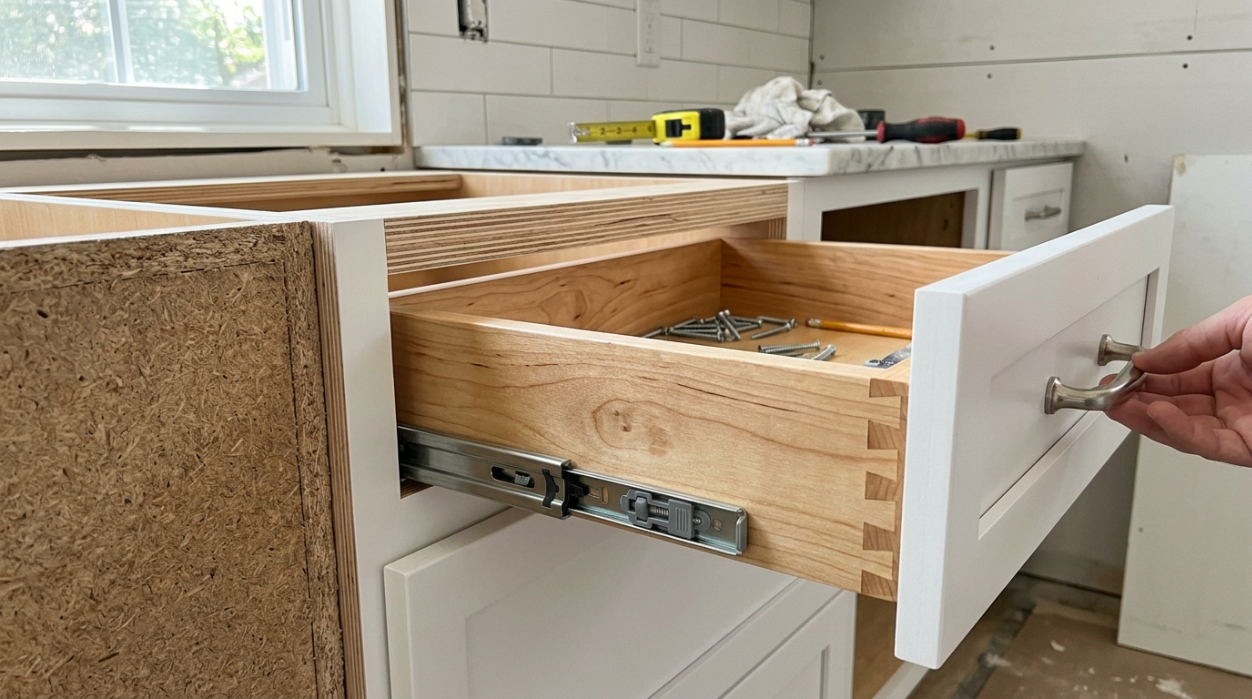
This is the single most important thing to understand about the RTA vs assembled cabinets comparison: quality is determined by materials and construction standards, not by the label on the box.
A solid wood, plywood-box RTA cabinet with dovetail drawer joints will outlast a particleboard pre-assembled cabinet every time. Both types can last 20–30 years when built from quality materials and properly installed.
What to Look For
The key quality markers are the same regardless of format:
Box material: Plywood (good) vs. particleboard or MDF (lower durability)
Drawer joints: Dovetail (strongest) vs. stapled butt joints (weakest)
Hardware: Soft-close hinges and drawer slides from reputable brands (Blum, Hettich)
Certification: The KCMA A161.1 standard is the primary benchmark. Certified cabinets undergo extensive testing, including loading wall cabinets to 600 pounds without visible failure.
Emissions compliance: CARB Phase 2 and EPA TSCA Title VI certification on the composite wood materials
For a detailed checklist, our guide on spotting quality cabinets walks through each indicator.
Cabinet Quality Checklist: What to Compare
Specification | What to look for | Why it matters |
|---|---|---|
Cabinet box | Plywood or clearly specified composite construction | Affects structural performance and durability |
Drawer box | Dovetail or other clearly specified joinery | Indicates construction quality |
Drawer slides | Reputable, appropriately rated hardware | Affects smooth operation and longevity |
Hinges | Adjustable soft-close hardware from a reputable manufacturer | Improves door alignment and everyday operation |
Finish | Consistent coating with documented specifications | Affects appearance and resistance to wear |
Certification | ANSI/KCMA A161.1 where applicable | Provides third-party performance testing |
Formaldehyde compliance | TSCA Title VI documentation when applicable | Helps verify federal composite-wood compliance |
Warranty | Clear written coverage and exclusions | Reduces post-installation risk |
Replacement parts | Doors, hinges, slides, and panels available | Makes future repairs easier |
Assembly instructions | Clear manufacturer documentation | Reduces installation errors on RTA cabinets |
The most useful comparison is not “RTA versus assembled.” It is cabinet specification versus cabinet specification.
The Assembler Variable
There is one real quality difference with RTA that most comparisons avoid stating directly. Trade-focused content from cabinet industry insiders frames it this way: “How well the box gets built depends on who’s building it.”
A factory-assembled cabinet gets built by workers doing the same task hundreds of times a day with jigs, clamps, and quality checkpoints. An RTA cabinet gets built by whoever opens the box. If that person is a skilled installer, the result is identical. If it’s a first-timer who skips the wood glue and doesn’t check for square, you’ll notice when the doors don’t align.
This is also why the hybrid model, where a supplier assembles RTA stock professionally before delivery, eliminates the variable entirely while preserving most of the cost advantage.
The Contractor’s Decision Framework
For trade professionals, the RTA vs assembled cabinets choice is ultimately a business math problem. A 2024 NAHB survey found that 71% of residential builders named labor costs as their single greatest challenge. Cabinets sit right at the intersection of material cost and labor cost, making the procurement format a real financial lever.
Hourly Billing vs. Flat-Rate Billing
This distinction changes everything.
If you bill hourly, the time your crew spends assembling RTA cabinets is billable, but your client sees it on the invoice. The material savings may not offset the optics of extra labor charges. Many hourly contractors prefer pre-assembled cabinets for this reason.
If you bill a flat project rate, RTA savings go straight to your margin. A 12-cabinet kitchen saves roughly $513 in materials. If your crew assembles in 4 hours at an internal cost of $200, you pocket $313 per kitchen. Across 10 kitchens a year, that’s over $3,000.
When Does RTA Make More Sense for a Contractor?
RTA is most financially attractive when several conditions line up:
1. Your crew can assemble efficiently.
The faster your team can assemble a cabinet without creating rework, the more of the material savings you retain.
2. You purchase repeatedly.
High-volume buyers can standardize assembly procedures, train crews once, and spread process improvements across multiple projects.
3. You have predictable cabinet specifications.
Repeated layouts and standardized product lines reduce the learning curve.
4. Your warehouse or jobsite can accommodate flat-pack inventory.
RTA cabinets require a clean, dry area for storage and assembly.
5. Your project schedule has assembly capacity.
The lower cabinet price is less valuable if assembly becomes the bottleneck that delays installation.
6. Your pricing model rewards efficiency.
Flat-rate projects can provide more opportunity to capture assembly savings as margin, while hourly projects may make the labor trade-off less important.
RTA is therefore not automatically the better contractor option. It is better when the contractor’s workflow can convert the lower procurement cost into a real installed-cost advantage.
Liability Considerations
High-volume contractors carrying significant liability insurance sometimes prefer assembled cabinets for a practical reason: assembly QC stays on the manufacturer. If a factory-assembled cabinet fails, the liability chain points back to the factory. If your crew assembled an RTA cabinet and it fails, you own that outcome.
Multi-Unit Economics
The RTA vs assembled cabinets math shifts dramatically on multi-unit projects (apartments, rental rehabs, builder-grade specs). When you’re ordering cabinets for 20 or 50 kitchens, the per-kitchen savings compound. A $300 net savings per kitchen across a 30-unit apartment project is $9,000 in margin.
For builders running volume projects, our builder cabinet packages guide covers how package pricing works at scale.
The Hybrid Option
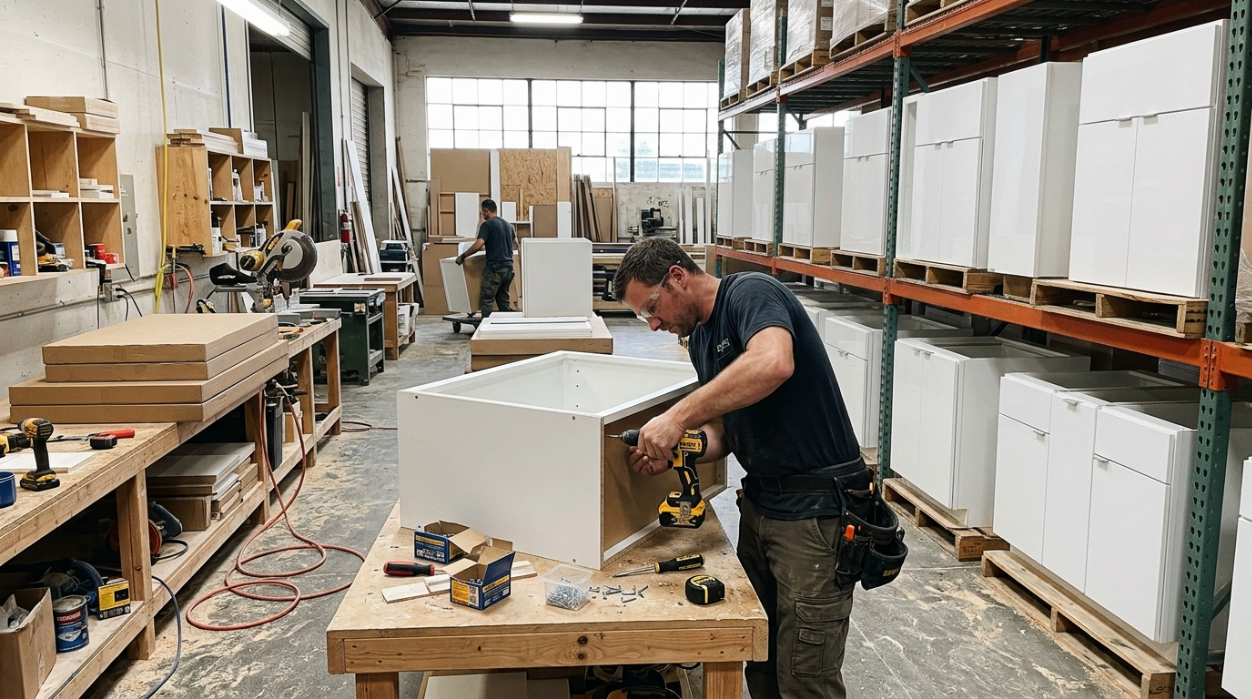
The best-kept secret in the RTA vs assembled cabinets debate is the hybrid supplier. These are companies that stock RTA inventory (giving you fast availability and lower base cost) but offer professional assembly services before delivery. You get RTA pricing with factory-quality assembly, and the supplier takes on assembly liability.
Krafter’s Land operates this model for its frameless cabinet line: next-day pickup for unassembled cabinets, or roughly one-week turnaround for professional assembly, with installation timelines around two weeks. That flexibility lets trade partners choose based on their project’s specific timeline and budget constraints.
RTA Storage and Jobsite Logistics
Flat-pack shipping solves one logistics problem but creates another: the cabinets still have to be stored and assembled.
Before choosing RTA, confirm that your operation has:
Dry, secure storage space
Enough floor space for sorting panels and hardware
A clean assembly surface
Tools required by the manufacturer
A system for identifying each cabinet and its components
Space to stage assembled boxes before installation
A process for inspecting damaged or missing parts
A way to keep hardware organized by cabinet
For a contractor, these operational requirements are part of the true cost of RTA cabinetry.
A cabinet that saves money on the purchase order but creates hours of sorting, staging, and rework may not be the cheapest cabinet to install.
Common RTA Assembly Mistakes to Avoid
If you go the RTA route, avoid these pitfalls that practitioners and reviewers consistently flag.
Skipping the Wood Glue
One of the most common RTA assembly mistakes is relying solely on mechanical fasteners. Professional installers emphasize that while screws and cam locks hold pieces together initially, glue provides the long-term structural integrity. Think of hardware as a temporary clamp while the glue dries.
Not Checking Squareness
A cabinet that looks fine on the floor will betray you on the wall. Doors won’t close evenly, drawers will bind, and reveals between adjacent cabinets will be visibly uneven. Check squareness during assembly, before you drive the final fasteners.
Over-Tightening Cam Locks
Cam lock fittings are designed to pull panels snug, not crush them. Over-tightening strips the particleboard or plywood around the fitting, creating a loose joint that can’t be re-tightened.
Ignoring the Instructions
Not all RTA brands assemble the same way. Hardware placement, cam lock orientation, and panel sequencing vary by manufacturer. One Trustpilot reviewer of a well-known RTA brand noted that drawer slide installation was the most common stumbling block, a problem that careful reading of the manual prevents entirely.
Failing to Inspect Before Assembly
Open every box and inspect every panel before you start building. Another reviewer reported that “the precision cut was a bit off on the right of each cabinet, which left a gap.” Catching defects before assembly saves you the time of disassembling and returning a completed unit.
For more on avoiding costly errors during a remodel, our guide on kitchen remodel mistakes covers assembly and beyond.
Which Should You Choose?
Choose RTA Cabinets If:
Budget is the driving priority. The 20–50% cost reduction is real and substantial.
You have time for assembly. Whether that’s your own time (DIY) or crew time that fits within your project schedule.
You’re a flat-rate contractor. Material savings translate directly into margin.
You’re running multi-unit or rental-grade projects. Savings compound at scale, and tenants won’t notice whether cabinets arrived flat or pre-built.
Your timeline is flexible. RTA ships in 1–3 weeks, but you need to add assembly hours on top of that.
Choose Pre-Assembled Cabinets If:
Your timeline is extremely tight. Assembled cabinets go straight from the delivery truck to the wall.
You bill hourly. Assembly time hits your client’s invoice and may not be well received.
You need complex custom configurations. Truly custom sizes and features are more commonly available in pre-assembled formats.
You want factory-controlled QC. Every joint, every panel alignment, every hardware placement was done by a dedicated assembly crew.
Liability matters for your insurance. Keeping assembly responsibility on the manufacturer simplifies your risk profile.
Choose a Hybrid Supplier If:
You want RTA cost savings without assembly risk.
You need fast availability (in-stock RTA inventory) with the convenience of receiving a finished cabinet.
You want flexibility to choose assembled or unassembled on a per-project basis.
This flexibility is exactly why the hybrid model is growing. It removes the either/or framing of the RTA vs assembled cabinets debate and turns it into a both/and option.
Looking for a supplier that offers both options? See our guide on the best cabinet supplier for contractors to compare what trade-focused suppliers actually provide.
RTA vs Assembled Cabinets and the Framed/Frameless Question
One decision that often gets tangled with the RTA vs assembled cabinets choice is framed versus frameless construction. These are separate axes.
Framed cabinets have a face frame (a solid wood border on the front of the box). They’re traditional, forgiving of minor wall irregularities, and common in Shaker-style kitchens.
Frameless cabinets (European-style) skip the face frame, relying on thicker box panels for structure. They offer slightly more interior space and a cleaner, modern look.
Both framed and frameless cabinets are available in both RTA and pre-assembled formats. Don’t conflate the two decisions. Pick your construction style based on aesthetics and function, then pick your procurement format based on budget and logistics. Our framed vs frameless guide covers that first decision in detail.
The RTA Market Is Growing for a Reason
The numbers tell the story. The North American RTA market was valued at $16.93 billion in 2024 and is projected to reach $26.79 billion by 2032. Globally, the RTA kitchen cabinet market is expected to grow from $10.57 billion in 2025 to $15.55 billion by 2032, at a CAGR of 5.67%.
Several forces are driving this growth:
Labor cost pressure. With 71% of builders citing labor as their top challenge, anything that reduces total installed cost gets attention.
Supply chain improvements. CNC manufacturing and better QC have closed the quality gap between RTA and factory-assembled cabinets.
Sustainability. Over 31% of RTA manufacturers incorporated recycled wood, bamboo, or low-VOC finishes by 2024. The flat-pack format itself reduces shipping volume by 40%, cutting the carbon footprint of delivery.
E-commerce logistics. Flat-packed cabinets are simply easier and cheaper to ship, which aligns with the growth of online cabinet sourcing.
FAQ
What does RTA stand for?
RTA stands for Ready-to-Assemble. It describes cabinets that ship as flat-packed components with pre-cut panels, pre-drilled holes, and all necessary hardware. The buyer or installer assembles them on-site.
Are RTA cabinets as strong as assembled cabinets?
When made from the same materials, yes. A plywood-box RTA cabinet with dovetail joints is just as durable as the same cabinet pre-assembled in a factory. Both can last 20–30 years. The difference is who puts it together, which is why assembly technique (especially using wood glue and checking for square) matters so much.
How long does it take to assemble one RTA cabinet?
First-timers should budget 30–45 minutes per cabinet. Experienced assemblers typically finish in 15–20 minutes. For a full kitchen of 20 cabinets, expect 6–15 hours of total assembly time before installation begins.
Can I buy RTA cabinets and have someone assemble them for me?
Yes. Some suppliers offer professional assembly services on their RTA inventory. This hybrid model gives you RTA pricing with factory-quality assembly. Krafter’s Land, for example, offers next-day pickup for unassembled frameless cabinets or approximately one-week turnaround for professional assembly.
Do RTA and assembled cabinets have the same warranty?
Warranty terms vary by manufacturer, not by format. Some manufacturers offer identical warranties on both RTA and pre-assembled versions of the same product. Others may limit RTA warranty coverage if assembly instructions weren’t followed. Always read the warranty terms for the specific product, not the category.
Does CARB Phase 2 compliance apply differently to RTA vs assembled cabinets?
No. CARB Phase 2 and EPA TSCA Title VI regulate formaldehyde emissions from composite wood materials (plywood, particleboard, MDF). These standards apply to the panels themselves, regardless of whether the cabinet ships flat or pre-assembled. Both formats must use compliant materials to meet U.S. requirements.
What is the difference between framed and frameless cabinets, and is it related to RTA vs assembled?
Framed vs. frameless describes the cabinet’s construction style (whether it has a face frame). RTA vs. assembled describes how it ships and who puts it together. Both framed and frameless cabinets are available in RTA and pre-assembled formats. These are independent decisions.
Is RTA a good option for rental property renovations?
RTA is often the best option for rental properties. The lower cost per kitchen compounds across multiple units, lead times are shorter (1–3 weeks vs. months for custom), and quality plywood RTA cabinets stand up well to tenant use. For more on this angle, see our guide on cabinets for rental properties.