TLDR
Kitchen updates can increase home value, but minor, visible refreshes almost always outperform expensive gut remodels on resale return. In Seattle, a minor midrange kitchen remodel recoups about 118% of its cost, while a major upscale remodel recoups less than 39%. The smartest approach is to bring your kitchen up to buyer expectations for the neighborhood, not to make it the most expensive room on the block.
Quick Answer: Do Kitchen Updates Increase Home Value?
Yes. Kitchen updates can increase home value, but the highest resale returns usually come from targeted, midrange improvements rather than expensive luxury remodels. In Seattle, JLC’s 2025 Cost vs. Value data estimates that a minor midrange kitchen remodel recoups 118.1% of its cost, compared with just 53.1% for a major midrange remodel and 38.7% for an upscale remodel. For resale, prioritize condition, functionality, broad buyer appeal, and neighborhood-appropriate finishes over luxury customization.
Seattle Kitchen Remodel ROI at a Glance
Kitchen Project | Seattle Cost | Cost Recouped | Estimated Resale Value Added | Best For |
|---|---|---|---|---|
Minor midrange remodel | $32,271 | 118.1% | $38,098 | Resale-focused homeowners |
Major midrange remodel | $95,542 | 53.1% | Approximately $50,700 | Long-term owners needing broader updates |
Upscale remodel | $188,401 | 38.7% | Approximately $72,900 | Luxury homes and lifestyle upgrades |
Source: 2025 JLC/Zonda Cost vs. Value data for the Seattle market.
What the Numbers Mean
The Seattle data shows a clear pattern: spending more does not necessarily create more resale value. The minor midrange project produces the strongest cost recovery because it substantially improves the kitchen while limiting the amount of money invested in highly customized finishes.
These figures are averages for defined project scopes, not guarantees for an individual Seattle home. Actual resale results depend on the home’s location, condition, comparable sales, buyer expectations, project quality, and the surrounding housing stock.
Do Kitchen Updates Actually Increase Home Value?
Yes, but not the way most people assume.
Kitchen updates add home value when they remove buyer objections, photograph well, and bring the space up to the standard of comparable homes nearby. They do not add value dollar-for-dollar, and bigger spending does not guarantee bigger returns.
The 2025 JLC/Zonda Cost vs. Value report makes this clear. In Seattle, a minor midrange kitchen remodel costs roughly $32,271 and adds an estimated $38,098 in resale value, recouping 118.1% of cost. A major upscale kitchen remodel in the same market costs $188,401 and recoups just 38.7%. The pattern holds nationally: smaller, focused kitchen updates outperform large custom projects on cost recouped.
That gap should change how homeowners, contractors, and designers think about kitchen investments. The question is not whether kitchen updates help home value. It is which updates, at what scope, in what market.
Explore kitchen and bath product categories to compare cabinet styles, countertop options, and related materials for value-focused kitchen projects.
The Big Rule: Refresh Before You Gut
If the goal is resale return, a cohesive minor refresh beats a full gut remodel in nearly every data set available.
JLC defines its minor midrange kitchen remodel as a project in a functional but dated 200-square-foot kitchen with 30 linear feet of cabinetry. Cabinet boxes stay in place. Doors and drawer fronts are replaced with Shaker-style panels. Hardware, appliances, countertops, sink, faucet, flooring, and paint are all updated. That is a meaningful transformation, but it is not a total teardown.
The major midrange version adds semi-custom wood cabinets, an island, custom lighting, and broader finish changes, costing about $95,542 in Seattle and recouping just 53.1%. The upscale version (custom cabinets, stone counters, commercial-grade appliances, imported tile) costs $188,401 and recoups 38.7%.
The takeaway is straightforward. Minor kitchen refreshes add the most home value per dollar because they cost less, appeal broadly, and involve fewer personal design choices that the next buyer might not share.
Exceptions exist. If the kitchen is severely damaged, the layout is dysfunctional, or the homeowner plans to stay for a decade, a bigger remodel can be worth it for lifestyle reasons. But for sellers and short-term planners, “refresh before you gut” is the safest financial play.
Which Kitchen Updates Add the Most Home Value?
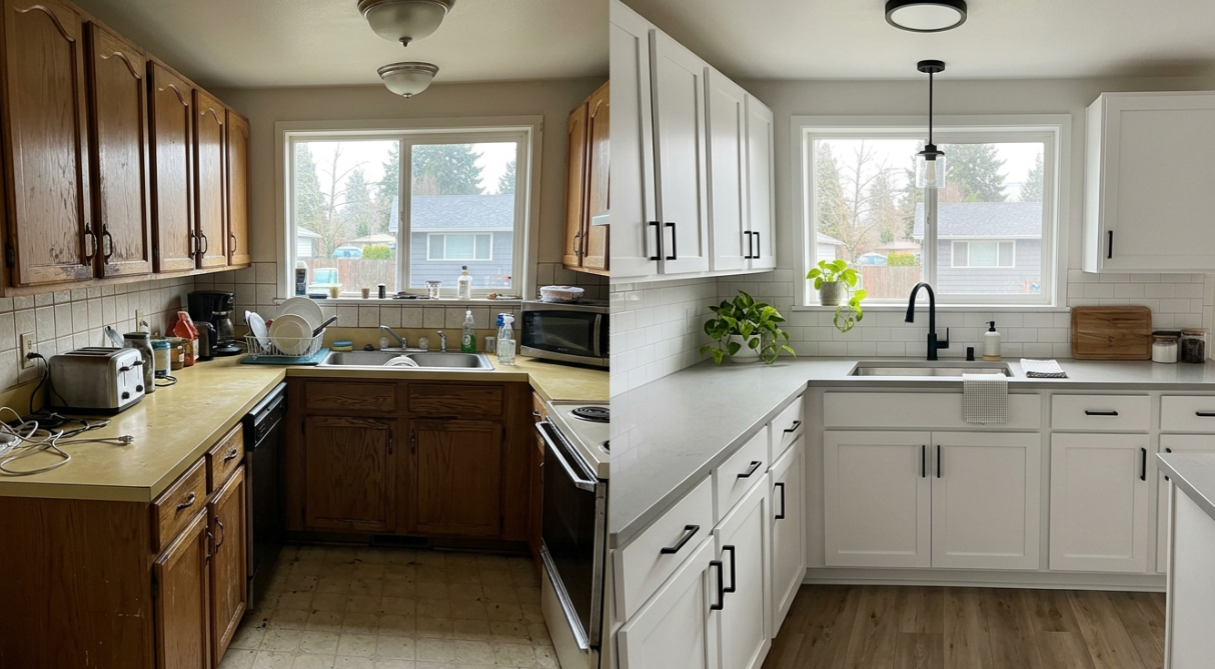
The kitchen updates most likely to support resale value are the ones that improve visible condition, everyday functionality, and buyer appeal without pushing the home beyond its neighborhood price range.
For most Seattle homeowners, prioritize updates in this order:
Cabinet refacing or a cabinet-front refresh when existing boxes are structurally sound
New countertops when existing surfaces are damaged or visibly outdated
Updated hardware on otherwise serviceable cabinets
A modern sink and faucet
Improved kitchen lighting, especially task lighting
Fresh paint and trim
Durable, cohesive flooring when existing flooring is worn or damaged
Storage improvements, such as pantry cabinets and drawer organizers
Clean, matching appliances appropriate for the home’s price range
A restrained backsplash that complements the rest of the kitchen
The goal is not to install the most expensive materials available. The goal is to make the kitchen look clean, functional, cohesive, and appropriate for comparable homes in the same price range.
The Highest-Value Principle
If the kitchen is functional but dated, start with cosmetic and surface-level improvements. If it is damaged, repair the problems creating buyer objections. If the layout is genuinely dysfunctional, a larger remodel may be justified.
This makes condition correction more important than luxury specification for most resale-focused projects.
Should You Update or Remodel? Use the Dated, Damaged, or Dysfunctional Test
Before spending money on a kitchen, identify which problem you actually have.
Dated
The kitchen works properly but looks old.
Best response: Clean, paint, update hardware, improve lighting, refresh cabinet fronts, and replace visibly dated surfaces.
Damaged
The kitchen has visible defects such as broken drawers, peeling surfaces, water damage, cracked flooring, failing grout, or damaged countertops.
Best response: Repair the defects first. CosKitchen Update vs. Kitchen Remodel: What’s the Difference?metic improvements can follow once the underlying problems are fixed.
Dysfunctional
The kitchen has a fundamentally poor layout, inadequate storage, insufficient workspace, or another functional problem that cosmetic updates cannot solve.
Best response: Consider a larger remodel if the home’s price range and neighborhood comps support the investment.
The Resale Rule
If a kitchen is dated, refresh it. If it is damaged, repair it. If it is dysfunctional, consider remodeling it.
This simple distinction helps prevent homeowners from spending remodel-level money to solve a cosmetic problem.
Kitchen Update vs. Kitchen Remodel: What’s the Difference?
A kitchen update improves the existing kitchen without necessarily changing its layout or replacing every major component. A kitchen remodel involves a broader renovation and may include new cabinets, countertops, appliances, flooring, lighting, plumbing, electrical work, or layout changes.
Kitchen Update | Kitchen Remodel |
|---|---|
Paint | New cabinets |
Hardware | New countertops |
Cabinet refacing | New flooring |
New faucet | New appliances |
Lighting | New electrical work |
Minor repairs | Plumbing changes |
Cosmetic improvements | Layout changes |
Usually lower cost | Usually higher cost |
For resale, an update is generally the better starting point when the kitchen is functional but dated. A remodel becomes more appropriate when the kitchen is damaged, poorly configured, or significantly below the standard buyers expect for comparable homes.
The distinction matters because the highest kitchen remodeling ROI does not come from simply spending less. It comes from matching project scope to the problem that actually needs to be solved.
Kitchen Update Glossary: Value Terms
Most articles about kitchen updates and home value throw around terms like “ROI” and “resale value” without defining them. That leads to bad decisions. Here is what these terms actually mean and why each one changes the math.
ROI (Return on Investment)
In kitchen remodeling, ROI means the value gained at resale divided by the project cost. A $30,000 update that adds $35,000 to the sale price has a positive ROI. A $90,000 remodel that adds $50,000 does not.
Why it matters: ROI is not a guarantee. It is a historical estimate based on averages. Your actual result depends on your market, your home, and the buyer who shows up.
Cost Recouped
The percentage of a project’s cost estimated to come back at resale. JLC’s 2025 data builds these estimates using Realtor surveys and local cost data, not a promise about one address.
Common mistake: Treating cost recouped as a fixed number. JLC explicitly warns that scope, finish quality, neighborhood values, and local labor availability shift results significantly.
Resale Value vs. Appraised Value
Resale value is what a project adds to the sale price. Appraised value is what a licensed appraiser determines using comparable sales. They often differ. A beautiful backsplash might help sell a home faster without moving the appraised value at all.
Marketability
How much an update helps a home attract attention, reduce objections, or sell faster. Zillow’s 2026 analysis of over 2 million listings found that homes described as “turnkey” sold for 2.9% more than expected, while “fixer-upper” listings sold for 14% less. This is correlation, not proof that one word causes a premium, but it shows how condition signals affect buyer behavior.
Turnkey
A home that feels ready to live in without major projects. Turnkey does not mean luxury. HomeLight’s 2026 agent insights report that 84% of agents see turnkey features helping homes sell. Practitioners on LinkedIn note that affordability pressures are making buyers define “move-in ready” more flexibly: functional, safe, and comfortable counts, even without top-of-the-line finishes.
Buyer Objection
Anything that makes a buyer hesitate, lower the offer, or plan an immediate repair. Peeling cabinet fronts, broken drawers, stained counters, mismatched appliances, poor lighting, and obvious water damage are all common kitchen objections.
Why it matters: The best pre-sale kitchen updates remove objections rather than add luxury. NAR’s 2025 report found that 46% of home buyers are less willing to compromise on home condition.
Neighborhood Comps
Comparable nearby homes used to judge market value. Kitchen updates should match what buyers expect at the home’s price point. A quartz countertop and Shaker cabinet refresh may be ideal in a mid-market home. Custom cabinetry and stone slabs may be expected in a luxury market but overkill in an entry-level neighborhood.
Price Ceiling
The practical upper limit buyers will pay for a home in a given neighborhood or property class. Spending above this ceiling is where kitchen updates stop adding home value and start becoming over-improvements. Practitioners on Reddit warn that a $40,000 kitchen upgrade will not automatically make a home worth $40,000 more than similar homes nearby.
Over-Improvement
Updating a home beyond what the neighborhood, buyer pool, or property type will support. This is one of the biggest ROI killers. JLC’s data confirms the pattern: as kitchen remodel scope gets bigger and more custom, the percentage of cost recouped drops sharply.
Buyer Credit
Money offered to the buyer at closing so they can make their own updates. This can make sense when taste is personal or the kitchen needs a full remodel the seller cannot complete. But many buyers prefer completed work when they are paying a premium and want move-in readiness.
Joy Score
NAR’s measure of homeowner satisfaction after a project. Kitchen upgrades received a perfect Joy Score of 10 in the 2025 report. This is the distinction between lifestyle value and resale value: homeowners love kitchen improvements even when cost recovery is not the highest among all project types.
Kitchen Update Glossary: Project Scope Terms
Understanding scope is critical because scope determines cost, and cost determines whether kitchen updates add home value or waste money.
Kitchen Update vs. Kitchen Remodel
A kitchen update is a targeted improvement to surfaces, finishes, fixtures, storage, or appliances without changing the full layout. A kitchen remodel is broader and may replace cabinets, counters, flooring, fixtures, appliances, lighting, and sometimes the layout itself.
For a deeper breakdown of planning terms and timeline phases, see this kitchen remodel planning glossary.
Minor Kitchen Remodel
A focused refresh of a functional but dated kitchen, usually keeping the layout and often keeping cabinet boxes. This is the strongest ROI kitchen category in JLC’s 2025 data. In the Pacific region, the minor midrange remodel recoups 129.1% of cost.
Major Kitchen Remodel
A larger project that replaces cabinets and appliances and may add an island, custom lighting, flooring, and broader finish changes. Better for lifestyle and long-term use than for short-term resale. The Seattle major midrange version recoups 53.1%.
Upscale Kitchen Remodel
A premium project with custom cabinetry, high-end appliances, stone counters, premium lighting, luxury sinks, and higher-end flooring. Often the right choice for luxury homes or long-term owners, but consistently the weakest resale ROI category.
Cosmetic Refresh
The lightest scope: paint, hardware, lighting, deep cleaning, grout repair, and maybe a new faucet. Costs the least, disrupts the least, and can be enough when the kitchen is dated but structurally sound.
Scope Creep
When a project grows beyond the original plan, budget, or timeline. Kitchen updates often start with cabinets or counters and expand into plumbing, electrical, flooring, and drywall. NAR reports that 31% of remodeling consumers said their project took more time than planned.
Lead Time
The time between ordering materials and having them ready for installation. Pre-sale kitchen updates are timeline-sensitive. Fast cabinet and countertop availability can determine whether a refresh is realistic before listing. This is one reason material sourcing matters as much as material selection.
Review cabinet pricing and lead times for trade-focused project planning.
Kitchen Update Glossary: Cabinet and Countertop Terms
Cabinets and countertops dominate the visual field and the budget. These terms come up in every kitchen update conversation about home value.
Cabinet Refacing
Keeping cabinet boxes and replacing doors, drawer fronts, and hardware. This aligns closely with JLC’s minor kitchen remodel scope and can deliver a fresh look without full replacement cost or disruption.
Cabinet Replacement
Removing old cabinets and installing new boxes, doors, drawers, and hardware. Replacement makes sense when existing boxes are damaged, poorly configured, or unable to support the desired design. If the boxes are solid, refacing may be the better ROI move.
RTA Cabinets
Ready-to-assemble cabinets shipped or picked up unassembled. RTA can help control material cost and lead time, which matters for budget-sensitive updates. For a full comparison, see this guide on RTA cabinets vs custom cabinets.
Framed vs. Frameless Cabinets
Framed cabinets have a face frame on the front of the box and often suit traditional American styles. Frameless cabinets skip the face frame, offer a cleaner look, and provide slightly more interior access. Both can work for value-focused updates depending on the home’s style and buyer expectations. This framed vs frameless guide breaks down the differences.
Shaker Cabinets
Cabinet doors with a simple recessed center panel and clean frame. Shaker is the go-to for value-focused kitchen updates because it reads clean, familiar, and broadly appealing. JLC’s minor kitchen remodel scope specifically uses Shaker-style wood panels and drawer fronts.
Quartz Countertops
Engineered stone countertops made from quartz and resins. Zillow’s 2026 listing analysis found quartz countertop mentions associated with a 3% sale premium. Quartzite (a natural stone) was associated with a higher 5.3% premium, though both figures reflect correlation in listing data, not a guarantee.
For help pairing counter and cabinet selections, see how to match quartz countertops with cabinets.
Prefab Quartz vs. Slab Quartz
Prefab quartz comes in pre-cut sizes and costs less. Slab quartz is custom-cut from larger pieces and allows more design flexibility. The choice affects budget and scope. Understanding the tradeoffs helps control costs, especially for value-focused projects. Here is a detailed comparison of prefab quartz vs slab quartz.
Kitchen Update Glossary: Finish and Function Terms
Backsplash
Wall protection behind counters, sinks, and ranges. A backsplash can complete a kitchen refresh, but bold or highly trendy choices can narrow buyer appeal and date quickly. Washington real estate practitioners warn against statement backsplashes as a resale strategy in most markets.
Layered Lighting
Combining ambient, task, and accent lighting. Bad lighting makes even good finishes look dull. Updated fixtures, under-cabinet task lights, and consistent color temperature can change how a kitchen feels and photographs.
Durable Flooring
Flooring that handles kitchen traffic, spills, and cleaning without looking worn. JLC includes resilient flooring in both minor and major midrange kitchen scopes. Worn, cracked, or mismatched flooring can make the whole kitchen feel neglected. For kitchen-specific options, see waterproof kitchen flooring choices.
Finish Quality
The visible quality of paint, stain, cabinet alignment, hardware installation, caulking, seams, and countertop fabrication. A cabinet-painting practitioner on LinkedIn warns that visible brush marks, peeling edges, and sticky doors from poor prep can erase the perceived value of a cabinet refinish. Finish quality is what separates a value-adding update from a value-destroying one.
Pantry Cabinet and Storage Upgrades
Storage is one of the most practical ways kitchen updates add home value. NAHB’s 2024 buyer research found that 80% of buyers rated walk-in pantry and kitchen table space as wanted features. Houzz’s 2026 kitchen trends study confirms pantry cabinets as the top built-in kitchen feature during renovations.
Best Kitchen Updates for Home Value, Ranked
Not all kitchen updates affect home value equally. This ranking is based on the JLC data, NAR findings, buyer preference research, and consistent patterns from practitioner discussions.
1. Cabinet Refresh, Refacing, or Value-Focused Replacement
Cabinets dominate what buyers see when they walk in. If the boxes are solid and the layout works, replacing doors, drawer fronts, and hardware can transform the room without a gut remodel. If boxes are water-damaged, poorly installed, or falling apart, replacement is justified.
JLC’s minor kitchen remodel, the highest-ROI kitchen category, centers on this approach: keep the boxes, replace the fronts with Shaker-style panels, update hardware.
For Washington homeowners and trade professionals evaluating cabinet costs, see kitchen cabinet costs in Washington.
2. New Hardware
Small cost, high visibility. Updated pulls and knobs can shift the entire style of a cabinet set. Practitioners on Reddit frequently recommend hardware as one of the few updates worth doing even on a tight pre-sale budget.
3. Countertop Replacement
Replace counters when they are visibly dated, damaged, or dragging down the room. But here is a warning that comes up constantly in online communities: putting new countertops on failing cabinets can look like a half-finished project. One Reddit thread about pre-sale kitchen updates drew multiple commenters advising against installing new stone on 40-year-old cabinets that the next buyer would likely rip out anyway.
4. Updated Sink and Faucet
A fresh sink and faucet make the kitchen feel cleaner and more current, especially when paired with new counters. JLC includes a midpriced sink and faucet in the minor kitchen remodel scope.
5. Better Lighting
Lighting is often underdone and high-impact. Task lighting under upper cabinets, updated fixtures, and consistent color temperature improve how every other finish looks. This is one of the cheaper updates that changes how the kitchen photographs for listings.
6. Paint and Trim Refresh
Paint is the lowest-cost reset available. Fresh walls, trim, and ceiling can make older cabinets and finishes look more intentional. Cabinet painting can work too, but poor execution (brush marks, drips, peeling) is worse than leaving clean older cabinets alone.
7. Durable Flooring
Update flooring only when it visibly hurts the kitchen. Cracked, stained, or clashing floors create buyer objections. Do not install ultra-premium flooring if the market will not reward it.
8. Storage Improvements
Pantry cabinets, deep drawers, pullouts, and interior organizers improve daily function. Buyers notice storage because they live in it. NAHB and Houzz data both support storage as a meaningful buyer priority.
9. Matching, Efficient Appliances
Matching, clean, energy-efficient appliances help. But ultra-premium chef-grade appliances may not pay unless the home’s price band expects them. Niche commercial ranges in a mid-market home are a classic over-improvement.
10. Backsplash
A backsplash can complete a cohesive refresh, but it should be the finishing touch, not the centerpiece. Overly bold or expensive backsplash choices can narrow the buyer pool.
Kitchen Update ROI: What Should You Do First?
Update | Typical Resale Value Potential | Relative Cost | Best Use |
|---|---|---|---|
Deep cleaning and repairs | High when condition is poor | Low | Preparing a dated or neglected kitchen |
Paint | Moderate | Low | Refreshing walls, trim, and ceilings |
Cabinet hardware | Moderate | Very low | Quick cosmetic improvement |
Cabinet refacing/front replacement | High | Moderate | Updating solid existing cabinets |
Countertop replacement | Moderate to high | Moderate | Replacing damaged or dated surfaces |
Sink and faucet | Moderate | Low to moderate | Completing a cohesive refresh |
Lighting | Moderate | Low to moderate | Improving function and presentation |
Flooring | Moderate | Moderate | Correcting worn or mismatched floors |
Storage improvements | Moderate | Moderate | Improving functionality |
Full cabinet replacement | Variable | High | Damaged cabinets or major functional problems |
Layout change | Highly variable | Very high | Dysfunctional kitchens |
Luxury appliances | Highly variable | High | Primarily luxury-market homes |
Full upscale remodel | Usually lower cost recovery | Very high | Long-term lifestyle or luxury properties |
Important: “Value potential” is directional rather than a guaranteed dollar return. Kitchen ROI depends heavily on the home’s price range, neighborhood, existing condition, project quality, and buyer expectations.
Kitchen Updates That Often Hurt ROI
Knowing what to avoid matters just as much as knowing what to do. These are the patterns that consistently lower the return on kitchen updates and home value.
Over-Customized Finishes
Bold backsplashes, unusual cabinet colors, niche tile, and highly personal layouts can narrow the buyer pool. The more personal the choice, the less likely a future buyer will pay for it. For more on this, see kitchen remodel mistakes to avoid.
Full Gut Remodel Right Before Selling
JLC’s 2025 data shows major and upscale kitchen projects recoup far less than minor refreshes. Practitioners on Reddit consistently warn that major pre-sale renovations are disruptive, expensive, and unlikely to produce a 1:1 price increase.
New Counters on Bad Cabinets
This is one of the most common complaints in kitchen remodel communities. If cabinets are clearly old, damaged, or misaligned, new counters look like wasted money. Several Reddit discussions show buyers saying they would rather buy a dated but clean kitchen than pay for a seller’s mismatched upgrade.
Luxury Appliances in a Mid-Market Home
Premium ranges and built-in refrigeration can be expected in luxury homes. In a broad-market home, they often represent spending that will never come back at resale.
Layout Changes Without Clear Payoff
Moving walls, plumbing, gas, or electrical raises cost dramatically. JLC warns that scope variations can change project pricing far beyond what averages suggest. Layout changes only make sense when the current configuration is genuinely dysfunctional.
Bad DIY Finish Work
A LinkedIn cabinet-painting practitioner warns that sloppy refinishing (visible brush marks, peeling edges, sticky doors) can erase the perceived value of the update entirely. Poor DIY work can be worse for home value than leaving clean older cabinets untouched.
Should You Update the Kitchen Before Selling?
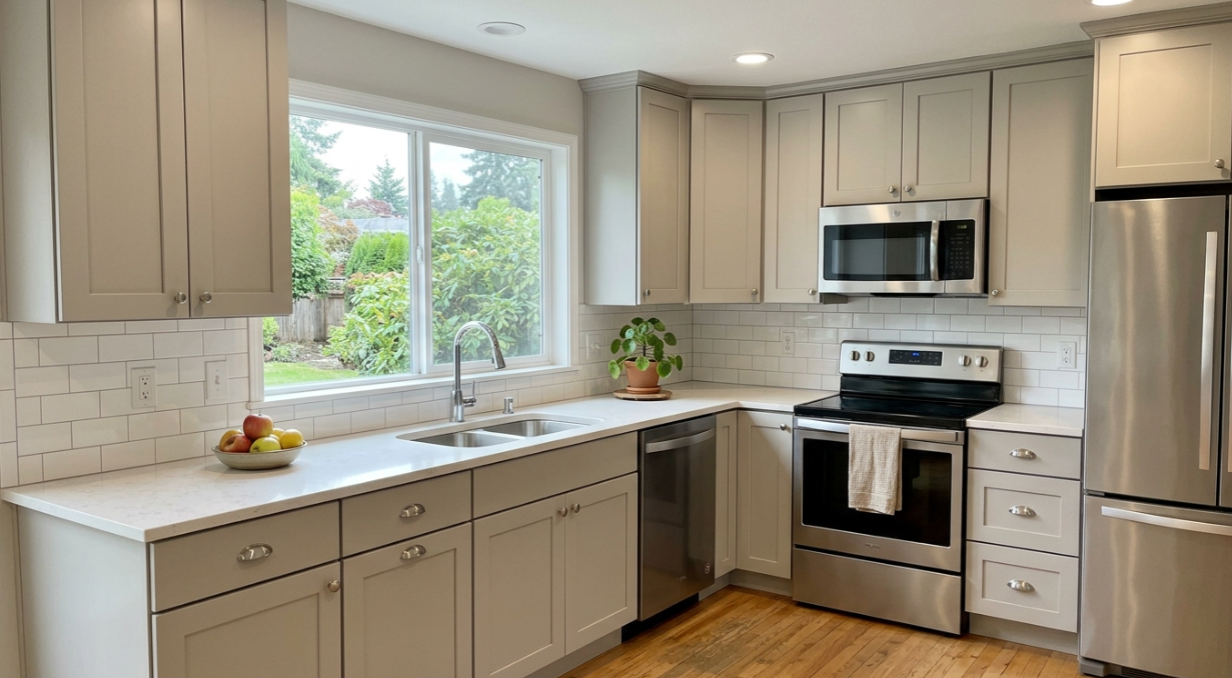
The answer depends on timing, condition, and market context. Here is a decision framework.
Selling in 0 to 6 months: Focus on cleaning, repairing visible damage, updating hardware, improving lighting, and painting if needed. Avoid major scope. Buyers often prefer a clean dated kitchen over a seller’s rushed renovation.
Selling in 6 to 24 months: A cohesive minor refresh (cabinet fronts, counters, sink/faucet, hardware, paint, lighting) is realistic and can improve marketability.
Staying 3 to 7 years: A moderate remodel can be worth it if the kitchen’s function is poor. Balance lifestyle improvement with resale discipline.
Staying 10+ years: Remodel for your life. NAR’s data gives kitchen upgrades a perfect Joy Score, confirming that homeowners love these projects regardless of resale math.
Kitchen is clean but dated: Refresh, do not gut. JLC’s data strongly supports this approach.
Kitchen is damaged or dysfunctional: Peeling cabinets, broken drawers, water damage, or a layout that does not work are legitimate reasons for a bigger scope. Reddit users consistently distinguish between “dated” and “genuinely bad condition.” Dated can be staged. Damaged needs repair. Dysfunctional may justify replacement.
The right question is not “Will a new kitchen add value?” It is: Is the current kitchen below buyer expectations for this home’s price band, and can a targeted update fix that without over-improving?
How Much Should You Spend on Kitchen Updates?
The Five-Budget Test
Before setting a number, ask five questions:
1. What are nearby updated homes selling for? This checks the price ceiling. JLC says resale value depends on comparable homes and local market conditions.
2. How long will the owner stay? Selling soon means focus on marketability. Staying means lifestyle value matters more.
3. Is the kitchen dated, damaged, or dysfunctional? Dated kitchens can often be refreshed cheaply. Damaged kitchens need repair. Dysfunctional kitchens may justify larger budgets.
4. Will the update look cohesive? A partial upgrade that clashes with the rest of the room can look unfinished. Practitioners on Reddit repeatedly advise against one shiny new element surrounded by old finishes. Either do a coordinated refresh or leave it alone.
5. Can the scope finish before the deadline? Kitchen projects often run longer than planned. Material lead times, contractor schedules, and scope creep all play a role.
Budget Ranges and What They Buy
Under $5,000: Deep clean, paint, hardware, faucet, lighting tune-up, grout and caulk repair.
$5,000 to $15,000: Hardware, faucet and sink, lighting, backsplash, selective flooring or countertop work, minor cabinet repairs.
$15,000 to $40,000: Value-focused minor remodel. Cabinet fronts or refacing, counters, sink and faucet, lighting, paint, and flooring where needed. JLC’s 2025 Seattle minor kitchen remodel cost falls in this range at $32,271.
$40,000 to $90,000: Full cabinet replacement with broader finish updates. ROI declines, so watch spending carefully against comps.
$90,000 and above: Lifestyle or luxury remodel. JLC’s Seattle major midrange project costs $95,542 and recoups 53.1%. Justify with long-term use or luxury comps, not generic ROI expectations.
Reddit discussions about kitchen budgets surface a common rule of thumb: 10% to 15% of home value for the kitchen. But users frequently warn that neighborhood comps matter more than a percentage. If comparable homes do not support the upgrade, the money may not come back.
Washington and Seattle: Local Context
For Washington and Seattle-area homeowners, contractors, and designers, local data is more useful than national averages when evaluating how kitchen updates affect home value.
JLC’s 2025 numbers tell a strong local story. Seattle’s minor kitchen remodel recoups 118.1%. The broader Pacific region recoups 129.1%. Both exceed the national average of 112.9%. This suggests that minor kitchen refreshes are particularly strong in the Pacific Northwest market.
Major and upscale remodels still show much lower cost recouped in Seattle, consistent with the national pattern.
A few local considerations worth noting:
Labor costs run higher. Seattle-area Reddit discussions show homeowners questioning whether $15,000 is enough for a meaningful kitchen update. DIY versus contractor labor changes the budget dramatically.
Material availability matters. Pre-sale updates are time-sensitive. Suppliers with broad in-stock inventory, local warehousing, and fast-turn assembly can make minor refreshes realistic within listing timelines.
Older homes may have hidden issues. Electrical, plumbing, and structural surprises can expand scope in older Seattle homes. Budget a contingency.
Explore showroom resources for designers planning Washington kitchen projects with client walkthroughs and product selection support.
Seattle vs. National Kitchen Remodel ROI
Market | Minor Midrange Kitchen Remodel | Major Midrange Kitchen Remodel | Upscale Kitchen Remodel |
|---|---|---|---|
Seattle | 118.1% | 53.1% | 38.7% |
Pacific Region | 129.1% | — | — |
U.S. | 112.9% | — | — |
The comparison reinforces the same conclusion across markets: minor kitchen remodeling tends to produce substantially better cost recovery than major or upscale remodeling.
Seattle’s minor remodel figure is also higher than the national average, making targeted kitchen refreshes particularly relevant for resale-focused homeowners in the region.
These figures should be presented as historical estimates for defined project scopes rather than guarantees of future resale performance.
How Contractors and Designers Can Talk About Kitchen ROI with Clients
Trade professionals are often the first people clients ask about whether kitchen updates increase home value. Having clear language helps.
Separate Three Kinds of Value
Resale value is what the project adds to the sale price. Marketability is how well the home competes in showings and listings. Lifestyle value is daily enjoyment. All three are real, but they are not the same thing. A $150,000 custom kitchen may score high on lifestyle value and low on resale ROI.
Use “Dated vs. Damaged vs. Dysfunctional”
This framework helps clients understand their actual starting point.
Dated means the kitchen works fine but looks old. These kitchens can often be cleaned, staged, or refreshed with minor updates. NAR data shows 27% of homeowners remodel because surfaces and materials are worn out, not because the kitchen is broken.
Damaged means visible problems: peeling laminate, broken drawers, water stains, cracked tiles, failing grout. These create buyer objections and usually justify repair-level spending.
Dysfunctional means the layout does not work, storage is inadequate, or the kitchen cannot serve the household. This is where bigger scope may be warranted.
Offer Good, Better, Best Packages
Good (under $5,000): Hardware, paint, lighting, cleaning, minor repairs. Enough for a clean dated kitchen heading to market.
Better ($5,000 to $20,000): Cabinet fronts or refacing, counters, sink and faucet, backsplash, lighting. A cohesive minor refresh that changes how the kitchen looks and photographs.
Best ($20,000 to $40,000): New cabinets and counters, flooring, appliances, and lighting when boxes are failing or the layout needs improvement. Still within the minor-to-moderate range that JLC data supports as the best ROI zone.
For every proposed update, apply a simple market-fit test: Would buyers in this price band expect it, notice it, and pay for it? If the answer to any of those is no, reconsider the scope.
Final Takeaway
Kitchen updates add the most home value when they make the room clean, functional, current, and aligned with the home’s price band. Minor, visible, broadly appealing refreshes, including cabinet door replacement, hardware, countertops, sink and faucet, lighting, paint, flooring, and storage, consistently outperform luxury gut remodels in resale data.
The data from JLC, NAR, Zillow, NAHB, and Houzz all point the same direction. And real-world discussions on Reddit and LinkedIn reinforce it: buyers want move-in-ready kitchens, but they do not want to pay a premium for someone else’s taste. A cohesive refresh that removes objections is almost always a safer bet than an expensive renovation that tries to impress.
For contractors, designers, retailers, and remodelers in Washington, material availability, scope discipline, and client communication are what separate profitable projects from delayed ones.
Register as a trade partner to access cabinet styles, countertop options, and project-ready materials through Krafter’s Land’s dealer and contractor channel.
FAQ
Do kitchen updates increase home value?
Usually, yes. Minor kitchen updates that improve the room’s appearance, function, and condition tend to add resale value and improve marketability. JLC’s 2025 data shows minor midrange kitchen remodels recouping 112.9% nationally and 118.1% in Seattle. The return drops significantly for major and upscale projects.
What kitchen updates add the most value?
Cabinet refresh or refacing, new hardware, countertop replacement, updated sink and faucet, better lighting, fresh paint, durable flooring, and storage improvements. These are the updates included in JLC’s highest-ROI kitchen project scope.
Is it worth remodeling a kitchen before selling?
It depends on the kitchen’s current condition and the timeline. A cohesive minor refresh can improve marketability and reduce buyer objections. A full gut remodel right before listing is rarely worth the cost or disruption. Practitioners on Reddit consistently advise sellers to clean, repair, paint, and make targeted updates rather than attempting a major renovation under time pressure.
What is the ROI on a minor kitchen remodel?
JLC’s 2025 Cost vs. Value data shows the minor midrange kitchen remodel recouping about 113% nationally, 118% in Seattle, and 129% in the broader Pacific region. These are averages based on defined project scopes and Realtor resale-value estimates, not guarantees for a specific home.
Do quartz countertops increase home value?
Quartz countertops are associated with a 3% sale premium in Zillow’s 2026 listing-feature analysis, while quartzite (a natural stone) is associated with a 5.3% premium. These are correlations observed in listing data, not proof that installing quartz automatically raises a home’s price by that amount.
Should I replace countertops before selling?
Only if the existing counters are visibly dated, damaged, or dragging down the kitchen’s appearance. And only if the cabinets underneath are in good enough condition to support the investment. New stone on failing cabinets is one of the most common mistakes homeowners make before selling.
What kitchen upgrades should I avoid before selling?
Full luxury remodels, over-customized finishes, bold or trendy backsplash choices, premium chef-grade appliances in mid-market homes, layout changes without clear functional payoff, and poor-quality DIY cabinet painting. All of these tend to lower ROI or narrow the buyer pool.
How much should I spend on kitchen updates before selling?
There is no universal number. Check what comparable updated homes in the neighborhood are selling for, assess whether the kitchen is dated, damaged, or dysfunctional, and set a budget that brings the kitchen up to buyer expectations without exceeding the neighborhood price ceiling. For most mid-market homes, a $15,000 to $35,000 minor refresh covers the highest-impact updates.