TL;DR
Plywood cabinets cost 30 to 50 percent more than particle board cabinets, but they last roughly two to three times longer, hold screws better, and resist moisture damage that particle board cannot survive. For kitchens, bathrooms, and any cabinet near water, plywood is the professional standard. Quality particle board with melamine coating performs adequately in dry, low-risk locations like upper wall cabinets. Both materials must meet federal CARB Phase 2 and EPA TSCA Title VI formaldehyde emission limits.
Quick Answer: Is Plywood or Particle Board Better for Cabinets?
Plywood is generally the better cabinet-box material for kitchens, bathrooms, sink bases, and long-term homes because it offers better screw-holding, durability, repairability, and resistance to moisture-related damage. Particle board is the better budget choice for dry areas, especially when it has a durable melamine surface and the cabinet is well constructed. For most homeowners planning to keep their cabinets for 10+ years, plywood is worth considering for the added upfront cost.
Best overall: Plywood
Best for tight budgets: Particle board
Best near water: Plywood
Best for dry upper cabinets: Quality particle board can be sufficient
Best for long-term durability: Plywood
Best value for short-term projects: Particle board
The Bottom Line
If you are choosing cabinet boxes for a primary kitchen or bathroom and plan to keep them for many years, choose plywood when the price premium fits your budget. If you are furnishing a rental, remodeling on a strict budget, or installing cabinets in a dry, low-stress location, quality particle board can be a reasonable choice.
The material alone does not determine cabinet quality. Panel thickness, joinery, back-panel construction, edge protection, hardware attachment, shelf support, and installation quality can make a major difference.
The cabinet box, sometimes called the carcass, is the structural foundation that holds everything together: shelves, doors, hinges, drawer slides. A stunning door on a weak box is a short-term win and a long-term headache. Yet most shoppers spend their energy choosing door styles and finishes while ignoring the material underneath.
This glossary covers every term you will encounter when comparing plywood vs. particle board cabinets, whether you are reviewing spec sheets, visiting a showroom, or quoting a job for a client. Definitions are grouped by theme, with practical context for each.
Explore cabinet pricing and lead times for trade professionals sourcing materials.
What Matters More Than the Cabinet Material?
Plywood versus particle board is important, but it is not the only factor that determines cabinet quality. A well-built particle board cabinet can outperform a poorly constructed plywood cabinet in some applications.
When comparing cabinet quotes, evaluate these factors together:
Factor | What to Look For | Why It Matters |
|---|---|---|
Cabinet box material | Plywood or quality particle board | Determines strength, durability, and moisture performance |
Panel thickness | Commonly 1/2-inch or 3/4-inch components | Thicker panels generally provide greater rigidity and support |
Back panel | Captured, recessed, or securely attached back | Adds rigidity and affects installation strength |
Shelf construction | Thick, well-supported shelves | Reduces sagging under heavy loads |
Edge protection | Durable edge banding or sealed edges | Helps prevent moisture from reaching the core |
Joinery | Screwed, doweled, dadoed, or otherwise reinforced joints | Affects long-term structural integrity |
Hardware attachment | Adequate material around hinges and slides | Reduces the risk of stripped mounting points |
Finish/coating | Melamine, laminate, veneer, paint, or other finish | Protects the substrate and affects appearance |
Certification | TSCA Title VI compliance where applicable | Helps verify formaldehyde-emission compliance |
Warranty | Clear coverage for boxes and hardware | Provides evidence of manufacturer support |
Buying rule: Do not choose cabinets based only on the word “plywood.” Ask the manufacturer for the exact box material, thickness, back construction, shelf material, edge treatment, and hardware specifications.
Core Material Definitions
Plywood. Multiple thin layers of wood veneer bonded together with the grain of adjacent layers running perpendicular. This cross-grain construction gives plywood exceptional strength relative to its weight, superior screw-holding capacity, and meaningful resistance to moisture-related swelling. In cabinet construction, plywood is the premium substrate choice for boxes, shelves, and back panels.
Particle board (also called chipboard or particleboard). A non-structural engineered wood panel made from wood waste residues, compressed with resin adhesives under heat and pressure. Natural Resources Canada describes it as cheaper, denser, and more uniform than conventional wood or plywood, a good substitute when cost matters more than strength. It is the most common cabinet box material in budget and mid-range lines.
MDF (Medium-Density Fiberboard). Made from hardwood or softwood residuals broken down into fine fibers, then combined with wax and resin under high pressure. MDF is denser and smoother than particle board, making it ideal for painted cabinet doors and drawer fronts. It is not the same as particle board, though shoppers frequently confuse the two. MDF machines cleanly and takes paint well, but it shares particle board’s vulnerability to moisture.
Furniture board. A marketing term some manufacturers use for high-density particle board. It is not a separate material. When you see “furniture board” on a cabinet spec sheet, you are looking at particle board. Users on Houzz forums have flagged this exact confusion when comparing quotes, where one brand lists “furniture board” and another lists “particle board” for the same thing.
Engineered wood. The umbrella term covering plywood, particle board, and MDF. All three are manufactured wood products that use adhesives. Calling something “engineered wood” tells you nothing about its quality; you need to know which type.
Melamine. A hard resin coating applied to particle board or MDF panels. Melamine adds surface moisture protection, scratch resistance, and color options. Many cabinet interiors feature melamine-coated particle board, which performs better than raw particle board but still fails if the core gets wet through exposed edges or hardware holes.
For context, frameless European-style cabinets originated using particle board panels with melamine coatings. The material choice and cabinet construction style are closely connected.
Construction and Quality Terms
Cabinet box (carcass). The structural shell of a cabinet, consisting of two side panels, a top, a bottom, and a back panel. The box is what gets screwed to the wall and supports the weight of everything inside. This is where the plywood vs. particle board cabinets debate lives. Doors and drawer fronts get all the attention, but the box determines how long the cabinet lasts.
Back panel. The rear panel of the cabinet box. Thickness here is a key quality indicator. A quarter-inch plywood back seated into grooves is stronger than stapled hardboard. Thin, stapled backs are a cost-cutting shortcut found in the cheapest cabinet lines.
Panel thickness. The thickness of side panels, shelves, and bottoms directly affects cabinet strength. Half-inch sides are standard, while three-quarter-inch components signal premium construction. KraftMaid notes that quality cabinets use a minimum of half-inch-thick end panels and shelves. Thinner panels save money but compromise stability, regardless of whether the material is plywood or particle board.
To learn more about what separates a well-built cabinet from a cheap one, see this guide on signs of quality construction.
Cross-grain lamination. The technique that gives plywood its strength. Each veneer layer is rotated 90 degrees from the one below it. This alternating grain pattern distributes stress across the panel, preventing it from splitting along a single grain line. Particle board has no grain structure at all, which is why it cracks differently under load.
Screw-holding capacity. Plywood grips screws tightly because the cross-grain layers resist pullout from multiple directions. Particle board holds screws adequately when new, but the bond weakens over time, especially with repeated hinge adjustments or if the material absorbs any moisture. Stripped screw holes in particle board are a common complaint, and they are nearly impossible to fix permanently.
Edge banding. Thin strips of veneer, PVC, or melamine applied to exposed panel edges. Edge banding is especially critical on particle board cabinets because exposed edges are the primary entry point for moisture. If the banding peels or chips, the raw particle board underneath begins absorbing humidity and water.
Dovetail joint. A wood-to-wood joint used in drawer box construction (not the cabinet box itself). Dovetail drawers indicate higher build quality. This is a related term worth knowing, though it is distinct from the box material question.
Performance and Durability Terms
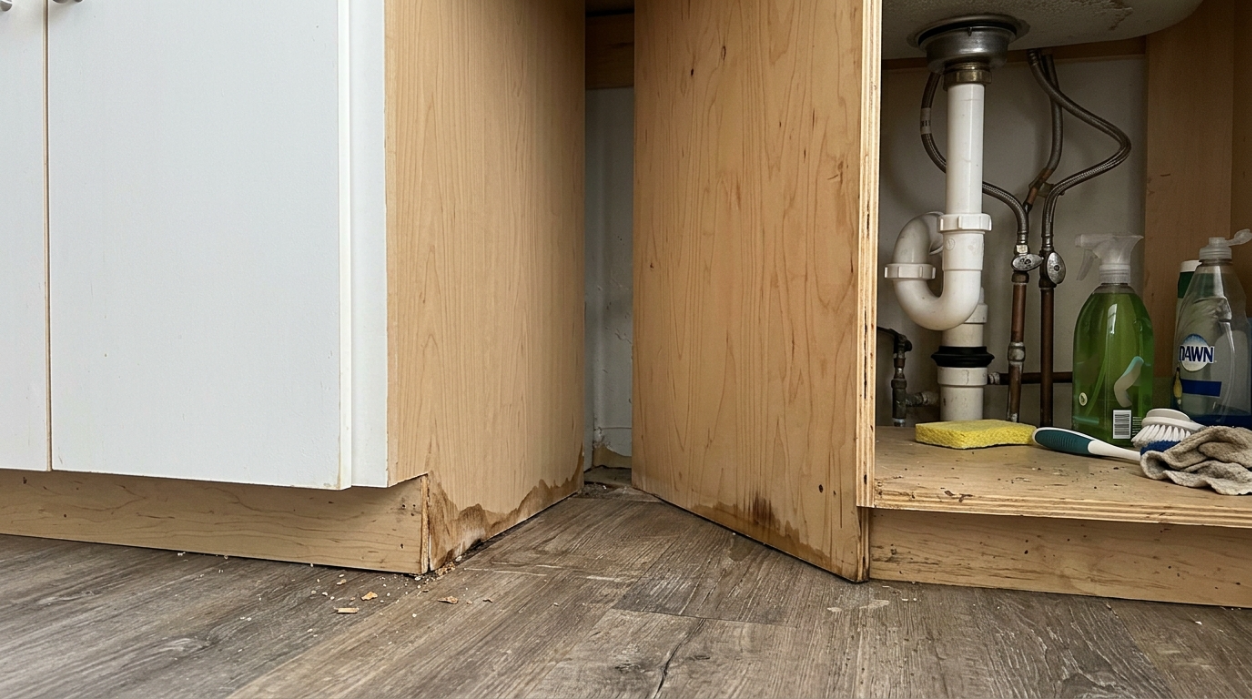
Thickness swell. The irreversible expansion that occurs when particle board absorbs water. Unlike plywood, which may warp or cup, particle board expands significantly in thickness and cannot return to its original state. Once the engineering has failed, the structural integrity is gone and mold risk becomes real. This is the single most important performance difference between plywood and particle board cabinets.
Moisture resistance. Plywood’s cross-grain structure resists swelling because water must penetrate multiple layers running in different directions. Particle board absorbs water quickly, causing it to swell, warp, and lose its structural integrity. Practitioners on woodworking forums consistently identify the under-sink cabinet as the vulnerability point: every sink eventually leaks, and that is where particle board fails first.
Load capacity. Standard three-quarter-inch plywood supports 50 to 60 pounds per square foot, while equivalent particle board handles only 35 to 40 pounds per square foot. That 25 to 30 percent strength gap matters for shelving loaded with dishes, cookware, or pantry goods.
Dimensional stability. A material’s ability to maintain its shape as temperature and humidity fluctuate. Plywood outperforms particle board here because its layered structure resists expansion and contraction in all directions. Particle board, being more porous, reacts more to environmental changes.
Sagging. What happens to particle board shelves under heavy loads over months and years. A loaded pantry shelf made from particle board will develop a visible bow. Plywood shelves sag far less under the same weight, especially at wider spans.
Refacing. The process of replacing cabinet doors and drawer fronts while keeping the existing boxes. Refacing only works if the cabinet box is structurally sound. As one cabinet refacing company put it, even the best refacing job cannot revive a cabinet box that is crumbling. If your particle board boxes show swelling, chipping, or hardware failure, replacement is the better long-term investment.
Plywood Cabinets: Pros and Cons
Plywood cabinet boxes are made from multiple veneer layers bonded together, typically with adjacent layers oriented in different directions. This construction gives plywood a strong, relatively stable panel that is widely used in residential cabinetry.
Advantages of Plywood Cabinets
Better resistance to moisture-related swelling than standard particle board
Strong screw-holding performance
Good structural strength relative to its weight
Easier to repair if a screw hole or panel is damaged
Strong option for shelves and cabinet boxes
Well suited to kitchens, bathrooms, and other areas where moisture is a concern
Generally a better long-term choice for homeowners who plan to keep cabinets for many years
Disadvantages of Plywood Cabinets
Usually costs more than particle board
Quality varies significantly by grade, core construction, thickness, and manufacturer
Not all plywood is designed for the same moisture exposure
A plywood cabinet can still be damaged by prolonged water exposure
Higher material cost does not automatically mean better cabinet construction
Important: Plywood is more moisture-tolerant than particle board, but it is not waterproof. Plywood products have different bond classifications and exposure ratings, so the specific panel matters. APA distinguishes between Exposure 1 and Exterior plywood based on intended moisture exposure.
Plywood vs. Particle Board vs. MDF for Cabinets
Plywood, particle board, and MDF are all engineered wood products, but they are manufactured differently and serve different purposes in cabinetry.
Material | Made From | Main Strength | Common Cabinet Use | Main Weakness |
|---|---|---|---|---|
Plywood | Veneer layers | Strength and durability | Cabinet boxes, shelves, panels | Higher cost |
Particle board | Wood particles | Affordability and uniformity | Cabinet boxes, shelves, melamine panels | Moisture vulnerability |
MDF | Fine wood fibers | Smooth, paintable surface | Painted doors and drawer fronts | Heavy and moisture-sensitive |
Simple rule: Choose plywood when cabinet-box durability is the priority, particle board when upfront cost matters most in a suitable dry environment, and MDF when a smooth painted surface is the priority.
Plywood vs. Particle Board: Head-to-Head Comparison
Feature | Plywood | Particle Board |
|---|---|---|
Composition | Laminated wood veneers, cross-grain | Compressed wood particles and resin |
Strength (load capacity) | 50–60 lbs/sq ft | 35–40 lbs/sq ft |
Moisture resistance | Good; resists swelling | Poor; irreversible thickness swell |
Lifespan | 25–50+ years | 10–15 years |
Cost | $35–$80 per 4×8 sheet | $15–$25 per 4×8 sheet |
Screw holding | Excellent, long-term | Adequate when new, degrades over time |
Repairability | Can be patched, re-screwed | Structural damage is permanent |
Best use | All cabinet locations, especially wet areas | Dry, low-stress locations (upper cabinets) |
Where Should You Use Plywood vs. Particle Board Cabinets?
The best material depends on the cabinet’s location, moisture exposure, expected load, budget, and how long you plan to keep it.
Cabinet Location or Project | Recommended Material | Why |
|---|---|---|
Sink base cabinet | Plywood | Highest risk of plumbing and leak exposure |
Dishwasher-adjacent cabinet | Plywood preferred | Frequent moisture and heat exposure make durability more important |
Bathroom vanity | Plywood preferred | Humidity and water exposure increase the risk of substrate damage |
Kitchen base cabinets | Plywood preferred | Higher loads and greater exposure to spills and leaks |
Kitchen wall cabinets | Either | Particle board can work well in dry conditions |
Pantry cabinets | Plywood preferred for heavy loads | Shelves may carry substantial weight |
Dry closet cabinets | Particle board can be sufficient | Low moisture and moderate loads reduce the need for plywood |
Rental property | Particle board can make sense | Lower upfront cost may be more important for short hold periods |
Long-term primary residence | Plywood preferred | Higher upfront cost can make sense for long service |
High-humidity environment | Plywood preferred | Better resistance to moisture-related damage |
Cost and Value Terms
Cost premium. Particle board cabinets cost roughly 30 to 50 percent less than plywood cabinets. For a 4×8 sheet, particle board runs $15 to $25, while comparable plywood ranges from $35 to $80. That gap adds up across a full kitchen.
Plywood upgrade. Many cabinet manufacturers offer the option to swap particle board boxes for plywood at an additional charge. The plywood premium averages $2,000 to $5,000 for a complete kitchen. One Houzz user reported a specific quote of $4,322 for upgrading to all-plywood construction on a Diamond Reflections order from Lowe’s.
Cost per year of service. This is the metric that changes the math. If plywood cabinets cost $8,000 and last 30 years, the annual cost is about $267. If particle board cabinets cost $5,000 and last 12 years, the annual cost is about $417. The cheaper material actually costs more per year of use. For rental properties the calculation shifts depending on hold period and tenant wear, so the context matters.
For a deeper look at RTA cabinet pricing and how material choices affect the total, that guide breaks down the numbers further.
Cabinet material choice also affects lead times for stock vs. custom orders. Plywood boxes in some lines are semi-custom, meaning longer waits.
How to Calculate the Real Cost of Cabinet Materials
The cheapest cabinet is not always the cheapest cabinet over its useful life. A simple way to compare options is to divide the purchase price by the number of years you realistically expect to use the cabinets.
Cost per year = Total cabinet cost ÷ Expected years of service
For example:
Option | Purchase Cost | Expected Service Period | Approx. Cost per Year |
|---|---|---|---|
Particle board example | $5,000 | 12 years | $417/year |
Plywood example | $8,000 | 30 years | $267/year |
These numbers are illustrations, not guaranteed lifespans. Actual cabinet life depends on construction quality, installation, moisture exposure, maintenance, hardware, and use.
For a short-term rental, the lower initial price may be more important. For a primary residence where the cabinets are expected to remain for decades, the higher upfront cost of plywood can be easier to justify.
Compliance and Safety Terms
CARB Phase 2 (P2). California’s formaldehyde emissions standard for composite wood, including plywood, particle board, and MDF. Allowable emission levels are capped at 0.09 ppm for hardwood plywood and 0.11 ppm for MDF. This standard applies to both materials equally, so neither plywood nor particle board gets an automatic safety advantage. What matters is that the specific product is certified compliant.
EPA TSCA Title VI. The federal version of CARB Phase 2, adopted in 2018. CARB Phase 2 and TSCA Title VI are functionally identical, so any cabinet sold in the U.S. must meet these limits regardless of where it is manufactured.
Formaldehyde off-gassing. The release of formaldehyde gas from the resin adhesives in composite wood panels. Emissions are highest immediately after manufacturing and decrease over time. Both plywood and particle board use formaldehyde-based resins (urea-formaldehyde is common in particle board, phenol-formaldehyde in exterior plywood). CARB Phase 2 certification is what confirms the product meets safety thresholds.
VOC (Volatile Organic Compound). A broader category of chemicals that can off-gas from building materials, finishes, and adhesives. Formaldehyde is one VOC among many. Trade pros working on projects with indoor air quality requirements should verify VOC data beyond just formaldehyde.
When to Choose Which: A Quick Reference
Not every cabinet in a kitchen needs to be plywood, and not every particle board cabinet is destined to fail. Placement and project type matter.
Primary kitchen, long-term home. Plywood boxes are the professional standard. The 25-to-50-year lifespan justifies the upfront premium, and you avoid the risk of premature replacement.
Sink base and dishwasher-adjacent cabinets. Plywood, full stop. This is the one point where virtually every contractor, woodworker, and kitchen designer agrees. Every sink eventually leaks. When it does, plywood survives and particle board does not.
Upper wall cabinets in dry areas. Quality particle board with melamine coating performs well. These cabinets see minimal moisture exposure and lighter loads. A veteran kitchen designer on ContractorTalk.com argued that industrial furniture-grade particle board, made with modern adhesives at high pressures, wears just as well as plywood if construction techniques are sound. That position holds in dry areas, though it breaks down anywhere water is a factor.
Rental properties and investment flips. Particle board is acceptable when budgets are tight and the hold period is short. Factor in a 10-to-15-year replacement cycle rather than assuming the cabinets will last as long as plywood. For a detailed breakdown, the cabinets for rental properties guide covers this calculation. Investors on Reddit’s r/realestateinvesting specifically worry about water damage to particle board under sinks in rental units, and that concern is well-founded.
Bathroom vanities. Plywood preferred. Bathrooms have constant humidity from showers, baths, and condensation. Particle board vanities in high-use bathrooms often show swelling within a few years. More on material selection in this bathroom vanity guide.
How to Identify the Material in Your Cabinets
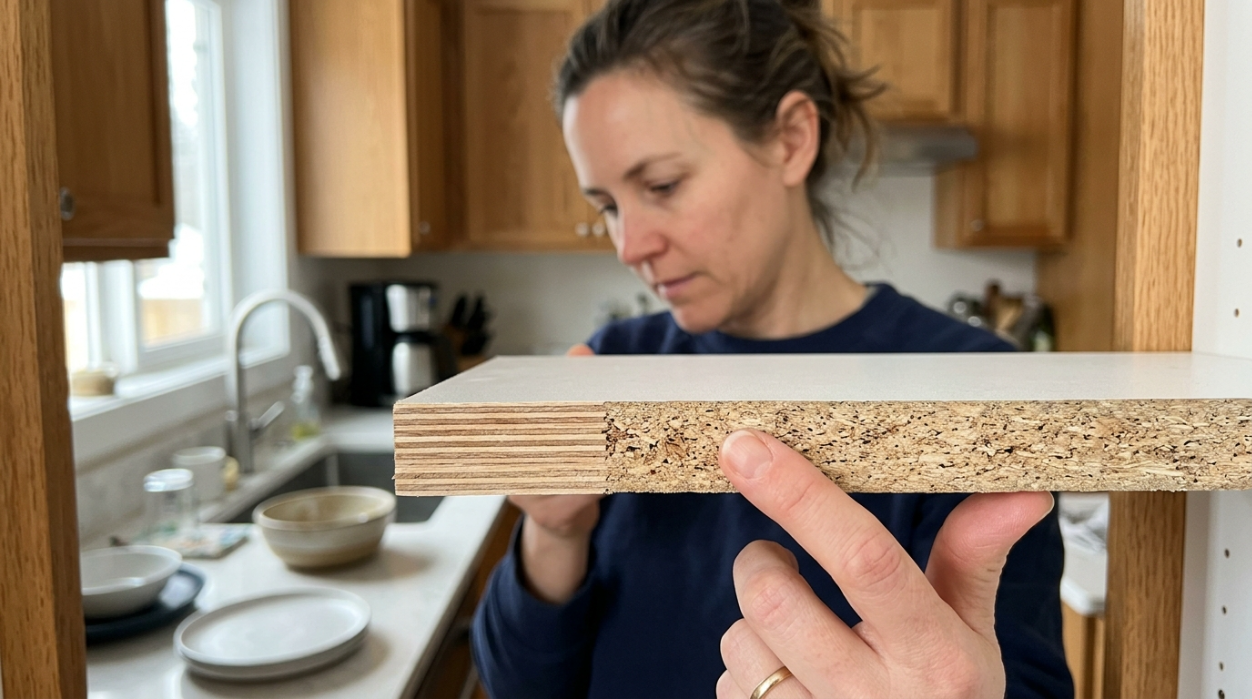
You do not need to be a woodworker to tell the difference. Open a cabinet door and look at exposed edges (inside corners, shelf edges, or the bottom panel).
Plywood shows visible layers. You will see thin stacked lines of wood veneer along any unfinished edge. The layers alternate in grain direction if you look closely.
Particle board has a uniform, speckled cross-section. It looks like compressed sawdust, because that is essentially what it is. The texture is grainy and consistent throughout.
MDF has an extremely smooth, dense, uniform cross-section with no visible wood chips or veneer layers. It looks almost like compressed cardboard.
If every edge is covered with edge banding or melamine, check the drill holes where hinges or shelf pins mount. The material inside the hole reveals the substrate.
10 Questions to Ask Before Buying Cabinets
Before comparing two cabinet quotes, ask the supplier these questions:
What material is used for the cabinet sides?
What material is used for the shelves?
What material is used for the cabinet bottom?
What material is used for the back panel?
What is the thickness of each panel?
How are the cabinet boxes joined?
How are exposed particle-board edges protected?
What material surrounds the hinge and drawer-slide mounting points?
Is the composite wood TSCA Title VI compliant?
What exactly changes when I upgrade from the standard box to the plywood box?
Tip: Ask for the specifications in writing. “Furniture board,” “engineered wood,” and “premium construction” can describe different products depending on the manufacturer. The actual substrate and panel thickness are more useful than marketing terminology.
FAQ
Is MDF the same as particle board?
No. MDF uses much finer wood fibers and is denser, smoother, and stronger than particle board. MDF is commonly used for cabinet doors (especially painted styles) because it machines cleanly and takes paint without grain telegraphing. Particle board uses coarser wood particles and is lighter and weaker. Both are engineered wood, and both are vulnerable to moisture, but they are distinct materials with different applications.
Are particle board cabinets safe?
Yes, as long as they are CARB Phase 2 or EPA TSCA Title VI certified. Both plywood and particle board use resin adhesives that can emit formaldehyde, but certified products meet federally mandated emission limits. Check for CARB P2 or TSCA Title VI labeling before purchasing any composite wood product.
Can water-damaged particle board be repaired?
Not effectively. Surface scratches can be touched up, but structural damage from moisture, including thickness swell, crumbling edges, and stripped screw holes, is irreversible. Once the particle board core absorbs water and expands, the engineering has failed. Replacement is typically the only real solution.
Is the plywood upgrade worth the extra cost?
For most kitchens in a primary home, yes. The $2,000 to $5,000 plywood upgrade is modest against a total kitchen remodel cost of $20,000 to $50,000 or more. The longer lifespan (25 to 50 years vs. 10 to 15) makes plywood cheaper per year of service. For short-term rental flips with a 5-year hold, the math favors particle board as long as you protect the sink base cabinet.
What is “furniture board” on a cabinet spec sheet?
It is particle board. Some manufacturers use the term “furniture board” or “furniture-grade particle board” to describe higher-density particle board. The name sounds better, but the material has the same moisture vulnerabilities as standard particle board. Ask for the actual material specification if a quote uses this term.
How does cabinet material affect refacing?
Refacing only works on structurally sound boxes. If your existing cabinet boxes are plywood and in good condition, refacing is a cost-effective way to update the look without full replacement. If the boxes are particle board and showing signs of swelling, chipping, or hardware failure, no amount of new doors will fix the underlying problem. In that case, full cabinet replacement is the better path.
Do frameless cabinets always use particle board?
Not always, but the connection is historical. Frameless (European-style) cabinets were designed around thick, flat panels, and particle board was the original material of choice because it produces consistent, flat sheets. Today, many manufacturers offer frameless cabinets with plywood boxes as an upgrade. The construction style does not dictate the material.
Comparing plywood vs. particle board cabinets comes down to where the cabinet goes, how long you need it to last, and what your budget allows. For trade pros evaluating options for a client project, visit a showroom to compare plywood and particle board construction side by side, because the difference is immediately obvious once you see and feel the materials in person.