
TL;DR
Cabinet lead times refer to the total elapsed time from placing your order to having cabinets ready for installation, and they range from same-day pickup for stock cabinets to 16+ weeks for fully custom builds. Lead time is not the same as shipping time; it includes order processing, manufacturing, transit, and delivery scheduling. In 2026, tariffs, seasonal demand, and finish complexity all influence how long you’ll wait. Cabinets sit on the critical path of every kitchen and bath project, so getting this number wrong cascades into weeks of downstream delays.
Quick Answer: How Long Do Cabinets Take in 2026?
The average cabinet lead time in 2026 ranges from same-day pickup for stock cabinets to 16+ weeks for fully custom cabinets.
Most homeowners should expect these timelines:
Cabinet Type | Average Lead Time |
|---|---|
Stock | Same day to 3 weeks |
RTA | 1 to 2 weeks |
Semi-custom | 4 to 8 weeks |
Custom | 8 to 16+ weeks |
Lead time includes more than shipping. It includes:
Order processing
Manufacturing
Transportation
Delivery scheduling
For a typical kitchen remodel, semi-custom cabinets remain the most common choice, with an average waiting period of approximately six weeks.
Key takeaway: If you haven’t ordered your cabinets, your remodel schedule isn’t finalized.
What Are Cabinet Lead Times?
Cabinet lead time is the period between placing your order and when your cabinets are ready for installation. That sounds simple enough, but the term trips people up because they confuse it with shipping time. Shipping is just one piece of the puzzle.
Total lead time has four components:
Order processing (verification, design confirmation, payment clearance)
Manufacturing or assembly (if the cabinets are built to order)
Transit (from factory or warehouse to your job site or local pickup point)
Delivery scheduling (the appointment window for final drop-off)
As one cabinet glossary puts it, lead time is an approximation of how long it will take to get your materials, and it is always considered approximate. Variables like backorders, seasonal surges, and manufacturer capacity can shift the timeline in either direction.
Why does this matter so much? Because cabinets are the pivot point of any kitchen or bath project. Until cabinets are installed, countertop templating can’t happen, plumbing finishes can’t go in, and backsplash tile stays in the box. Cabinet installation sits between rough construction and finish work, which means a cabinet delay isn’t just a cabinet problem. It’s an everything problem.
For a deeper look at how cabinets fit into the broader project sequence, see the kitchen remodel timeline guide.
Lead Time Ranges by Cabinet Type (2026 Reference)
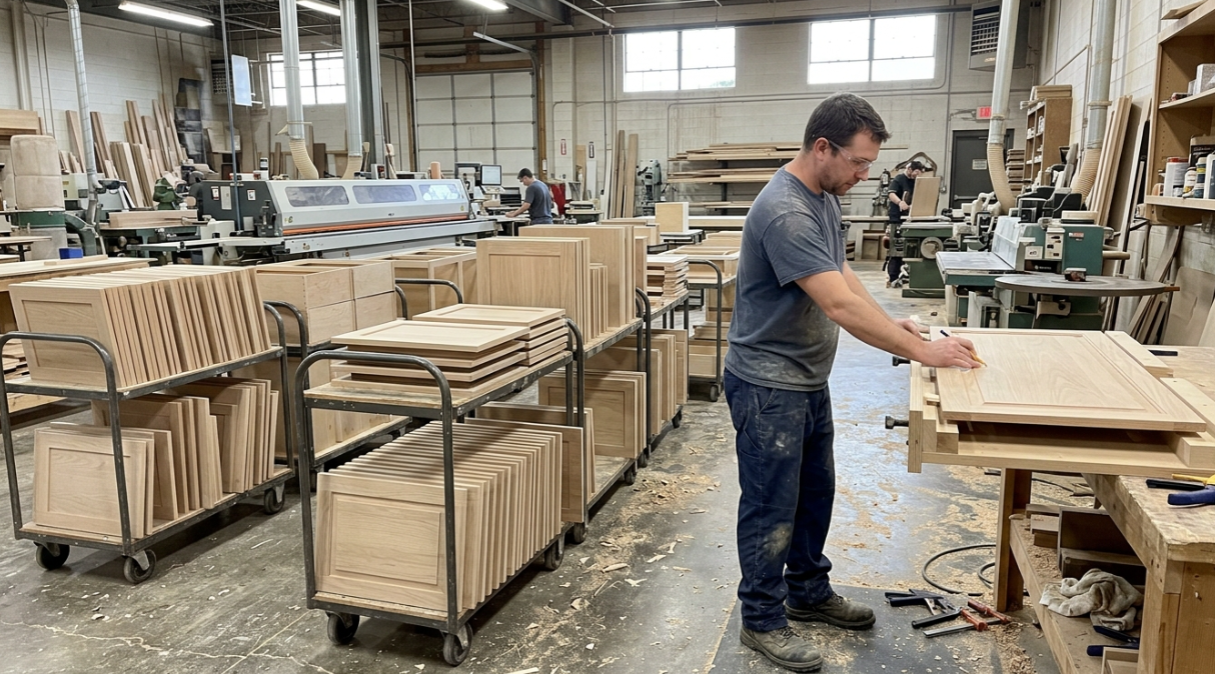
The single biggest factor determining your lead time is the cabinet tier you choose. Here are the current industry benchmarks:
Cabinet Type | Typical Lead Time | Notes |
|---|---|---|
RTA (Ready-to-Assemble) | 1 to 2 weeks | Next-day pickup possible from local warehouse stock |
Stock (Pre-built) | Same-day to 3 weeks | Depends on retailer inventory and proximity |
Assembled (factory pre-assembled) | 2 to 4 weeks | Some suppliers ship semi-custom assembled orders in 7 to 10 days |
Semi-Custom | 4 to 8 weeks | Most popular tier for mid-range remodels |
Custom | 8 to 16+ weeks | Can extend further for specialty wood species, vintage finishes, or room-matching |
These ranges hold across multiple industry sources. For specific brand data, Cabinetworks Group (parent of KraftMaid) publishes a lead time schedule showing three weeks of standard production plus one to three weeks for delivery, putting their total at four to six weeks.
Not sure which tier fits your project? The tradeoff between RTA and custom cabinets is fundamentally about lead time versus flexibility. Tier is about flexibility and lead time first; quality is decided by the specifications inside whichever tier you choose.
Looking for current contractor pricing and lead time data? Check the contractor cabinet pricing and lead times page for up-to-date numbers.
Some regional suppliers with large local warehousing can cut these timelines dramatically, offering next-day pickup for unassembled cabinets and roughly two-week installation windows. That kind of speed requires inventory scale, which is why warehouse square footage matters as much as brand name when you’re evaluating suppliers.
Cabinet Lead Time Timeline: From Order to Installation
Stage | Typical Duration |
|---|---|
Design approval | 1 to 5 days |
Order processing | 3 to 5 days |
Manufacturing | 0 to 12 weeks |
Shipping | 2 days to 2 weeks |
Delivery scheduling | 2 to 7 days |
Inspection | 1 to 3 days |
Installation | 2 to 5 days |
Example timeline for a semi-custom kitchen:
Week 1: Design approval
Weeks 2-6: Manufacturing
Week 7: Shipping
Week 8: Delivery and inspection
Week 9: Installation
What Affects Cabinet Lead Times?
Beyond cabinet tier, seven other variables push timelines longer or shorter.
Seasonal Demand
This one catches people off guard. Orders placed in April may take one to two weeks longer than the same order placed in January. The spring and summer remodeling season creates a predictable crunch, and a second demand spike hits from October through December as homeowners push to finish before the holidays.
In markets like the Pacific Northwest and Midwest, the remodeling season peaks in spring and summer, leading to higher demand for cabinetry. This pattern is consistent nationwide.
Finish Type and Customization Complexity
Painted finishes generally take longer than stained options because of additional curing steps. Specialty colors, detailed door profiles, and decorative drawer fronts each add manufacturing time. If you’re choosing between framed and frameless construction, know that the construction type itself can affect production timelines depending on the manufacturer’s tooling and workflow.
Design Approval Delays
This is where projects quietly bleed weeks. Delays happen when approvals are postponed, revisions come in late, or measurements need to be reverified. Even a small change can require updated drawings and a new sign-off, pushing the production start date further out. Measurement errors are particularly costly because they create a second lead-time cycle on top of the original. Getting measurements right the first time with a step-by-step measuring process eliminates this risk.
Supplier Distance and Warehousing Model
Cabinets sourced from distant manufacturers incur longer shipping times. Local suppliers with warehouse stock eliminate this variable entirely. One contractor on a popular trade forum shared that being far from a showroom meant replacement pieces “would take forever,” delaying the entire project. Proximity to a warehouse or showroom isn’t a luxury; it’s a scheduling necessity.
The 2026 Tariff Environment
Since October 14, 2025, a 25% Section 232 tariff has been in effect on all imported kitchen cabinets, bathroom vanities, and their component parts. While early January headlines reported that tariffs were “canceled,” only the planned increase to 50% was delayed until January 1, 2027. The current 25% duty remains fully active.
This matters for lead times because increased costs may prompt some suppliers to reduce inventory or withdraw from the market entirely, creating delays in project timelines. In 2026, contractors are more likely to experience supply chain disruptions with imported cabinets.
Order Volume and Manufacturer Capacity
Large orders take longer due to increased complexity. A 40-cabinet order for a full kitchen isn’t processed the same way as a 10-cabinet bathroom job. Factor in additional time if you’re ordering for multiple units or a multi-phase project.
Replacement Parts and Reorders
Here’s a pain point no one talks about until it happens. A damaged door, a wrong-size filler, or a missing panel triggers a second lead-time cycle. For RTA cabinets, that replacement piece might arrive in a week. For semi-custom, you could be looking at another four to six weeks. Ordering a small buffer of extra pieces upfront is cheap insurance against this scenario.
Stock vs Semi-Custom vs Custom Cabinets: Which Is Right for Your Timeline?
Factor | Stock | Semi-Custom | Custom |
|---|---|---|---|
Lead time | Fastest | Moderate | Slowest |
Cost | Lowest | Moderate | Highest |
Design flexibility | Limited | Moderate | Unlimited |
Finish options | Limited | Extensive | Unlimited |
Best for | Tight deadlines | Most remodels | Unique layouts |
If speed is your priority, stock cabinets are the clear winner.
If balancing customization and scheduling matters most, semi-custom cabinets offer the best compromise.
Custom cabinets should be reserved for projects where design flexibility is more important than turnaround time.
The Cascade Effect: Why a Cabinet Delay Costs More Than Time
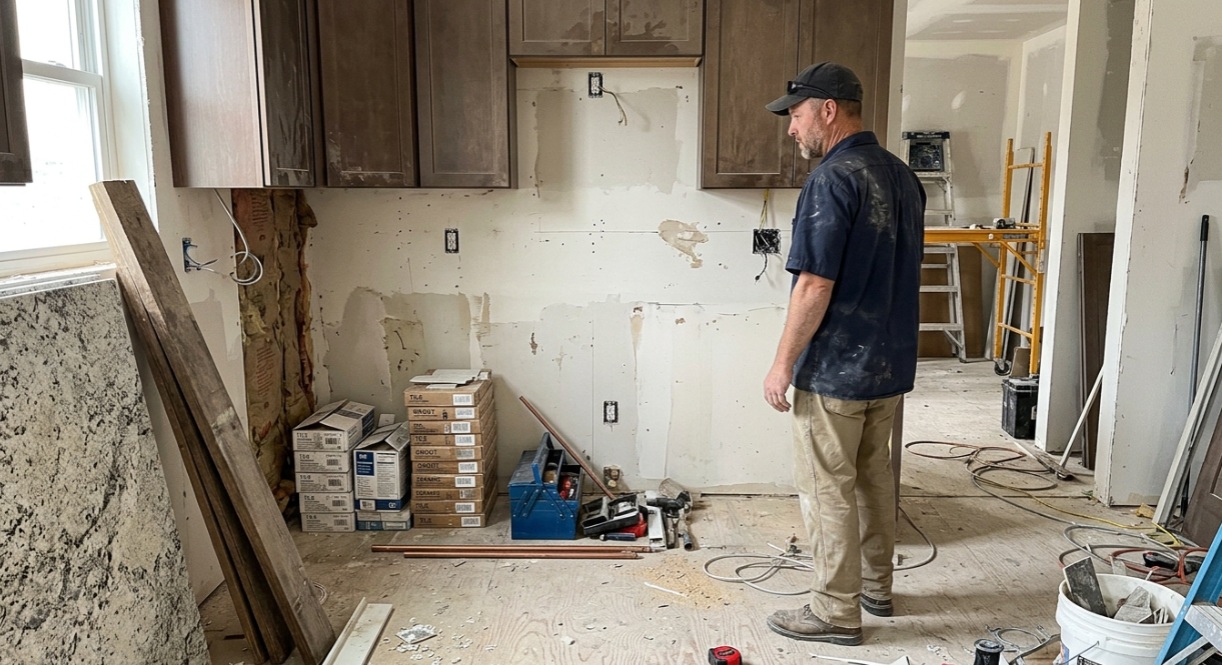
Most contractors mentally budget for the cabinet cost. Few budget for the cost of waiting.
A one-week delay in material decisions during the design phase can cascade into a two to three week delay at the finished-kitchen end. The math is straightforward: a late cabinet pushes countertop templating, which pushes the fabricator’s queue, which pushes installation, which pushes plumbing trim-out and backsplash. Each trade has its own scheduling constraints, so you don’t just lose the original week. You lose the rebooking gaps between every downstream contractor.
The financial cost is real too. Subcontractors may charge rescheduling fees. Fabricators bump you to the back of their queue. If the homeowner is living elsewhere during construction, every extra week adds housing costs. These are the hidden expenses that turn a $30,000 kitchen into a $35,000 kitchen.
Practitioners on contractor forums point out another often-overlooked time sink: GCs who spend weeks shopping bids between subcontractors are unknowingly eating schedule time that could have been used for production. By the time the final sub is selected and the order placed, weeks have evaporated.
To understand how cabinet delays interact with every other phase of a remodel, the kitchen remodel checklist maps the full dependency chain.
Where Cabinets Fit in the Kitchen Remodel Timeline
Remodeling Phase | Can It Begin Without Cabinets? |
|---|---|
Demolition | Yes |
Framing | Yes |
Electrical rough-in | Yes |
Plumbing rough-in | Yes |
Drywall | Yes |
Cabinet installation | No |
Countertop templating | No |
Countertop fabrication | No |
Backsplash installation | No |
Plumbing fixture installation | No |
Cabinets are the transition point between rough construction and finish work.
Once cabinets are delayed, every downstream trade experiences scheduling disruptions.
This is why experienced contractors treat cabinetry as the critical path item in a kitchen remodel.
How to Plan Around Lead Times (Backward Planning Method)
Working backward from your install date is the safest planning method. Here’s how it works:
Step 1: Set your target cabinet installation date.
Step 2: Subtract one week for delivery scheduling and damage inspection. (This buffer is non-negotiable. You need time to open every box, check every piece, and request replacements before the installer shows up.)
Step 3: Subtract transit time. For a local warehouse supplier, this might be one to two days. For a factory shipment across the country, it could be one to two weeks.
Step 4: Subtract manufacturing or assembly time. This is the core production window, ranging from zero (for in-stock items) to 12+ weeks (for custom builds).
Step 5: Subtract order processing time. Typically three to five business days, but longer during peak season.
The result is your order deadline.
For a practical example: if your target install date is September 1 and you’re ordering semi-custom cabinets with a six-week production time, two-week transit, and one-week buffer, you need to place your order by June 7 at the latest.
The Lock-Cabinets-Before-Demo Rule
A good rule is to lock the cabinet order before demolition starts, not after, so the longest-lead item is already in production while the messy work happens. Order late, and the cabinets, not the contractor, become the thing everyone waits on.
The standard advice from suppliers is to order six to nine months ahead. Pre-ordering that far in advance can cut lead times by up to 25%. That sounds reasonable until you consider that most residential contractors don’t have permits approved nine months out, clients change their minds, and projects get delayed. A more realistic approach for most residential work: finalize cabinet selections during the design phase and place the order the week permits are approved.
For trade professionals looking at how to build this into their overall workflow, the builder cabinet packages guide covers grade selection and ordering strategies.
The 5 Biggest Cabinet Ordering Mistakes
Starting demolition before ordering cabinets
An empty kitchen doesn’t accelerate cabinet production.
Delaying design approvals
Every revision resets the production schedule.
Assuming shipping time equals lead time
Manufacturing usually consumes most of the timeline.
Ordering during peak remodeling season
Spring and summer orders experience the longest waits.
Ignoring replacement pieces
Damaged or missing components can trigger a second production cycle.
Seasonal Calendar: When Lead Times Are Shortest and Longest
No cabinet supplier publishes a month-by-month demand chart, but the pattern is predictable year after year based on industry data:
Month | Demand Level | Lead Time Impact |
|---|---|---|
January to February | Low (post-holiday lull) | Shortest lead times of the year |
March to April | Rising (spring planning starts) | Add 1 to 2 weeks to baseline |
May to June | High (peak ordering season) | Lead times at or near maximum |
July to August | High (spring orders still in pipeline) | Manufacturers running at capacity |
September | Moderate (brief plateau) | Slight relief as summer orders clear |
October to December | Rising again (holiday deadline rush) | Add 1 to 2 weeks; some manufacturers institute cutoff dates |
The takeaway: if you have flexibility in your project start date, placing cabinet orders in January or February gives you the fastest turnaround and the best chance of avoiding production backlogs.
Cabinet Lead Times by Major Brands (2026 Estimates)
Brand | Typical Lead Time |
|---|---|
IKEA | 1 to 3 weeks |
Home Depot stock cabinets | Same day to 3 weeks |
Lowe’s stock cabinets | Same day to 3 weeks |
KraftMaid | 4 to 6 weeks |
Thomasville | 6 to 8 weeks |
Custom cabinet shops | 8 to 16+ weeks |
Lead times vary by inventory, finish selection, and geographic location. Always confirm current production schedules with your supplier before finalizing your remodel calendar.
Post-COVID Supply Chain: Where Things Stand in 2026
The extreme delays that characterized 2020 through 2022 have largely subsided. The most significant development for 2026 is the widespread return to pre-COVID norms for remodel material lead times.
But “normal” doesn’t mean “easy.” In 2025, the average wait time for cabinet installations increased by 10 to 15% compared to 2023, with 70% of builders reporting delays in obtaining raw materials and critical components. And 75% of companies have faced increased demand coupled with supply chain disruptions.
The tariff situation described above adds another layer of uncertainty for 2026. Domestic manufacturers have capacity constraints of their own, and imported cabinet inventory may thin out as the 25% duty squeezes margins for importers.
How Trade Professionals Manage Lead Time Risk
Experienced contractors and remodelers don’t just accept lead times. They manage them. Here are the strategies that work:
Work with in-stock local suppliers. A regional supplier with a large warehouse holding inventory in stock eliminates the longest variable in the equation: manufacturing wait time. When cabinets are sitting on a shelf 20 miles from the job site, your “lead time” drops to days instead of weeks.
Finalize selections during design, not construction. Every week spent debating door styles or finish colors during the build phase is a week added to the end of the project. Lock decisions early.
Order replacement and extra pieces upfront. A spare filler, an extra door in each size, a backup drawer front. The cost is minimal compared to a four-week reorder delay that idles your crew.
Build supplier relationships. During peak season, suppliers with limited capacity prioritize their established accounts. The contractor who orders consistently and pays on time gets bumped ahead of the one-time buyer.
Stop over-shopping bids. Getting three quotes is standard practice. Getting seven quotes over three weeks is schedule sabotage. The time spent chasing marginally better pricing often exceeds the money saved.
For a deeper breakdown of what to look for in a cabinet supplier, read the guide for trade professionals.
Frequently Asked Questions
What is the average lead time for kitchen cabinets?
It depends entirely on the cabinet type. Stock cabinets can be available same-day to three weeks. Semi-custom cabinets typically take four to eight weeks. Fully custom cabinets run eight to sixteen weeks or longer. The industry midpoint for a typical semi-custom kitchen order is about six weeks.
Are cabinet lead times still longer because of COVID?
Mostly no. The extreme delays of 2020 to 2022 have largely normalized. However, lead times in 2025 and 2026 are still running about 10 to 15% longer than 2023, driven by tariff uncertainty, raw material availability, and sustained demand rather than pandemic-era disruptions.
How do tariffs affect cabinet lead times in 2026?
The 25% Section 232 tariff on imported cabinets and vanities (active since October 2025) is squeezing importer margins and thinning inventory for some product lines. Suppliers carrying imported cabinets may reduce stock depth, which means items that were previously “in-stock” could shift to “made-to-order” with longer wait times.
What’s the difference between lead time and shipping time?
Shipping time is just one component of lead time. Total lead time includes order processing, manufacturing or assembly, transit (shipping), and the delivery appointment window. A cabinet with a “two-week shipping time” might have a six-week total lead time once production is factored in.
Can I speed up my cabinet lead time?
Yes. Choose in-stock or RTA cabinets instead of custom builds. Order from a local supplier with warehouse inventory. Finalize your design and approve drawings quickly. Avoid changes after the order is placed. And place your order in January or February when demand is lowest.
Should I order cabinets before or after demolition starts?
Before. Lock your cabinet order before demolition begins so the longest-lead item is already in production while the rough work happens. If you wait until after demo to start shopping for cabinets, you’ll have an empty kitchen and a crew with nothing to do.
What happens if a cabinet piece arrives damaged?
You enter a second lead-time cycle for the replacement piece. For RTA or stock cabinets, a replacement might arrive in one to two weeks. For semi-custom or custom pieces, expect another four to eight weeks. This is why inspecting every box on delivery day (before signing off) and ordering a few spare pieces upfront are standard best practices among experienced contractors.
When is the best time of year to order cabinets for the shortest lead time?
January and February consistently offer the shortest cabinet lead times. Manufacturers are past the holiday rush, and spring demand hasn’t ramped up yet. If your project timeline allows it, placing orders during this window gives you the best chance of on-time delivery.