TL;DR
Small kitchen remodels (70 to 150 square feet) are high-volume, fast-turn projects for contractors and dealers in the Seattle metro and across Washington State. The challenge isn’t design inspiration; it’s sourcing cabinets that are in stock, competitively priced at wholesale, and ready to install on tight timelines. This guide covers the cabinet styles that move fastest for compact kitchens, where to source them locally (with showroom and warehouse details), how to manage lead times, and what 2026 tariffs mean for your project bids. Whether you’re a remodeler working condo kitchens in Bellevue or a dealer supplying builders in Spokane, this is your sourcing playbook for small kitchen cabinets.
Browse in-stock cabinet lines available for trade partners at Krafter’s Land showrooms across Washington.
Quick Answer: How Should Contractors Source Small Kitchen Cabinets in Washington?
For most Washington State remodeling projects, the best cabinet strategy depends on three factors:
Project Type | Recommended Cabinet | Why |
|---|---|---|
Condo remodel | Frameless European | Maximum storage |
Rental property | Shaker | Broad tenant appeal |
ADU | Floor-to-ceiling | Uses vertical space |
Spec home | Slim Shaker | Modern without customization |
Luxury remodel | Glass-front + two-tone | Higher perceived value |
Trade professionals should prioritize suppliers that offer:
In-stock inventory
Lead times under three weeks
Local warehouse support
CARB and TSCA compliance
Design services
Multi-product sourcing
In Washington, sourcing locally often reduces project timelines by four to ten weeks compared with special-order cabinet programs.
Comparison: Small Kitchen Cabinet Lines for Trade Projects
Cabinet Type | Best Project Fit | Storage Efficiency | Style | Wholesale Price Tier | Trade Advantage |
|---|---|---|---|---|---|
Frameless European (Krafter’s Land) | Condos, apartments, galley remodels | High (+15% drawer width) | Modern | $$–$$$ | Next-day RTA pickup, 1-week assembly, ~2-week install |
Shaker Framed (Krafter’s Land) | Rental upgrades, SFH remodels | Moderate | Classic/transitional | $$ | In-stock at WA warehouses, broad tenant/buyer appeal |
Slim Shaker (Krafter’s Land) | Transitional projects, spec homes | Moderate | Modern-classic | $$ | Covers the gap between frameless and traditional Shaker |
Slab/Flat-Panel | Urban condos, open-concept apartments | Moderate | Contemporary | $$ | Clean look for modern staging |
Glass-Front Uppers | Higher-end small kitchens | Visual expansion | Transitional | $$$ | Upsell opportunity on selective upper cabinets |
Floor-to-Ceiling Runs | Studios, micro-kitchens | Very high | Any | $$–$$$ | Maximizes billable linear footage in tight layouts |
Corner w/ Pull-Out Inserts | L-shaped, U-shaped kitchens | High | Any | $$–$$$ | Solves callback complaints about dead corners |
Drawer-Base Units | Any small kitchen | High | Any | $$ | Strong client satisfaction, fewer post-install complaints |
Why Small Kitchen Projects Are High-Value for WA Contractors
Small kitchens account for a growing share of remodel work across the Puget Sound region. Seattle’s condo stock, Tacoma’s older bungalows, Lynnwood’s apartment renovations, and Spokane’s rental property upgrades all funnel into the same category: compact kitchens with 10 to 15 linear feet of cabinetry that need to turn over fast.
For contractors and dealers, these projects are attractive because:
Shorter project cycles mean faster invoicing and more projects per quarter
Lower material costs per job reduce risk on each project
Repeat volume from property managers, landlords, and multi-unit builders compounds quickly
Fewer change orders since there are simply fewer decisions to make in a small footprint
The bottleneck is almost never design. It’s sourcing. Practitioners on Reddit report that lead times on special-order cabinets regularly push small kitchen remodels past 8 to 12 weeks, a timeline that frustrates clients and ties up crew availability. The contractors who win this segment source from local suppliers with in-stock inventory and predictable turnaround.
What Is Considered a Small Kitchen?
The kitchen industry doesn’t use a single definition for “small.”
Instead, contractors typically classify kitchens according to square footage and cabinet runs.
Kitchen Size | Square Footage | Cabinet Length |
|---|---|---|
Micro kitchen | Under 70 sq. ft. | Under 10 LF |
Small kitchen | 70-150 sq. ft. | 10-15 LF |
Medium kitchen | 150-250 sq. ft. | 15-25 LF |
Large kitchen | 250+ sq. ft. | 25+ LF |
In Washington, most small kitchens fall into one of these categories:
Seattle condos
Tacoma bungalows
Bellevue apartments
ADUs
Rental properties
Understanding the kitchen’s size before sourcing cabinets improves estimating accuracy and reduces ordering mistakes.
Krafter’s Land: Your Local Wholesale Source for Small Kitchen Cabinets
Showrooms: Tukwila, Tacoma, Lynnwood, Spokane
Warehouse: 110,000+ sq ft regional facility
Showroom space: 20,000+ sq ft across four locations
Sales model: Authorized retailers, licensed contractors, dealers, designers, and builders only (no direct-to-consumer online sales)
Krafter’s Land Cabinetry is built around the exact problem that slows down small kitchen projects: inventory availability and turnaround speed. The company stocks both a frameless European line and framed Shaker lines (including a Slim Shaker option) in its 110,000+ square foot Washington warehouse, so trade partners aren’t waiting 6 to 10 weeks for cabinets to arrive from out of state.
Lead Times That Keep Projects on Schedule
Stage | Frameless Line | Shaker/Slim Shaker Line |
|---|---|---|
RTA Pickup (Unassembled) | Next day | In-stock, check availability |
Assembly Service | ~1 week | ~1 week |
Full Installation | ~2 weeks | ~2 weeks |
For a typical small kitchen with 10 to 15 linear feet of cabinetry, that means you can go from order to installed cabinets in roughly two weeks on the frameless line. Compare that to special-order brands where you’re looking at 6 to 12 weeks just for delivery, and the competitive advantage is clear.
Cabinet Lead Times: Local Inventory vs Special Orders
Sourcing Method | Typical Delivery |
|---|---|
In-stock local inventory | 1-3 weeks |
Regional distribution | 3-5 weeks |
Semi-custom cabinets | 6-8 weeks |
Imported cabinets | 8-12 weeks |
Fully custom cabinetry | 10-16 weeks |
Longer lead times affect:
Crew scheduling
Countertop templating
Client satisfaction
Cash flow
Small kitchens are especially sensitive to delays because contractors typically stack multiple projects into a single quarter.
What Trade Partners Get
Dealer-only pricing: Login-gated wholesale pricing protects your margins against direct-to-consumer undercutting
Free design and quotes: Krafter’s Land provides 2020 Design files and a project preview tool, reducing your pre-sales time and speeding up client approvals
3D renderings: Show clients exactly how cabinets will look in their compact kitchen before they sign off, cutting change orders
Multi-category sourcing: Cabinets, quartz countertops (prefab and custom), SPC/LSPC flooring, porcelain tile, shower doors, and closet systems from one supplier. One PO instead of five.
Compliance documentation: CARB Phase 2 and EPA TSCA Title VI compliance on composite wood products, giving you the specs you need for permitting and IAQ documentation
Warranties: 5-year limited on cabinets and closets; 15-year limited on quartz countertops
Delivery and Installation Scope
Delivery is garage or first-floor drop, which means GCs need to plan jobsite logistics for upper-floor condos or walk-ups. Installation covers cabinet work but excludes plumbing, electrical, and appliance hookups, so coordinate those trades accordingly. Clear return and restocking policies are published, which helps when communicating scope to homeowner clients.
Request trade pricing or visit a showroom in Tukwila, Tacoma, Lynnwood, or Spokane to see the full small kitchen cabinet lineup.
Cabinet Styles That Move Fastest for Small Kitchen Projects
Frameless (European-Style) Cabinets
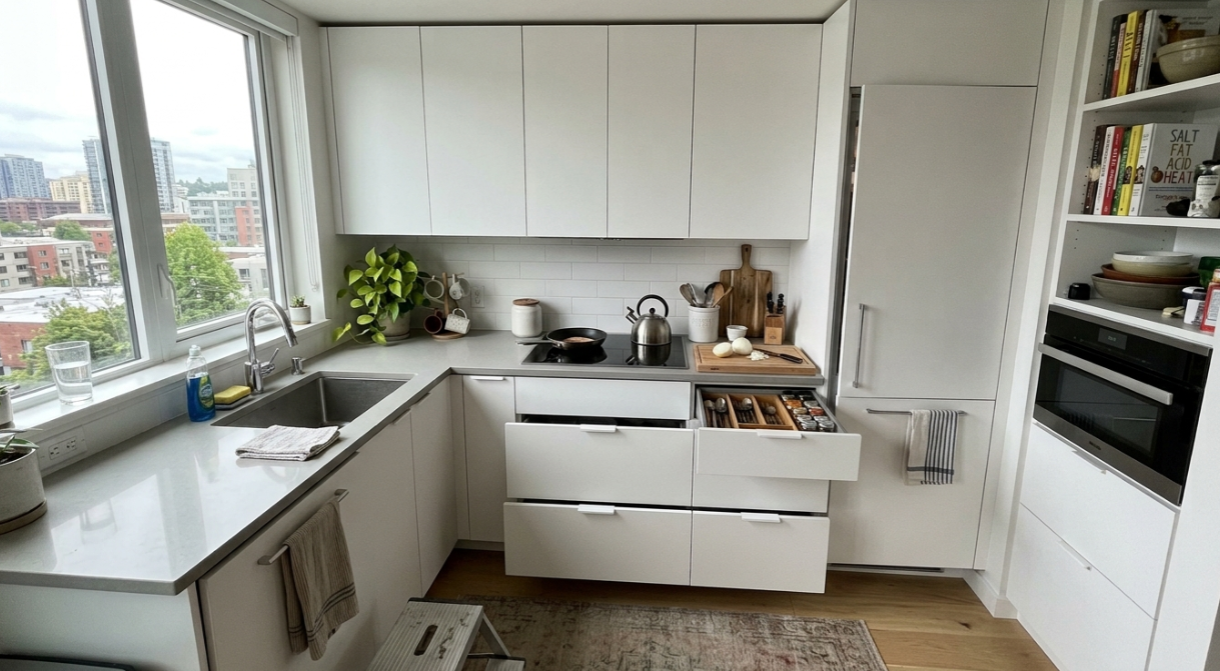
Frameless cabinets are the top pick for contractors working small kitchens in condos and apartments. By eliminating the face frame, these cabinets deliver up to 15% more usable drawer width than framed equivalents. Dura Supreme’s measurements put it concretely: a 15-inch wide four-drawer base in framed construction gives a 10.25-inch opening, while frameless gives 12 inches. In a kitchen with only 10 linear feet of cabinetry, that adds up to meaningful storage gains that clients notice.
Why contractors prefer them for small projects:
Full-overlay doors create a clean, modern look that photographs well for your portfolio
Wider interior openings mean fewer complaints about “not enough storage”
The seamless front minimizes visual clutter in tight layouts, which is a selling point when pitching to condo owners
Soft-close hardware (standard on Krafter’s Land’s frameless line) is what clients expect in 2026
Installation note: Frameless cabinets require more precise installation since there’s no face frame to mask alignment issues. Accurate field measurements are non-negotiable. Krafter’s Land provides measurement and assembly videos that reduce installer errors and support callbacks.
For a detailed comparison of construction types, read the framed vs. frameless cabinets guide.
Shaker-Style Cabinets
Shaker cabinets remain the volume leader for small kitchen remodels across Washington, and for good reason. They appeal to the broadest range of end clients, from first-time homebuyers to landlords upgrading rental units. Helen Parker of deVOL puts it simply: “The lack of ornamentation and simple, clean lines of Shaker cabinetry make it the smart choice in small spaces.”
Why dealers stock them:
Universal appeal means fewer client deliberation cycles and faster closes
Works in every layout: galley, L-shaped, one-wall, U-shaped
Available in both framed and frameless construction
Pairs with nearly any countertop material, simplifying the upsell to quartz or other surfaces
Trade consideration: Krafter’s Land carries both a standard Shaker and a Slim Shaker line. The Slim Shaker splits the difference between a traditional five-piece door and a modern flat panel, which gives you an option for clients who want “classic but not too traditional.” Having both lines from one supplier means fewer vendor relationships to manage.
For contractors working rental properties, where tenant appeal and durability both matter, see this cabinets for rental properties guide.
Slab/Flat-Panel Cabinets
Slab fronts are the default for modern condo kitchens in Seattle and Bellevue. With no panel profiles or frame lines, they create what GoldenHome describes as “a simple visual foundation” that “creates the illusion that a kitchen is bigger than it is.” For contractors staging spec units or working with designers on urban apartments, slab fronts photograph cleanly and appeal to younger buyers.
Project fit:
Handleless or recessed-handle versions eliminate protruding hardware that snags in narrow galley kitchens (a frequent client complaint)
Light-colored finishes amplify the space-expanding effect
Easy to clean, fewer callbacks about dirt collecting in door profiles
Glossy finishes show fingerprints, so matte or satin is the better recommendation for clients who don’t want to wipe cabinets daily
Floor-to-Ceiling (Tall) Cabinets
When horizontal wall space is extremely limited (common in Seattle studio conversions and older Tacoma bungalows), floor-to-ceiling cabinets capture vertical storage that standard 30-inch or 36-inch wall cabinets waste. For contractors, tall cabinets also mean more billable linear footage per project.
Sourcing note: Ceiling heights vary significantly in older Pacific Northwest homes. Accurate field measurements are critical before ordering tall cabinets, since off-by-an-inch errors mean visible gaps or cabinets that won’t fit. Krafter’s Land’s free design consultation can help verify dimensions before you commit to an order.
Planning resource: Follow the cabinet measuring guide to avoid costly reorders.
Corner Cabinets with Pull-Out Inserts
L-shaped and U-shaped small kitchens, common in WA single-family homes, waste 6 to 10 square feet of corner space without smart inserts. For contractors, poorly designed corners are a callback magnet. One renovation forum user admitted: “boy do I hate the corner cabinets,” and the frustration is almost always about corners without modern pull-out mechanisms.
Trade recommendation: Spec corner cabinets with lazy Susans, swing-out trays, or half-moon shelves from the start. The $100 to $300 per cabinet upcharge for pull-out hardware is far cheaper than a callback from a frustrated homeowner who can’t reach anything in the back. This is an easy upsell that clients genuinely appreciate.
Drawer-Base Units
Replacing traditional door-and-shelf lower cabinets with full-extension drawer bases is one of the highest-satisfaction upgrades for small kitchen clients. IKEA’s small-spaces research found that replacing even 50% of lower cabinets with drawers can increase usable storage by 30%.
Why contractors should push this option: Community consensus on Reddit and kitchen forums is overwhelming. “Lower drawers instead of cabinets! So much more functional” is one of the most repeated tips in small kitchen discussions. Clients who get drawer bases almost never complain about storage. Clients who get traditional lowers frequently do. Soft-close hardware is standard on Krafter’s Land’s lines, which one Reddit user called “non-negotiable” for any kitchen project in 2026.
Glass-Front Uppers
Glass-front doors are a selective upsell for higher-end small kitchen projects. They make walls appear to recede and add visual depth. The trade play is to suggest glass fronts on two or three upper cabinets flanking a window rather than across the entire run. This keeps the project price reasonable while giving clients a premium feel.
Two-Tone Cabinet Schemes
Two-tone cabinets remain a popular request from end clients in 2026. The most effective approach for small kitchens: light uppers with deeper-toned lowers. This grounds the room visually while keeping the upper portion open.
Dealer consideration: Stocking or sourcing two finishes from the same supplier simplifies logistics. Krafter’s Land’s Shaker and frameless lines are available in multiple finishes, so you can offer two-tone options without splitting the order across vendors.
For color coordination guidance, this matching quartz countertops with cabinets resource is useful for client presentations.
Open Shelving (Strategic Use Only)
Open shelving is a design trend that sounds better in theory than it works in practice. For trade professionals, the recommendation is simple: suggest one or two open shelf sections to break up a wall of cabinetry, but don’t replace enclosed storage with it. A designer’s warning holds true: “open shelving often gives the kitchen a messy look” if overfilled, and that reflects poorly on your finished project photos.
Cabinet Materials: Which Construction Holds Up Best?
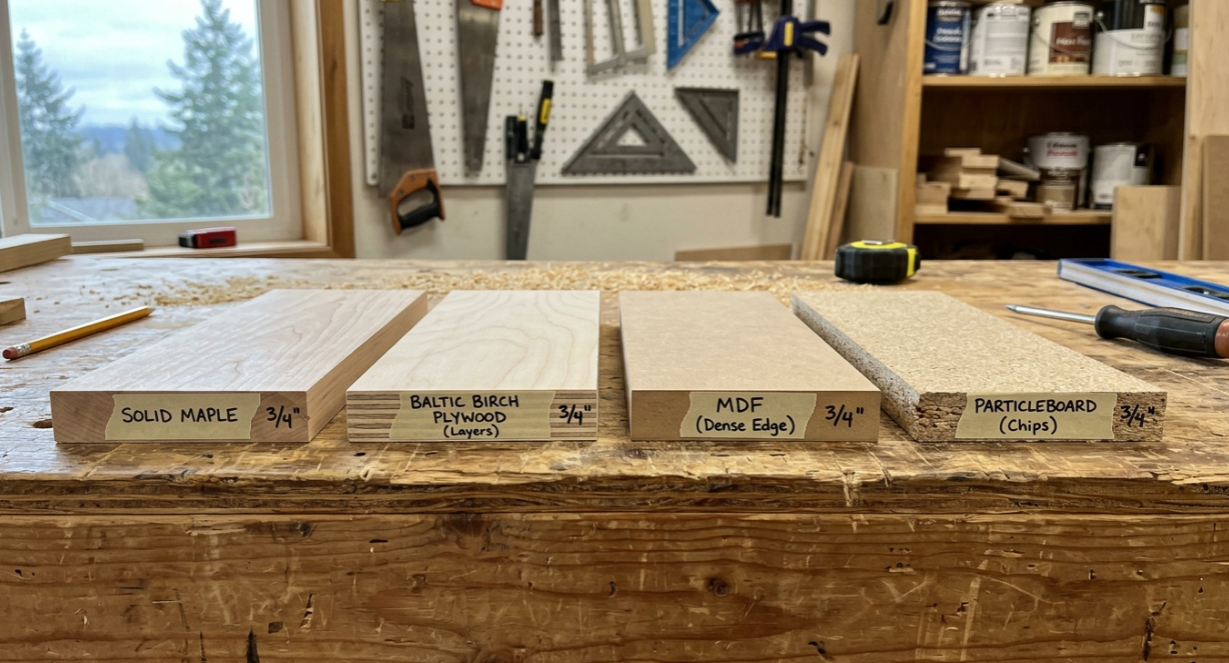
Cabinet materials directly affect durability, moisture resistance, and warranty claims.
Material | Durability | Moisture Resistance | Best For |
|---|---|---|---|
Particleboard | Low | Low | Budget rentals |
MDF | Moderate | Moderate | Painted cabinets |
Plywood | High | High | Long-term remodels |
Solid wood | Very high | Moderate | Premium projects |
For Washington projects, plywood boxes generally perform better because of the Pacific Northwest’s humidity and seasonal moisture fluctuations.
Contractors bidding rental properties can often reduce callbacks by upgrading cabinet boxes from particleboard to plywood.
Small Kitchen Cabinet Costs in Washington State (2026)
Cabinetry typically runs 30 to 40% of a total kitchen remodel budget. Here’s what to expect for a small kitchen with 10 to 15 linear feet of cabinetry:
Tier | Cost Per Linear Foot (Installed) | Small Kitchen Total (10–15 LF) |
|---|---|---|
Stock / RTA | $80–$150 | $1,200–$2,250 |
Semi-Custom | $150–$300 | $2,250–$4,500 |
Custom | $500–$800+ | $7,500–$12,000+ |
The 2026 Tariff Factor: What It Means for Your Bids
This is critical for anyone quoting projects right now. As of mid-2026, most imported kitchen cabinets carry a 25% Section 232 tariff that took effect in October 2025, scheduled to rise to 50% in January 2027. Many vendors have already implemented 5 to 8% preemptive price hikes. By early 2026, remodeling firms were reporting total cabinet cost increases in the 15 to 35% range.
What this means for contractors and dealers:
Build tariff-adjusted pricing into bids now, not after the client signs
Locking in pricing with a local, in-stock supplier like Krafter’s Land protects against mid-project price jumps
Sourcing from a WA-based warehouse with inventory on hand avoids the double hit of tariff increases plus extended import lead times
Communicate the pricing environment to clients early, it builds trust and reduces sticker shock at contract signing
For Washington-specific pricing data, check this kitchen cabinet cost guide.
Matching Cabinet Type to Layout: A Contractor’s Reference
Choosing small kitchen cabinets for a client project depends on the layout. Here’s the quick reference for trade professionals:
Galley (Two Parallel Walls)
Common in Seattle condos and older Tacoma apartments. Frameless cabinets are the go-to because every fraction of an inch of drawer width matters in a 42 to 48-inch corridor. Handleless or recessed-handle doors prevent snags. Drawer-base lowers are practically mandatory since crouching into deep shelves in a narrow corridor is a usability problem clients will bring up.
L-Shaped
The most versatile layout for small spaces and the most common in WA single-family homes. Corner cabinets with pull-out inserts are essential at the junction. Two-tone schemes work particularly well here.
One-Wall
Typical in studio conversions and ADUs (accessory dwelling units), which are booming across King County. With only 8 to 12 linear feet to work with, floor-to-ceiling cabinets are critical. Open shelving at the ends prevents the wall from feeling like a solid block.
U-Shaped
Less common in sub-100-square-foot kitchens but found in some older WA homes. Two corner junctions mean two corner cabinet specifications. Glass-front uppers on the back wall prevent a boxed-in feeling.
For help managing the full project timeline, see this phase-by-phase kitchen remodel guide.
Do Small Kitchen Cabinet Projects Require Permits in Washington?
Cabinet replacement alone usually doesn’t require a permit.
However, permits may be necessary when a project includes:
Electrical work
Plumbing relocation
Wall removal
Gas line modifications
Structural changes
Contractors should always verify requirements with local jurisdictions because permit requirements differ between Seattle, Bellevue, Tacoma, Spokane, and other municipalities.
How Contractors Estimate Small Kitchen Cabinet Projects
Most contractors estimate cabinets using linear footage.
Step 1: Measure the cabinet run.
Measure all wall lengths that will contain cabinetry.
Step 2: Calculate linear footage.
Add all cabinet wall lengths together.
Step 3: Choose the cabinet category.
Stock
RTA
Semi-custom
Custom
Step 4: Apply the cost multiplier.
Cabinet Type | Cost Per LF |
|---|---|
Stock | $80-$150 |
Semi-custom | $150-$300 |
Custom | $500-$800+ |
Step 5: Add contingency.
Most contractors include a 10-15% contingency for material increases and delivery changes.
Avoiding Common Mistakes on Small Kitchen Cabinet Projects
These are the issues that generate callbacks, blow timelines, and erode margins on small kitchen projects:
1. Poor field measurements. In a small kitchen, measurement errors of even half an inch mean cabinets that don’t fit, awkward filler strips, or doors that collide. This is especially problematic with floor-to-ceiling runs where ceiling height variation matters. Krafter’s Land provides measurement resources specifically to reduce these errors.
2. Specifying cheap cabinets to win a bid. In a small kitchen, clients interact with every cabinet dozens of times a day. Cheap particleboard boxes and flimsy hardware wear out fast, and the client blames the contractor. As one experienced practitioner on Reddit put it: “Get the best quality you can afford, plywood boxes and solid wood fronts with high-end closers, rollers and hardware. Our inexpensive stuff started to wear out day one.” Spec quality materials from the start. Your reputation depends on it.
3. Not coordinating trades around cabinet delivery. Cabinet installation in a small kitchen typically comes before countertop templating, backsplash, and flooring trim. With Krafter’s Land’s defined delivery terms (garage/first-floor drop), GCs need to plan upper-floor staging in advance. Know the delivery window, have the site prepped, and schedule plumbing and electrical rough-in ahead of cabinet arrival.
4. Ignoring client workflow in the design. Practitioners on Reddit recommend organizing storage into zones “based on how you actually use your space.” For trade pros, this means asking clients where they cook, prep, and clean before finalizing the cabinet layout. In a small kitchen, there’s no room for “we’ll figure it out later.”
5. Not showing cabinets in person before the client commits. Online photos can’t convey finish quality, color accuracy, or hardware feel. Direct clients to a cabinet showroom to compare options side by side. Krafter’s Land’s showrooms in Tukwila, Tacoma, Lynnwood, and Spokane are set up for exactly this kind of walk-through with clients.
For a broader list of project pitfalls, see this kitchen remodel mistakes guide.
Color and Finish Guidance for Client Presentations
Color choice matters more in a small kitchen than almost anywhere else. The general rule still holds: lighter colors make compact kitchens feel larger and more open. But the 2026 trend is shifting away from stark white toward warm neutrals (creamy off-white, light-stained wood, soft greige).
What’s selling in WA right now:
Light-stained wood finishes now rank as the most preferred cabinet finish nationally, with off-white in second
White Shaker remains the safe, universal choice for rental upgrades and spec homes
Blues are dominating accent color requests, especially saturated hues on lower cabinets paired with light uppers
Matte and satin finishes outsell high-gloss in small kitchens because they hide fingerprints better
For clients going with white or near-white cabinets who need countertop guidance, share this best quartz colors for white cabinets resource.
Small Kitchen Cabinet Trends in 2026
Several cabinet trends are influencing Washington remodeling projects.
Warm Neutrals
Bright white cabinets are giving way to cream, greige, mushroom, and light oak finishes.
Mixed Materials
Wood textures paired with quartz continue to gain popularity.
Hidden Storage
Appliance garages, pull-out spice racks, and integrated organizers are replacing traditional shelving.
Slim Shaker Doors
Slim Shaker cabinets continue to bridge the gap between traditional and modern aesthetics.
Soft-Close Hardware
Soft-close hinges and drawer glides have become standard expectations rather than premium upgrades.
Why WA Trade Professionals Source Small Kitchen Cabinets Locally
National online cabinet retailers offer low prices, but they create problems that eat into contractor margins:
Unpredictable lead times: 6 to 12 weeks is standard for shipped-to-site orders, and delays are common
Damage in transit: Cabinets shipped across the country arrive with dents, chips, and broken components at a far higher rate than locally warehoused product
No local support: When something arrives wrong, you’re dealing with a call center, not a person at a showroom 20 minutes away
No design support: You’re creating your own layouts and drawings rather than getting free 2020 Design files and 3D renderings
Sourcing from a local supplier with warehouse inventory in Washington eliminates these risks. Krafter’s Land’s 110,000+ square foot warehouse keeps stock on hand, and four showrooms across the state (Tukwila, Tacoma, Lynnwood, Spokane) give you a place to bring clients, compare finishes, and resolve issues face to face.
A Reddit thread discussing the Lynnwood area noted Krafter’s Land expanding into a larger showroom space, reflecting the demand for local cabinet sourcing in the region.
Conclusion
Small kitchen cabinet projects are bread-and-butter work for contractors, dealers, and remodelers across Washington State. The key to profitability isn’t finding exotic materials or complicated designs. It’s sourcing quality cabinets that are in stock locally, priced at wholesale, and available on timelines that keep your crew moving to the next job.
Frameless European cabinets for maximum storage efficiency. Shaker and Slim Shaker lines for broad client appeal. Drawer-base units and corner inserts to prevent post-install complaints. Floor-to-ceiling runs to maximize billable footage in tight layouts. All available from a single WA-based supplier with defined lead times and trade-only pricing.
Explore Krafter’s Land’s full cabinet lineup or visit a showroom in Tukwila, Tacoma, Lynnwood, or Spokane. Request trade pricing and a free design consultation with 3D renderings for your next small kitchen project.
Frequently Asked Questions
What size qualifies as a small kitchen for bidding purposes?
The NKBA defines a small kitchen as 70 or more square feet, with the 10×10 (100 square foot) layout widely considered the industry benchmark. Most condo and apartment kitchens in the Seattle metro fall between 70 and 150 square feet. If the project has 10 to 15 linear feet of cabinetry, it qualifies as a small kitchen scope.
Are frameless cabinets better than framed for small kitchen projects?
For storage efficiency, yes. Frameless cabinets provide up to 15% more usable drawer width because there’s no face frame reducing the interior opening. In a kitchen with only 10 linear feet of cabinetry, that extra space translates to measurably more storage, which matters when clients inevitably complain about capacity. The tradeoff is that frameless requires more precise installation.
How much should I bid for cabinets on a small kitchen in 2026?
Stock and RTA cabinets for 10 to 15 linear feet run $1,200 to $2,250 installed. Semi-custom ranges from $2,250 to $4,500, and fully custom runs $7,500 to $12,000+. Factor in 2026 tariffs on imported cabinets (currently 25%, rising to 50% in January 2027), which have pushed material costs up 15 to 35% over the past year. Build this into your quotes now.
Does Krafter’s Land sell direct to homeowners?
No. Krafter’s Land sells exclusively through authorized retailers, licensed contractors, dealers, designers, and builders. This protects trade partner margins and prevents direct-to-consumer price undercutting. Homeowners work with a trade partner to purchase. Pricing is login-gated for authorized accounts.
What are the lead times for small kitchen cabinets at Krafter’s Land?
The frameless European line is available for next-day RTA (unassembled) pickup from the WA warehouse. Assembly service takes approximately one week. Full installation runs roughly two weeks. These timelines are significantly faster than special-order brands, which typically require 6 to 12 weeks for delivery alone.
Can I source countertops, flooring, and other materials from the same supplier?
Yes. Krafter’s Land carries quartz countertops (prefab and jumbo slabs), SPC/LSPC flooring, porcelain tile, shower doors, closet systems, sinks, faucets, and accessories. Consolidating sourcing to one supplier means one PO, one delivery coordination point, and one relationship to manage, which simplifies small kitchen projects where margins depend on efficiency.
What warranty coverage do Krafter’s Land cabinets carry?
Cabinets and closets carry a 5-year limited warranty. Quartz countertops carry a 15-year limited warranty. All composite wood products are CARB Phase 2 and EPA TSCA Title VI compliant, which provides the documentation you need for permitting and indoor air quality compliance.
Where are Krafter’s Land showrooms located?
Showrooms operate in Tukwila (Seattle metro), Tacoma, Lynnwood, and Spokane, Washington. Total showroom space exceeds 20,000 square feet across the four locations. Showrooms are set up for trade partner walk-throughs and client meetings where you can compare cabinet styles, finishes, and hardware in person.