TL;DR
Quartz countertops are the strongest default choice for mid-range and premium rental property renovations. They combine tenant appeal with zero sealing, reliable stain resistance, and repeatable specs across multi-unit turns. Granite beats quartz when hot pan abuse is the primary concern. Laminate remains a legitimate strategy for budget rentals where fast, cheap replacement matters more than rent premiums. For contractors, remodelers, and property managers in Washington State, sourcing quartz alongside cabinets, flooring, and fixtures from a single regional supplier like Krafter’s Land cuts lead times and consolidates purchase orders, which matters when vacancy days eat into your client’s returns.
If you’re renovating a rental property, quartz countertops are the best overall choice for most Class B and Class A rentals because they require no sealing, resist stains, appeal to tenants, and are easy to standardize across multiple units. Granite is a better option only if tenant heat damage is your biggest concern, while laminate remains the smartest budget choice for Class C rentals where replacement cost matters more than appearance. For most landlords and contractors, quartz countertops in a rental property provide the best balance of durability, maintenance, and long-term value.
Quartz Countertops for Rental Properties: Pros and Cons
| Pros | Cons |
|---|---|
| No sealing required | Hot pans can damage resin |
| Highly stain resistant | More expensive than laminate |
| Modern appearance attracts tenants | Edge chipping possible |
| Consistent colors across multiple units | Heavy installation |
| Easy to clean | Difficult to repair once burned |
| Strong resale appeal | Requires professional fabrication |
Quick Answer: Are Quartz Countertops Worth It for Rental Property?
Rental kitchens take different punishment than owner occupied kitchens. Tenants may skip trivets, use harsh cleaners, cut directly on surfaces, and delay reporting sink leaks. That reality shapes which countertop material you should spec for your clients.
Quartz countertops work well in most mid-range and premium rental properties. They look modern, never need sealing, resist ordinary stains, and photograph well for listings. But quartz is not the universal answer. Direct heat from pans can scorch the resin binder, edges can chip, and the upfront cost may not pencil for every unit. Practitioners on Reddit split sharply on this. One landlord reports quartz in four rentals with no issues, while others prefer granite because a single hot pan can permanently damage quartz.
The short version by rental class:
- Class A or premium single family: Quartz or granite. Tenants expect stone.
- Class B or B+: Quartz is usually the best fit. Granite works too.
- Class C or budget: Laminate. Cheap, fast, replaceable.
- Short term rental: Quartz or granite for photos and guest expectations.
- Multifamily value add: Quartz, especially 2cm or prefab, for speed and repeatability across units.
- Apartments and condos: Quartz is increasingly the standard, with specific considerations for unit size, HOA rules, and building logistics (more on this below).
Countertop decisions almost always happen alongside cabinets, sinks, faucets, and flooring. Contractors and property managers running rental turns in Washington can browse countertop options and related products through Krafter’s Land’s dealer channel, with showrooms in Tukwila, Tacoma, Lynnwood, and Spokane.
Why Quartz Has Become the Standard for Modern Rental Renovations
Over the last decade, quartz has largely replaced laminate and entry level granite in many renovated rental properties. National apartment renovations, build to rent communities, and property investors increasingly specify quartz countertops for rental property kitchens because the material offers predictable appearance, minimal maintenance, and consistent manufacturing.
Unlike natural stone, engineered quartz provides nearly identical slabs across multiple installations, making future unit renovations easier to match.
For landlords managing dozens of units, standardized colors simplify replacement orders while helping every renovated kitchen maintain a consistent appearance. When property managers ask whether quartz countertops in a rental property justify the cost, the answer usually comes down to how many units share the same spec and how long the hold period is.
Although quartz costs more than laminate upfront, many investors view it as a long term operational decision rather than simply a cosmetic upgrade.
Quartz Countertops for Apartments and Condo Units
Apartments and condos present unique challenges that make quartz both especially attractive and slightly more complicated to install than in single family rentals. The material itself is the same, but the logistics, approval processes, and design constraints differ enough to warrant separate consideration.
Why Quartz Works Well in Apartment and Condo Settings
Smaller kitchen footprints in apartments and condos actually make quartz more affordable per unit. A typical apartment kitchen might have 20 to 30 square feet of counter space compared to 40 or more in a single family home. At $50 to $100 per square foot installed, that means a quartz upgrade for a small apartment kitchen can run $1,000 to $3,000, a range where the cost difference over laminate shrinks enough that quartz becomes an easy financial call.
Practitioners on Reddit who manage apartment portfolios report that quartz is now expected by tenants in Class A and B apartment buildings, especially in competitive urban markets. One property manager noted that listing photos with quartz countertops consistently generate more inquiries than units with laminate, even when the rent difference is minimal.
The consistency advantage matters even more in apartment and condo settings than in scattered site rentals. When renovating 10 or 50 units in a single building, ordering the same quartz color and edge profile for every kitchen creates visual uniformity that simplifies maintenance, speeds up turns, and makes partial replacements easier if a single unit gets damaged.
Apartment and Condo Specific Considerations
HOA and building rules. Many condo associations require board approval for renovations, including countertop replacement. Some buildings restrict construction hours, require contractor insurance certificates, and mandate use of the freight elevator. Check the CC&Rs before speccing materials.
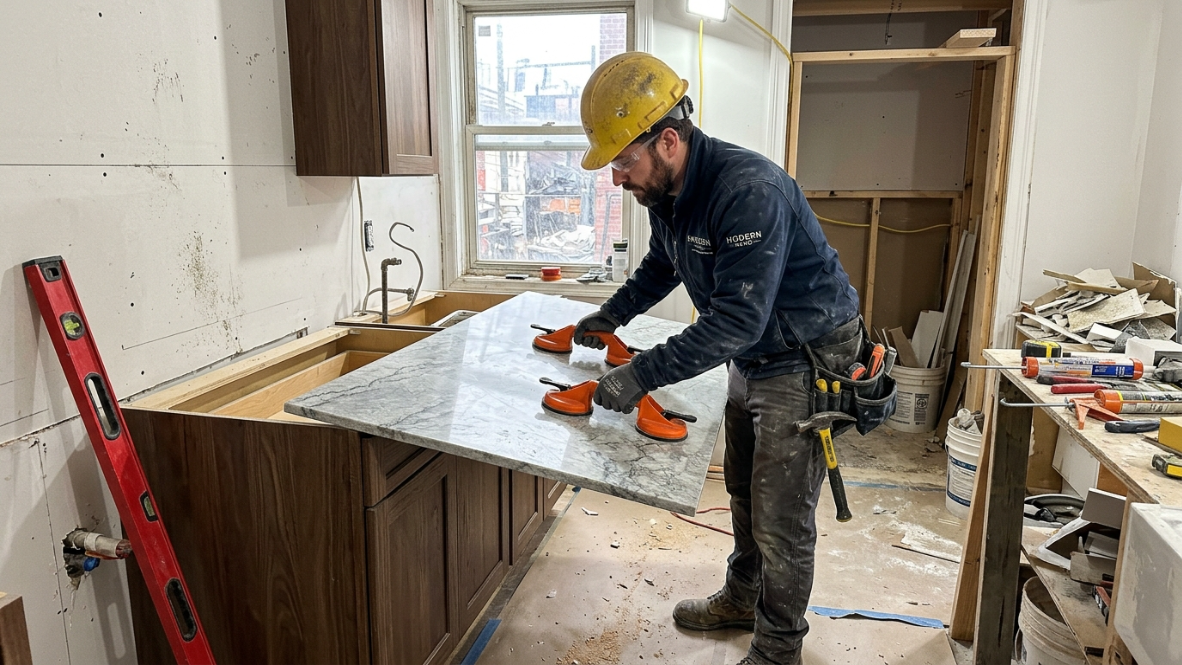
Delivery logistics. Quartz slabs are heavy. A standard kitchen countertop can weigh 300 to 500 pounds. In apartment buildings, this means elevator capacity matters. Buildings with no freight elevator or narrow stairwells may require cutting slabs into more sections, which adds seams and fabrication cost. Krafter’s Land delivers first floor or garage drop, so for upper floor apartment installs, the contractor’s crew handles staging and transport to the unit.
Noise and dust during fabrication. In multifamily buildings, cutting and fitting quartz on site generates noise that affects neighboring units. Most fabrication happens off site at the shop, but on site trimming and fitting still occurs. Coordinate install days with building management.
Smaller layouts favor prefab. Apartment kitchens with standard L shaped or galley layouts are often a strong fit for prefab quartz, which costs less than custom slab fabrication. Standard prefab sizes cover many apartment kitchen configurations without custom cutting. For more on the cost and format differences, see this guide on prefab vs slab quartz.
Undermount sinks in apartments. Undermount sinks pair well with quartz in apartments because they make small counters feel larger and are easier to clean. But undermount installation requires a solid countertop material (quartz qualifies, laminate does not), so upgrading to quartz sometimes enables a sink upgrade too.
Condo Investor Considerations
For condo investors, quartz countertops serve double duty in a rental property. They attract better tenants during the rental hold period, and they add resale value if the owner decides to sell. Quartz is now a baseline expectation in many condo resale markets, not a differentiator. Skipping it can actually hurt resale value in buildings where other units have already been updated.
One BiggerPockets investor shared that they install quartz in every condo unit they purchase because the rent premium covers the cost within two years, and the countertops still look good when it is time to sell. The math works better in condos than in single family homes because the kitchen square footage (and therefore the quartz cost) is smaller.
When renovating a condo kitchen, consider the full scope. If cabinets also need replacing, bundling them with countertops from a single supplier reduces coordination headaches and keeps the project timeline tight. Understanding kitchen cabinet costs in Washington helps budget the complete renovation accurately.
At a Glance: Rental Countertop Comparison
| Material | Typical Installed Cost | Best For | Main Strength | Main Rental Risk | Sealing Needed? |
|---|---|---|---|---|---|
| Krafter’s Land Quartz | Dealer/contractor pricing (login gated) | WA contractors & property managers needing fast turn quartz + one stop kitchen sourcing | 15 year warranty, in stock regional warehouse, bundled cabinets/flooring/counters | Dealer only purchasing, first floor delivery | No |
| Quartz | $50 to $200/sq ft | Mid range, premium, value add | No sealing, strong tenant appeal | Hot pan scorching, edge chips | No |
| Granite | $40 to $200/sq ft | Heat abuse prone rentals | Heat resistance, natural stone look | Porosity, staining, sealing upkeep | Often yes |
| Laminate | $10 to $55/sq ft | Budget rentals, fast turns | Lowest cost, easy replacement | Burns, water swelling, lower appeal | No |
| Solid Surface | $70 to $130/sq ft | Repairability focused rentals | Scratches can be sanded out | Heat damage, scratching, less excitement | No |
| Butcher Block | $10 to $38/sq ft | Design accents, STRs | Warm look, low material cost | Water, burns, tenant neglect | No (but needs oiling) |
| Porcelain / Sintered | $17 to $70/sq ft | Premium heat resistant installs | Heat and stain resistance | Fabrication complexity, edge chips | No |
| Tile | $1 to $15/sq ft | Ultra budget, retro style | Cheapest material option | Grout stains, cracks, uneven surface | Grout sealing |
Pricing signals drawn from Angi, HomeAdvisor, and Fixr. Actual costs vary by region, kitchen layout, slab selection, and fabricator.
1. Krafter’s Land Quartz Countertops
Best for: Contractors, remodelers, builders, and property managers in Washington State running rental kitchen turns who need in stock quartz with short lead times and one stop sourcing.
Krafter’s Land Cabinetry Inc. is a Washington based supplier offering prefab and jumbo quartz slabs exclusively through authorized dealers and licensed contractors. The dealer only model protects your pricing and margins, which matters when you are bidding multi unit rental renovations or competing against other trade partners in the Seattle metro and Spokane markets.
For trade professionals managing rental property rehabs, consolidating quartz, cabinets, sinks, faucets, flooring, and tile under a single PO eliminates the coordination headaches of juggling multiple vendors and delivery schedules. When your client’s vacancy clock is running, that consolidation translates directly into faster project turnover.
Trade Ordering & Lead Times:
- Dealer and contractor pricing accessed through login gated accounts (register as a dealer)
- Prefab and jumbo slab quartz formats available for standard and custom kitchen layouts
- Large regional warehouse (110,000+ sq ft) supports in stock availability across quartz, cabinets, and flooring
- Frameless cabinet line offers next day pickup (unassembled), one week assembly, and approximately two week installation windows
- Free design and quotes with 2020 Design file compatibility reduce pre sales friction and speed client approvals
- 3D renderings available to help property managers and landlord clients visualize finished kitchens before committing
- Delivery terms: first floor or garage drop, with clear scheduling expectations for GC coordination
Key Specs & Warranty:
- 15 year limited warranty on quartz countertops
- 5 year limited warranty on cabinets and closets
- CARB Phase 2 and EPA TSCA Title VI compliant materials across cabinet and closet lines (supports permitting and IAQ documentation)
- Prefab and jumbo slab formats for standard and custom kitchen layouts
Showroom Locations for Walk Throughs & Client Meetings:
- Tukwila (Seattle metro)
- Tacoma
- Lynnwood
- Spokane
Bringing a landlord or property owner client to a showroom to see and touch materials speeds up approvals and reduces change orders. The 20,000 sq ft combined showroom footprint gives you enough variety to finalize specs in a single visit.
Tradeoffs:
- No direct to homeowner sales. All purchases route through authorized dealers or licensed contractors.
- Login gated pricing means your clients cannot casually price compare online, which protects your margins but requires you to manage quoting.
- Delivery is first floor or garage drop only. Upper floor unit installs require your crew to handle material staging.
- Installation scope excludes plumbing and electrical. Plan GC coordination for disconnect/reconnect.
What practitioners say:
Practitioners on Reddit have noted Krafter’s Land expanding its showroom footprint in Washington, including a Lynnwood location. The dealer first model appeals to remodelers and property managers running multiple rental turns because it prevents clients from undercutting contractor pricing. Consolidating cabinet, countertop, and flooring orders through one supplier also reduces the vendor management overhead that eats into project margins on multi unit jobs.
For contractors and property managers planning rental kitchen upgrades in the Seattle metro, Tacoma, Lynnwood, or Spokane areas: browse countertop and cabinet options, request a free quote, or register as a dealer to access trade pricing and 2020 Design files.
2. Quartz Countertops (General)
Best for: Mid range and premium rental turns that need no seal counters, strong listing photos, and repeatable specs across multiple units.
Quartz is the best default countertop for rental properties above budget tier. It gives a premium look without annual sealing, handles most tenant behavior well, and can be standardized across a portfolio with repeatable colors and patterns, which simplifies re ordering and client expectations when you are managing ongoing renovation work.
Pricing:
- Average quartz countertop project runs about $4,500 nationally
- Typical range: $50 to $200 per square foot installed
- Builder grade quartz starts around $50 to $60 per square foot
- Many mid range projects land between $70 and $100 per square foot
Key features:
- Nonporous surface, no sealing required
- Consistent color and pattern from slab to slab (critical for multi unit specs)
- Marble look designs without marble maintenance
- Strong resistance to coffee, wine, and common kitchen stains
- Modern visual appeal that photographs well for listings
- Standardizable specs across a portfolio of rental units
Tradeoffs and limitations:
- Not heat proof. The resin binder can only withstand about 150°F, and direct hot pans can permanently scorch or discolor the surface. Caesarstone’s own care guide warns against placing hot cookware directly on quartz.
- Can chip at exposed edges or around sink cutouts
- Expensive for large kitchens needing multiple slabs, complex cutouts, or significant cabinet prep
- Fabrication creates respirable silica dust that must be controlled for worker safety
What practitioners say:
Landlords on Reddit consistently praise quartz countertops for rental property use but split on the heat issue. One landlord wrote that entry level quartz stands up well to renters, while another said their installer specifically recommended granite over quartz because tenants will set hot pans down without thinking. Rental Housing Journal reports that many property management companies are shifting toward 2cm quartz for rental units because tenant expectations for the look are becoming prominent and fabrication can be faster than older laminate processes.
A LinkedIn practitioner in multifamily development noted that 2026 value add renovation specs often follow the same playbook: quartz countertops, LVP flooring, LED lighting, updated vanities, and modern hardware. The competitive edge, they argued, comes from controlling the cost basis, not just choosing the trendy material. For contractors, this means building reliable supplier relationships that keep material costs predictable across multiple project bids.
Include a move in care sheet in every handoff package for the property manager: no hot pans, no cutting directly on the surface, no bleach or oven cleaner, and report sink leaks immediately. Krafter’s Land offers quartz countertops backed by a 15 year limited warranty, providing post install assurance that simplifies your callback risk on long hold rental investments.
3. Granite
Best for: Rentals where tenants are likely to put hot pans directly on the counter.
Granite is the better stone choice when your client’s main fear is heat damage rather than sealing. It handles direct hot cookware far better than quartz, and dark, patterned slabs hide everyday wear effectively.
Pricing:
- $40 to $200 per square foot installed, depending on stone type and complexity
- Entry level slabs and remnants can bring costs close to mid range quartz
- In small kitchens, the premium over laminate can be just $500 to $1,000
Key features:
- Strong heat resistance compared with quartz and laminate
- Natural stone look with perceived high value
- Long lifespan, often 20+ years
- Many affordable entry level slab options
- Dark, patterned colors camouflage chips and wear
Tradeoffs and limitations:
- Many granites need periodic sealing or at least stain risk checks. The Natural Stone Institute notes that sealing makes stone more stain resistant, not stain proof.
- Natural slab variation makes repeat specs across multiple units harder to maintain
- Can chip at sink edges and corners, same as quartz
- Some lighter, more porous stones stain easily if not sealed properly
What practitioners say:
Reddit landlords repeatedly recommend dark granite for rentals because hot pans are less scary than with quartz and because dark chips are less visible. One landlord reported their dark granite still looked good after 10 years, adding that their installer specifically recommended granite over quartz for tenant occupied units. A BiggerPockets investor with 19 years of experience said the choice depends on local comps and kitchen size: they use tier 1 granite or quartz in small kitchens where the premium is only $500 to $1,000 more, but stick with quality custom laminate in bigger kitchens where stone does not pencil.
Granite is the safer stone when your client does not trust tenants with heat. Spec darker, patterned, common stones over light, porous varieties. Build sealing or inspection into the annual property walkthrough schedule. For a deeper side by side, see this quartz vs granite comparison.
4. Laminate
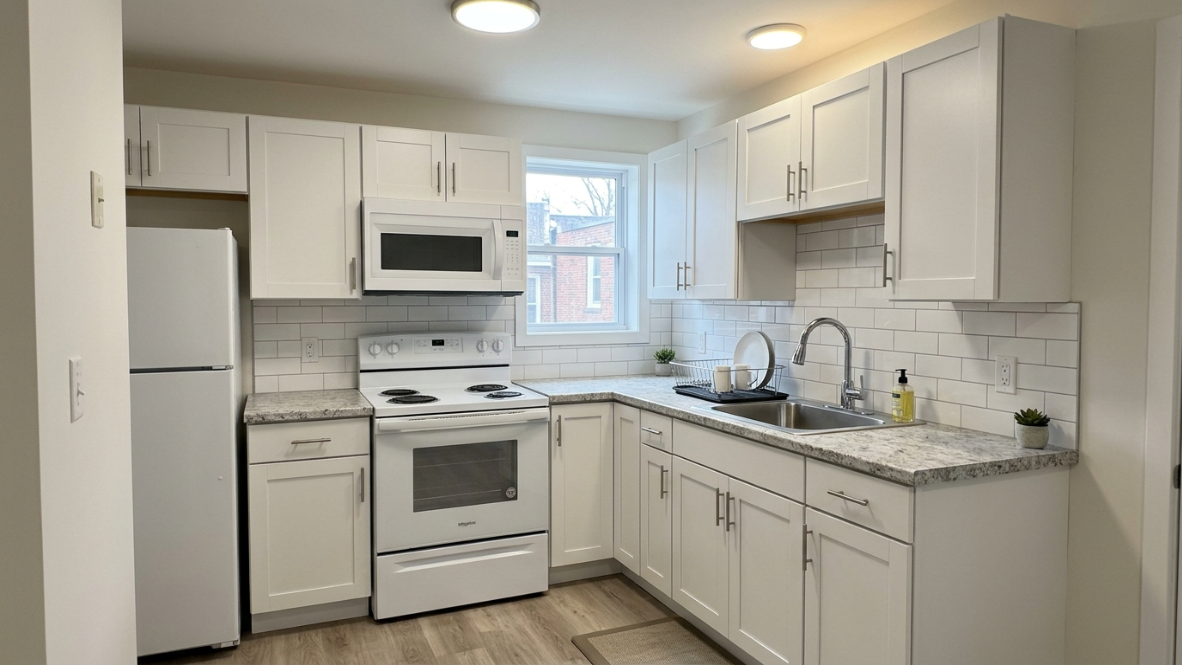
Best for: Budget rentals and fast tenant turns where upfront cost matters most.
Laminate is not “bad.” It is a budget strategy. When the cabinets are old, the rent ceiling is low, and competing rentals do not advertise stone, laminate is the rational spec. For contractors running high volume turns on Class C properties, laminate keeps project costs tight and timelines short.
Pricing:
- Average installed cost about $1,251, with a typical range of $841 to $1,748
- Average around $35 per square foot installed
- Standard material runs $10 to $18 per square foot
- High durability coatings push to $20 to $55 per square foot
Source: HomeAdvisor laminate pricing
Key features:
- Lowest upfront cost among common countertop materials
- Widely available, fast to source
- Modern patterns can mimic stone convincingly
- Easy to replace entirely between tenants
- More DIY friendly than slab stone
Tradeoffs and limitations:
- Burns from hot pans or appliances
- Cuts and scratches from knives
- Water can penetrate seams and swell the particleboard substrate. Formica’s care guide warns against flooding near seams.
- Lower perceived value in markets where competing rentals have stone
What practitioners say:
The most popular reply in a BiggerPockets thread recommends off the shelf Formica because it is cheap, DIY friendly, and can last 10 to 15 years in some rentals. Nexus Property Management, which manages over 1,200 units, also recommends laminate for many rental properties because it is inexpensive, available, and replacement cost is low. On the other side, Reddit landlords report laminate getting destroyed by burns, cuts, and moisture at seams.
Use quality laminate, not the cheapest thin stock top. Avoid it when local competing rentals advertise stone. If the cabinets themselves need replacing during a turn, check whether RTA cabinets are worth it for faster, lower cost renovation cycles. Krafter’s Land’s frameless cabinet line offers next day pickup (unassembled), letting you pair new laminate with new cabinets on a compressed timeline.
5. Solid Surface
Best for: Rentals where on site scratch and damage repair outweighs stone appeal.
Solid surface (Corian and similar brands) is the maintenance manager’s material. Scratches can be sanded out on site, the surface is nonporous, and the color runs all the way through. It does not generate the same tenant excitement as quartz or granite, but it may last longer with less replacement cost.
Pricing:
- $70 to $130 per square foot installed
- Kitchen range: roughly $2,100 to $5,200 for about 30 square feet of counter space
Key features:
- Nonporous, no sealing required
- Scratches and some damage can be sanded and renewed
- Seamless appearance possible with integral sinks
- Color runs through the full material thickness, not just a printed surface layer
Tradeoffs and limitations:
- Scratches more easily than quartz or granite during daily use
- Burns or melts with high heat, similar to laminate
- May not attract tenants the way stone surfaces do
- Larger damage may need professional refinishing
What practitioners say:
Reddit landlords report Corian surviving 20 years and multiple tenants, with one noting that white Corian is easy to clean and “bring back to life.” A BiggerPockets investor found Corian nice for repairability but more expensive than granite in their market, with less tenant appeal. Corian’s own care documentation confirms many scratches, cuts, and chemical damage can usually be repaired on site, though they still recommend minimizing direct heat exposure.
Solid surface is worth considering for bathrooms, vanities, and kitchens where the property owner values renewability over premium stone perception. It will not command the same tenant excitement as quartz, but it may outlast quartz in a high abuse environment because damage is fixable.
6. Butcher Block
Best for: Short term rentals or design accents where the owner controls maintenance.
Butcher block photographs well but creates real problems in long term rentals. Tenants rarely oil surfaces every six months, water rings form around sinks, and burns accumulate. The warm, natural aesthetic fades quickly without active upkeep.
Pricing:
- Material cost: $10 to $35 per square foot (butcher block), $18 to $38 per square foot (solid wood)
- Oiling every six months is effectively required
- Installed cost can approach cheap granite once labor, finishing, and sink work are included
Key features:
- Warm, natural appearance
- Can be sanded and refinished multiple times
- Low material cost in some markets
- Works well as an accent island paired with stone perimeter counters
Tradeoffs and limitations:
- Water damage around sinks is common and can be severe
- Burns and staining accumulate without trivets and cutting boards
- Maintenance burden falls on tenants who rarely accept it
- Can cost as much as entry level granite once properly installed
What practitioners say:
A BiggerPockets investor bluntly noted that butcher block can be as expensive as cheap granite and most tenants will not appreciate or care for it. Nexus Property Management calls wood impractical for rentals because it must be protected from water and deteriorates quickly without maintenance.
Avoid butcher block as the primary counter in long term rentals unless your client accepts refinishing between tenants. If speccing it, limit it to a small island or decorative accent where water exposure is minimal.
7. Porcelain and Sintered Stone
Best for: Premium rentals demanding both heat resistance and a modern slab aesthetic.
Porcelain slab countertops and sintered stone products (like Neolith or Dekton) solve the heat problem quartz has. They handle direct hot cookware, resist stains, and offer a modern large format look. The tradeoff is fabrication complexity and limited fabricator availability, especially outside major metro areas.
Pricing:
- Compact stone products: roughly $17 to $70 per square foot for material
- Slab formats cost more than tile formats and require skilled fabrication
- Labor costs can be higher than quartz because fewer fabricators specialize in these materials
Key features:
- Strong heat and stain resistance
- Modern, large format slab appearance
- UV resistance can be better than some quartz products
- Good for high end design
Tradeoffs and limitations:
- Requires specialized fabrication and edge detailing
- Brittle edge or chip concerns depending on product thickness
- Higher labor skill requirement limits fabricator availability
- Less familiar to many tenants and property owners, which can reduce the “wow” factor
What practitioners say:
Reddit discussions mention porcelain as potentially “indestructible,” but opinions on niche materials like Dekton remain mixed enough that contractors should not default to these for standard rental turns. They are promising for premium applications where a skilled local fabricator is available.
Porcelain solves the heat problem but can create a fabrication and edge detail problem if the installer is not experienced. This is a premium option, not a budget one.
8. Tile
Best for: Ultra budget renovations or retro style units with grout maintenance capacity.
Tile countertops are cheap as a material but create an ongoing grout maintenance problem. In modern rentals, they tend to signal a dated kitchen. In retro or vintage units, they can fit the character. For most rental property projects, tile is not the best modern countertop spec.
Pricing:
- Ceramic tile material: $1 to $15 per square foot
- Labor can erase material savings if professionally installed
- Grout maintenance adds ongoing cost and effort
Key features:
- Lowest material cost
- DIY friendly installation
- Heat resistant tile surface (though grout is not)
- Individual broken tiles can be replaced
Tradeoffs and limitations:
- Grout stains, cracks, and harbors bacteria over time
- Uneven surface makes daily use less convenient
- Lower tenant appeal in most modern rental markets
- Professional labor costs reduce the material savings advantage
What practitioners say:
BiggerPockets users describe large format tile as potentially viable but labor intensive, lower value than stone, and eventually needing grout maintenance. For most rentals today, tile is not competitive with laminate on cost or quartz on appeal.
Tile is cheap as a material, but grout is the property manager’s long term problem. Reserve it for ultra budget situations or units where the style fits.
What Actually Damages Quartz Countertops in a Rental Property?
Many landlords assume quartz is indestructible. It isn’t.
The most common causes of damage to quartz countertops in rental property kitchens include:
- Placing hot frying pans directly on the surface
- Dropping cast iron cookware on exposed edges
- Standing on countertops during cabinet work
- Harsh chemical cleaners
- Leaking sink plumbing that weakens cabinet support
- Impacts near sink cutouts
- Dragging heavy appliances across the surface
Most warranty claims come from installation problems or misuse rather than manufacturing defects.
Teaching tenants proper countertop care often prevents far more damage than choosing a different countertop material. Avoiding common kitchen remodel mistakes during installation also reduces the risk of problems showing up after tenants move in.
How to Decide: Rental Class, Local Comps, and Payback
The best rental property countertop is not universal. It depends on the math, the market, and the tenants. Houzz users repeatedly advise looking at comparable rentals in the local market and judging the kitchen as a whole, not obsessing over one material. For contractors and property managers in Washington, this means checking what competing listings in the Seattle metro, Tacoma, and Spokane markets are advertising.
The Rental Countertop Decision Matrix
Spec quartz countertops for a rental property if:
- Competing rentals in the area advertise quartz or stone counters
- The unit is Class B or above
- Your client wants a no sealing surface with minimal maintenance
- The kitchen is small enough that stone cost is manageable
- You want repeatable colors across multiple units in a portfolio
- The countertop is part of a larger value add kitchen package (cabinets, flooring, fixtures) that can be sourced from a single supplier
Spec granite if:
- Tenants are likely to put hot pans directly on counters
- Your client prefers natural stone and can manage periodic sealing
- You can choose a darker, less porous, patterned stone
- You found an affordable remnant or entry level slab
Spec laminate if:
- The rental is budget tier with low rent upside
- Cabinets are old and may be replaced soon
- Vacancy time matters more than long term finish value
- Local comps do not require stone
Spec solid surface if:
- Repairability matters more than luxury perception
- The focus is bathrooms or smaller counters
- The client wants nonporous without the stone price tag
Avoid butcher block in long term rentals unless your client accepts refinishing between tenants and limits it to low moisture areas.
Simple Quartz Payback Formula
This formula helps property managers and landlords evaluate whether quartz countertops in a rental property will pay for themselves. Contractors who can walk clients through this math close more stone upgrades:
Payback period in months = incremental quartz cost / monthly rent premium or savings
Example:
- Laminate installed cost: $1,250
- Quartz installed cost: $2,500
- Incremental quartz cost: $1,250
- If quartz helps justify $50 more per month (or avoids equivalent vacancy or maintenance cost): $1,250 / $50 = 25 months
Rental Housing Journal cites average quartz countertop replacement costs of $2,000 to $2,500 per unit in rental housing, while HomeAdvisor puts laminate projects around $1,251. These are national signals, not a substitute for a local quote, but they support a useful incremental cost approach.
Beyond rent premiums, quartz can also pay back through faster lease up, better listing photos, fewer countertop replacements over the hold period, and lower owner stress during turns. But do not promise a specific rent bump without checking local comps. Renters still prioritize price, location, and in unit features like washer/dryer access above kitchen finishes.
Cost conscious projects should also compare prefab vs slab quartz to find the format that fits the kitchen size and budget.
See how quartz, cabinets, and other finishes come together in real projects in the Krafter’s Land gallery.
Best Quartz Specs for Rental Properties
Choosing quartz countertops for a rental property is only half the decision. The specific color, edge, backsplash, and sink details determine whether the countertop stays looking good across multiple tenants or becomes a callback headache.
Colors That Hold Up
Stick with classic, neutral, lightly patterned quartz:
- Light gray
- Warm white with subtle veining
- Beige or greige tones
- Soft marble look quartz with moderate movement
- Mid tone patterns that hide small marks
Avoid pure white with no movement in rough rental environments. Also avoid very dark polished quartz if fingerprints and dust visibility will frustrate tenants or property managers. Skip highly trendy dramatic veining if the unit needs to stay current for 10 or more years. When speccing across multiple units, pick a color that your supplier reliably stocks. For ideas on pairing countertop colors with cabinetry, check this guide on how to match quartz countertops with cabinets.
Edge Profiles
Simple edges survive rentals better and reduce chip related callbacks:
- Eased edge or small radius: the safest choice, hardest to chip visibly
- Simple square with softened corner: clean look, minimal chip risk
- Avoid ornate ogee or decorative edges: chips are more visible and repairs are costlier
Backsplash
A 4 inch quartz backsplash provides water protection at the countertop to wall joint and simplifies cleaning. Reddit landlords mention that a quartz top plus a 4 inch quartz splash shows well and reduces maintenance at that transition point. Pair with tile backsplash above if the unit needs a higher design impression. Krafter’s Land carries porcelain tile alongside quartz, so contractors can source both in a single order.
Sink and Faucet Details
- Spec a common sink size for easier future replacement
- Avoid fragile specialty fixtures
- Make sure sink cutouts and overhangs are properly supported (unsupported overhangs are a chip risk and a callback source)
- Photograph sink edges and seams at install completion to document condition for the property manager’s records
Tenant Countertop Care Card
Recommend that property managers include this in the lease packet or move in folder:
- Use cutting boards. Do not cut directly on the countertop.
- Use trivets and hot pads for all hot cookware and appliances.
- Wipe spills promptly.
- Avoid bleach, oven cleaner, drain cleaner, degreasers, and abrasive pads.
- Report sink leaks immediately.
- Do not stand or sit on counters.
This care card applies whether you install quartz countertops in a rental property, granite, or laminate. The specific vulnerabilities differ (heat for quartz, seams for laminate, staining for unsealed granite), but providing this card to your client reduces disputes and extends the countertop’s useful life, which reduces warranty calls back to you.
Best Quartz Thickness for Rental Properties
Thickness affects both durability and project cost. When speccing quartz countertops for a rental property, this decision has real implications for weight, install logistics, and budget.
| Thickness | Best For | Recommendation |
|---|---|---|
| 2 cm | Apartments, multifamily, value add projects | Best overall |
| 3 cm | Luxury rentals, custom homes | Premium option |
| Prefab | Standard kitchens | Lowest installation cost |
| Full Slab | Large custom layouts | Highest design flexibility |
For most rental renovations, 2 cm quartz provides the best balance between appearance, structural performance, and installation cost. This is especially true in apartment and condo units where kitchen square footage is smaller and the thinner profile keeps material weight manageable for upper floor installs.
Mistakes Landlords Make When Choosing Quartz Countertops for Rental Property
Avoid these common mistakes:
- Choosing pure white quartz that easily shows stains and scratches
- Selecting trendy colors that quickly become dated
- Ignoring cabinet condition before installing heavy stone
- Buying the cheapest quartz available without reviewing warranty coverage
- Forgetting expansion gaps around walls
- Using decorative edge profiles that chip easily
- Skipping tenant countertop care instructions
Many expensive countertop failures begin before the first tenant even moves in. Understanding the full kitchen remodel timeline helps prevent rushed decisions that lead to these problems.
Hidden Costs That Affect Project Bids
The slab price is not the full installed cost. These line items catch property owners off guard, and trade professionals who account for them upfront build more accurate bids and avoid scope creep:
- Tear out and disposal of the existing countertop
- Templating (measuring for the exact slab cut)
- Slab waste (the client pays for the full slab, not just the portion used)
- Sink and faucet cutouts and reconnection
- Plumbing disconnect and reconnect (note: Krafter’s Land’s installation scope excludes plumbing and electrical, so plan GC coordination)
- Cabinet leveling or reinforcement if old cabinets cannot support stone weight
- Backsplash removal and replacement when the old backsplash was caulked to the old counter
- Delivery and stair or elevator logistics for upper floor units (Krafter’s Land delivers first floor or garage drop, so factor in staging labor for upper floors)
- Vacancy days during demolition and install
- Future repairability (quartz chips and burns are harder to fix than laminate replacement)
If the cabinets themselves are in poor condition, replacing them alongside the countertop may be more cost effective than leveling and reinforcing old boxes. Bundling cabinets, counters, and flooring from a single supplier also simplifies scheduling and reduces delivery coordination. Check cabinet costs in Washington to budget the full kitchen scope.
Quartz Countertop Maintenance Schedule
| Time | Recommended Maintenance |
|---|---|
| Daily | Wipe with warm water and mild soap |
| Monthly | Inspect caulk around sink |
| Every Tenant Turn | Check for chips, burns and loose sink clips |
| Yearly | Inspect plumbing beneath sink |
| After Heavy Damage | Repair chips immediately to prevent larger failures |
Responsible Quartz Buying: Ask About Silica Safety
The installed quartz countertop is not a health hazard. The risk is in fabrication: cutting, grinding, and polishing engineered stone creates respirable crystalline silica dust. Engineered stone often has very high crystalline silica content, and CDC/NIOSH warns that countertop fabricators working with engineered stone are at risk of silicosis. Australia banned most work involving engineered stone benchtops starting July 1, 2024, because of worker health risks.
This is a fabricator safety issue, not an installed product issue. But responsible contractors and trade partners should confirm that their fabricator uses wet cutting, dust collection, PPE protocols, and follows OSHA compliance standards. This is both a worker safety obligation and a liability management practice.
Final Recommendation
There is no single best countertop for every rental property. But there is a best default for each situation:
- Best overall for mid range and premium rentals: Quartz. No sealing, strong tenant appeal, consistent look across units.
- Best when heat abuse is the top concern: Granite. Choose dark, patterned, less porous stones.
- Best for budget rentals: Laminate. Cheap, fast, replaceable.
- Best when repairability matters: Solid surface. Scratches sand out, damage can be renewed.
- Best as a design accent only: Butcher block. Limit to small islands with minimal water exposure.
- Best premium alternative with heat resistance: Porcelain or sintered stone, with a skilled fabricator.
- Best for apartments and condos: Quartz, especially prefab or 2cm, where smaller kitchen footprints make the cost premium manageable and the consistency advantage shines across multiple units in a single building.
Quartz countertops are worth the investment for rental properties that can recover the cost through rent, occupancy, or reduced maintenance cycles. They are not magic. They still need trivets, care cards, and move in documentation. But for most rental property upgrades above budget tier, quartz countertops in a rental property offer the best combination of durability, tenant appeal, and long term value.
Contractors, remodelers, builders, and property managers in Washington State can compare quartz countertops, cabinet packages, and installation timelines through Krafter’s Land’s authorized dealer and contractor channel. With four showrooms (Tukwila, Tacoma, Lynnwood, Spokane) and a 110,000+ sq ft warehouse, in stock availability and short lead times keep your project timelines tight.
Request a free quote or register as a dealer to access trade pricing, 2020 Design files, and project support.
Is Quartz Worth It? ROI by Rental Type
| Rental Type | Quartz Recommendation |
|---|---|
| Luxury Rental | Excellent choice |
| Class B Rental | Best overall option |
| Apartment / Condo | Excellent, especially with prefab |
| Student Housing | Good if properly managed |
| Budget Rental | Usually not worth the premium |
| Vacation Rental | Excellent for guest appeal |
| Build to Rent | Highly recommended |
| House Flip | Depends on neighborhood comps |
Frequently Asked Questions
Are quartz countertops good for rental property?
Yes, for mid range and premium rentals. Quartz countertops in a rental property provide a modern look, zero sealing, and strong stain resistance, making them appealing where kitchens influence leasing decisions. But quartz still needs heat protection. Direct hot pans can permanently scorch the resin binder, and tenants may not use trivets consistently.
Is quartz better than granite for rentals?
It depends on the risk profile. Quartz is better if the priority is no sealing and consistent design across units. Granite is better if tenants placing hot pans directly on the counter is the primary concern. Reddit landlord discussions split almost exactly along this line. For a full breakdown, see this quartz vs granite guide.
Is laminate still acceptable in rentals?
Yes, especially in budget rentals or older kitchens where stone will not pay back. Landlords on Reddit and BiggerPockets defend quality laminate because it is cheap, fast, and replaceable. But it can burn, swell at seams, and signal a lower end unit in markets where competing rentals have stone counters.
Can tenants damage quartz countertops?
Yes. Tenants can chip edges, scorch the resin with hot pans, discolor surfaces with harsh chemicals, or cause damage around sinks. Quartz is durable but not indestructible. Manufacturer care guides recommend trivets, hot pads, and avoiding bleach, oven cleaner, and abrasive pads. Providing a care card at move in and documenting countertop condition with photos reduces dispute risk.
Does quartz increase rent?
It can support higher rent when local comps and tenant expectations justify it, but there is no universal rent premium. Rental Housing Journal and multifamily practitioners frame quartz countertops in a rental property as part of modern value add renovation specs. However, renter surveys consistently show that price, location, and core features (air conditioning, in unit laundry, parking) still rank above kitchen finishes in tenant decision making. Contractors who can walk clients through the payback math (see the formula above) close more stone upgrades.
What quartz color is best for rental property?
Classic, neutral, lightly patterned quartz performs best: warm white, gray, beige, or marble look with moderate movement. These colors hide small marks, stay current across design trends, and appeal to the broadest range of tenants. Avoid extreme trend colors unless the unit targets a design forward audience. For multi unit projects, pick a color your supplier reliably keeps in stock.
How long do quartz countertops last in a rental?
Quartz can last 15 to 25 years or more when properly cared for. The lifespan depends on tenant behavior, edge protection, heat exposure, and cleaning habits. A care card, move in photos, and trivet language in the lease packet all help extend the countertop’s useful life. Krafter’s Land backs their quartz with a 15 year limited warranty.
Should I choose prefab or slab quartz for a rental?
Prefab quartz costs less, installs faster, and works well for standard kitchen layouts. Full slab quartz offers more color options, custom sizing, and fewer seams. For cost sensitive rental turns, prefab is often the smarter play. Krafter’s Land stocks both prefab and jumbo slabs in their Washington warehouse for faster availability. Learn more about prefab vs slab quartz to decide which fits your project.
Is quartz a good choice for apartment and condo rentals specifically?
Quartz is one of the best countertop choices for apartment and condo units. Smaller kitchen footprints keep total material costs lower, the no sealing requirement eliminates a maintenance task that is nearly impossible to enforce with tenants, and the consistent appearance across units simplifies portfolio management. For condos, quartz countertops in a rental property also support resale value. The main logistical consideration is getting heavy slabs to upper floors, which may require prefab sizing or additional seams. Check building rules and elevator access before ordering.
How do contractors and dealers order from Krafter’s Land?
Krafter’s Land sells exclusively through authorized dealers and licensed contractors. Register as a dealer to access login gated trade pricing, or contact them directly for a free quote. Showrooms in Tukwila, Tacoma, Lynnwood, and Spokane are available for walk through product selection and client meetings. Design services include 2020 Design file compatibility and 3D renderings to speed up client approvals.