TL;DR
Choosing the right local cabinet supplier contractors can trust comes down to five factors: margin protection, lead time reliability, construction quality, tariff insulation, and multi-category sourcing. This guide compares seven suppliers across those dimensions, with a focus on Washington State options. Krafter’s Land Cabinetry tops the list for trade professionals because of its contractor-only model, four WA showrooms, and next-day RTA pickup. If you’re outside the Pacific Northwest, the evaluation framework and checklist still apply to finding the right partner in your market.
Why Your Cabinet Supplier Choice Matters More in 2026
The economics of cabinet sourcing have shifted dramatically. Since October 2025, a 25% Section 232 tariff has applied to all imported kitchen cabinets, bathroom vanities, and their component parts. A UBS analyst estimated this adds roughly $280 to the average single-family home’s cabinet costs alone. For contractors running multiple jobs, that number compounds fast.
The tariff situation could get worse. A planned increase to 50% was originally scheduled for January 2026. That increase has been delayed, but the current 25% rate will remain in place until at least January 1, 2027. Contractors sourcing heavily imported product are exposed to both current price inflation and future uncertainty.
Meanwhile, lead times have gotten longer, not shorter. In 2025, the average wait time for cabinet installations increased 10 to 15% compared to 2023, with 70% of builders reporting delays in obtaining raw materials. Cabinets are the pivot point of every kitchen and bath project. Until they’re installed, countertops can’t be templated, plumbing trim can’t go in, and final inspections stay on hold.
The wrong supplier costs you more than money. It costs you schedule days, client trust, and margin.
Compare contractor cabinet pricing and lead times before your next project.
At-a-Glance Comparison Table
| Supplier | Best For | Trade-Only? | Lead Times | WA Showrooms | Multi-Category? | Cabinet Warranty |
|---|---|---|---|---|---|---|
| Krafter’s Land | WA trade pros, one-stop sourcing | ✅ Yes | Next-day RTA; ~1 wk assembled; ~2 wk installed | 4 (Tukwila, Tacoma, Lynnwood, Spokane) | ✅ Cabinets + quartz + flooring + tile + shower doors + closets | 5-year limited |
| Luxe Cabinet & Stone | Seattle-area wholesale + retail | ❌ Also retail | Varies | 2 (Seattle, Bellevue) + Tacoma warehouse | ✅ Cabinets + counters + flooring | Not publicly confirmed |
| Abodian | Custom/high-end projects | ❌ Also homeowners | Custom: 4-12+ weeks | 1 (Seattle) | ❌ Cabinets only | Lifetime (with exclusions) |
| ABS Building Supply | Seattle-area local pickup | ❌ Also homeowners | Varies | Lynnwood + Battle Ground | Partial | Not publicly confirmed |
| J&K Cabinetry | National volume RTA | ❌ Also consumers | Ships RTA | None (national) | ❌ Cabinets only | Varies by line |
| Highland Cabinetry | Fast-ship RTA anywhere | ❌ Also consumers | 7-9 day shipping | None (national) | ❌ Cabinets only | Varies |
| Local Custom Shops | Unique specs, one-off projects | Varies | 8-14 weeks typical | Varies | ❌ Usually cabinets only | Varies |
What Contractors Should Look for in a Local Cabinet Supplier
Before comparing specific companies, it helps to know which criteria actually matter. Practitioners on Reddit’s r/Contractor and r/cabinetry consistently rank construction quality and lead time reliability above brand name recognition. That’s a good starting point, but the full evaluation framework is broader.
In-Stock Inventory Depth
A supplier with warehouse stock means fewer backorder surprises. Local or regional warehouse distribution provides faster pickup options, reduced shipping delays, and better inventory transparency. Ask how many SKUs are stocked locally versus special-ordered.
Actual vs. Stated Lead Times
Every supplier quotes a lead time. Fewer deliver on it consistently. Ask for actual performance data, not marketing numbers. One contractor on a popular trade forum shared that being far from a showroom meant replacement pieces “would take forever,” delaying the entire project. Proximity to a warehouse isn’t a luxury; it’s scheduling insurance. For a deeper breakdown, see this guide to stock vs. semi-custom vs. custom lead time benchmarks.
Construction Quality Markers
Reddit’s recommendation threads almost always start with construction before any brand name comes up. The markers that matter: plywood box construction (not particleboard), dovetail drawer joints, and soft-close hardware as standard. If a supplier can’t confirm these specifics, move on. You can verify these details using a cabinet quality checklist.
Trade Program Structure and Margin Protection
This one is underrated and under-discussed. When a homeowner Googles your cabinet brand and finds the same product at the same price online, it creates uncomfortable conversations about markups. Trade-only suppliers eliminate that problem entirely. More on this below.
Multi-Category Sourcing
Coordinating cabinets, countertops, flooring, and tile from four different vendors means four delivery windows, four communication threads, and four potential failure points. A supplier that consolidates those categories into one purchase order simplifies scheduling and reduces risk.
Compliance Certifications
CARB Phase 2 and EPA TSCA Title VI compliance isn’t a marketing differentiator. It’s a code requirement for projects that need indoor air quality documentation. If your supplier can’t provide compliance certificates, you may face permitting issues.
Tariff Exposure
Suppliers relying heavily on imports are passing along that 25% tariff, and they’re more vulnerable to supply disruptions. Ask where the product is warehoused and how much of the supply chain depends on overseas manufacturing.
7 Best Local Cabinet Suppliers for Contractors
1. Krafter’s Land Cabinetry
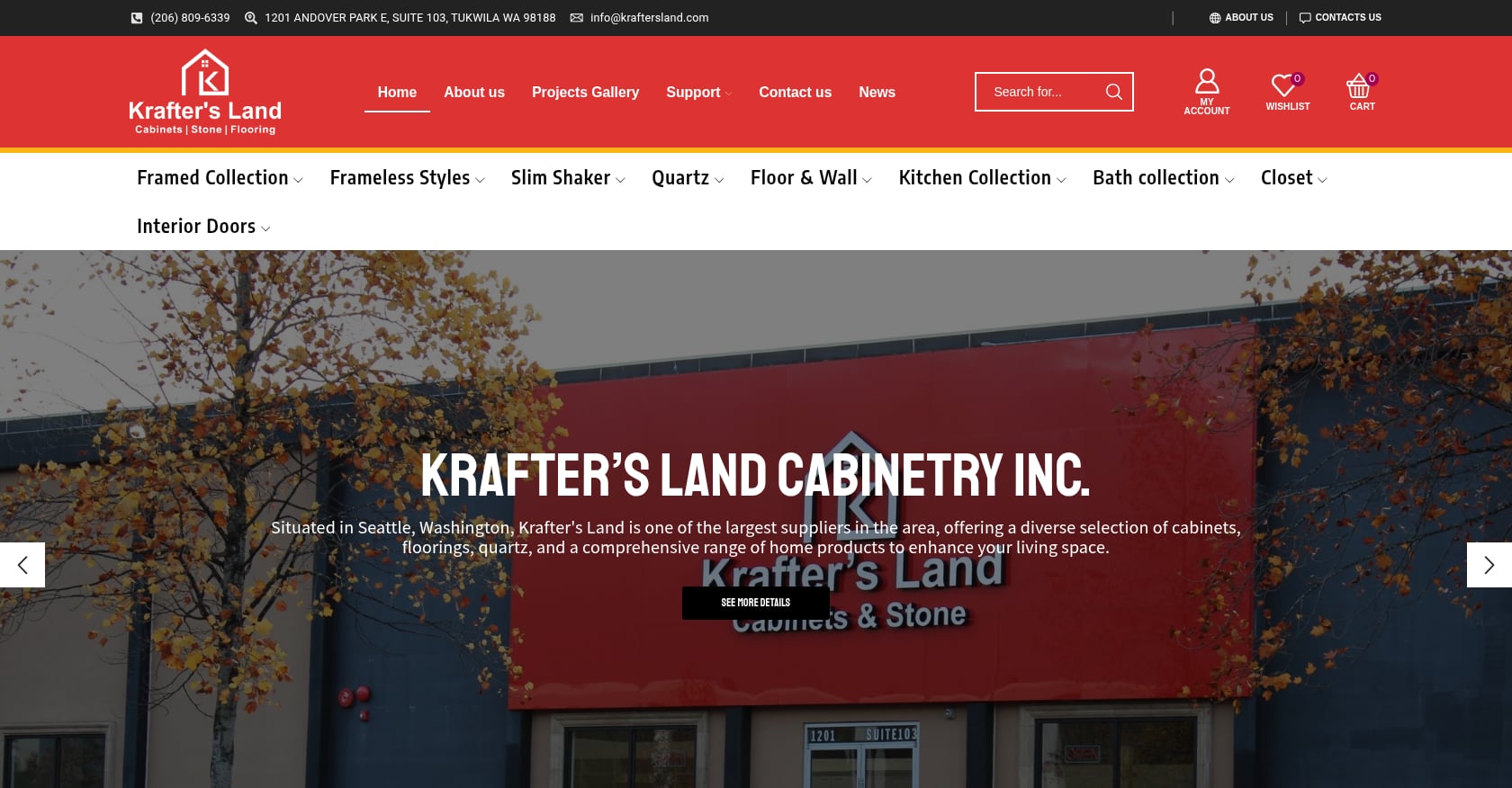
Best for: Washington State contractors who want a trade-only, multi-category supplier with showroom access and fast turnaround.
Krafter’s Land sells exclusively through authorized retailers and licensed contractors. There is no direct-to-consumer online sales channel, which means homeowners can’t comparison-shop your markup away.
Key strengths:
- Four Washington showrooms (Tukwila, Tacoma, Lynnwood, Spokane) backed by 110,000+ square feet of warehouse space and 20,000+ square feet of showroom footprint
- Next-day pickup for RTA cabinets, approximately one-week assembly, and roughly two-week installation for the frameless European line
- Covers framed (Shaker), frameless (European), and Slim Shaker lines, so you can serve both modern and traditional client tastes from one source
- Multi-category: cabinets, quartz countertops, sinks, faucets, flooring, porcelain tiles, shower doors, closets, and accessories, all on one PO
- Free design and quotes with 2020 Design files and 3D renderings
- CARB Phase 2 and EPA TSCA Title VI certified
- 5-year limited warranty on cabinets and closets; 15-year limited warranty on quartz countertops
Tradeoffs:
- No direct-to-consumer sales means homeowners can’t order independently (this is actually a feature for contractors, but it limits walk-in DIY buyers)
- Delivery is first-floor or garage drop only; installation excludes plumbing and electrical
- Washington State footprint only, so contractors outside WA need to look elsewhere
If you’re weighing framed vs. frameless cabinets, Krafter’s Land offers both from the same warehouse, which eliminates the need to source from multiple suppliers for mixed-style projects.
Why it tops this list: The trade-only model is rare. Combined with local warehouse depth, fast lead times, and multi-category sourcing, it addresses the specific pain points contractors actually have, not the ones marketing copy assumes they have.
2. Luxe Cabinet & Stone
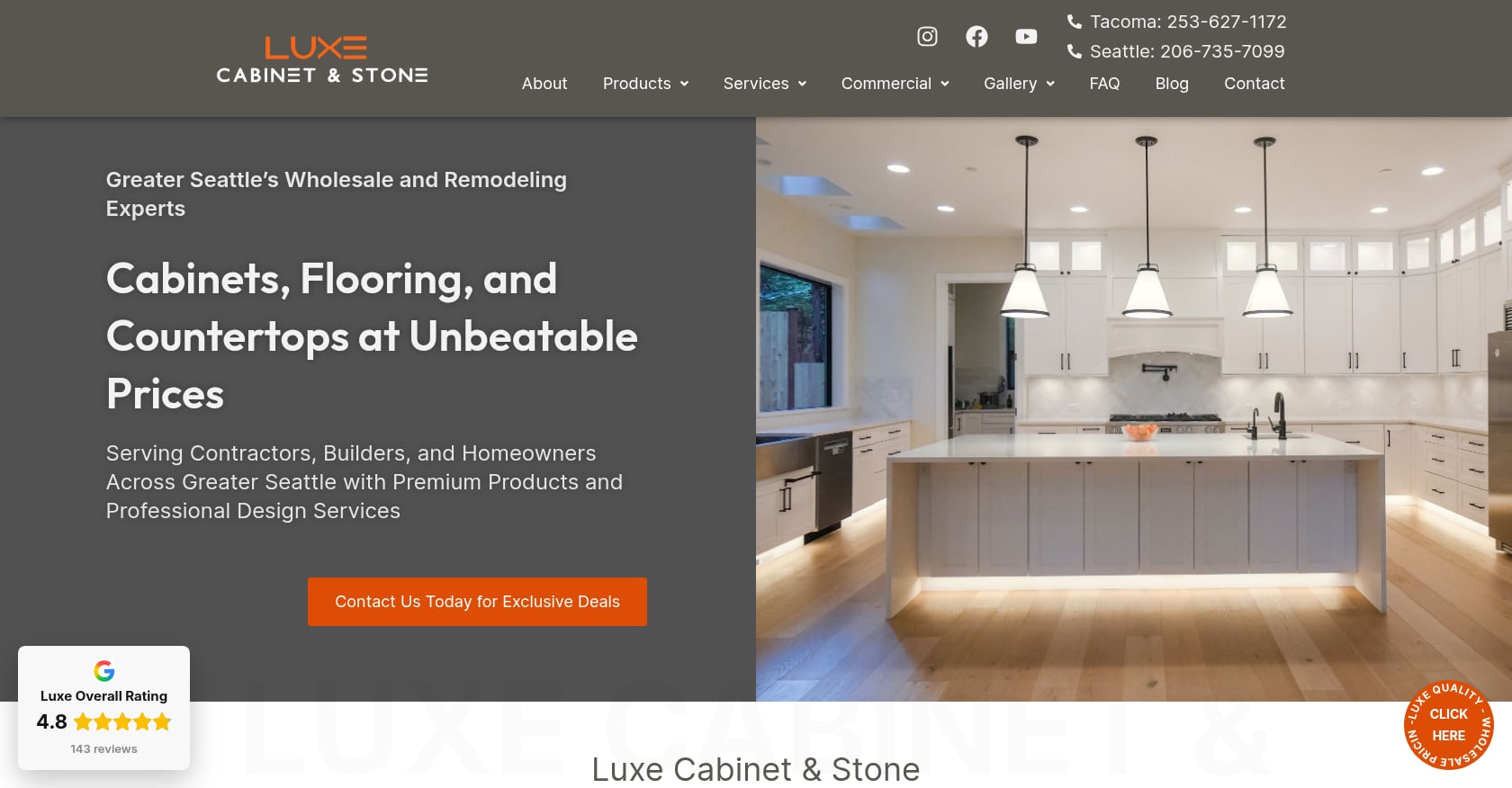
Best for: Greater Seattle contractors who also want a retail-friendly showroom experience for client walkthroughs.
Luxe has been operating in the Seattle market for over 10 years, with a 90,000-square-foot showroom and warehouse space that allows fast order processing and consistent inventory access. They maintain two showrooms in Seattle and Bellevue, plus a Tacoma warehouse.
Key strengths:
- Large local footprint with multiple locations
- Carries cabinets, countertops, and flooring under one roof
- 10+ years of market presence in the Seattle metro area
Tradeoffs:
- Sells to both retail customers and trade buyers, meaning homeowners can access the same product lines and pricing
- No publicly confirmed cabinet warranty information
- Limited independent third-party review volume available online
The dual retail/trade model is worth weighing carefully. If margin protection matters to your business (and it should), a supplier that also sells to your client creates a pricing transparency problem.
3. Abodian
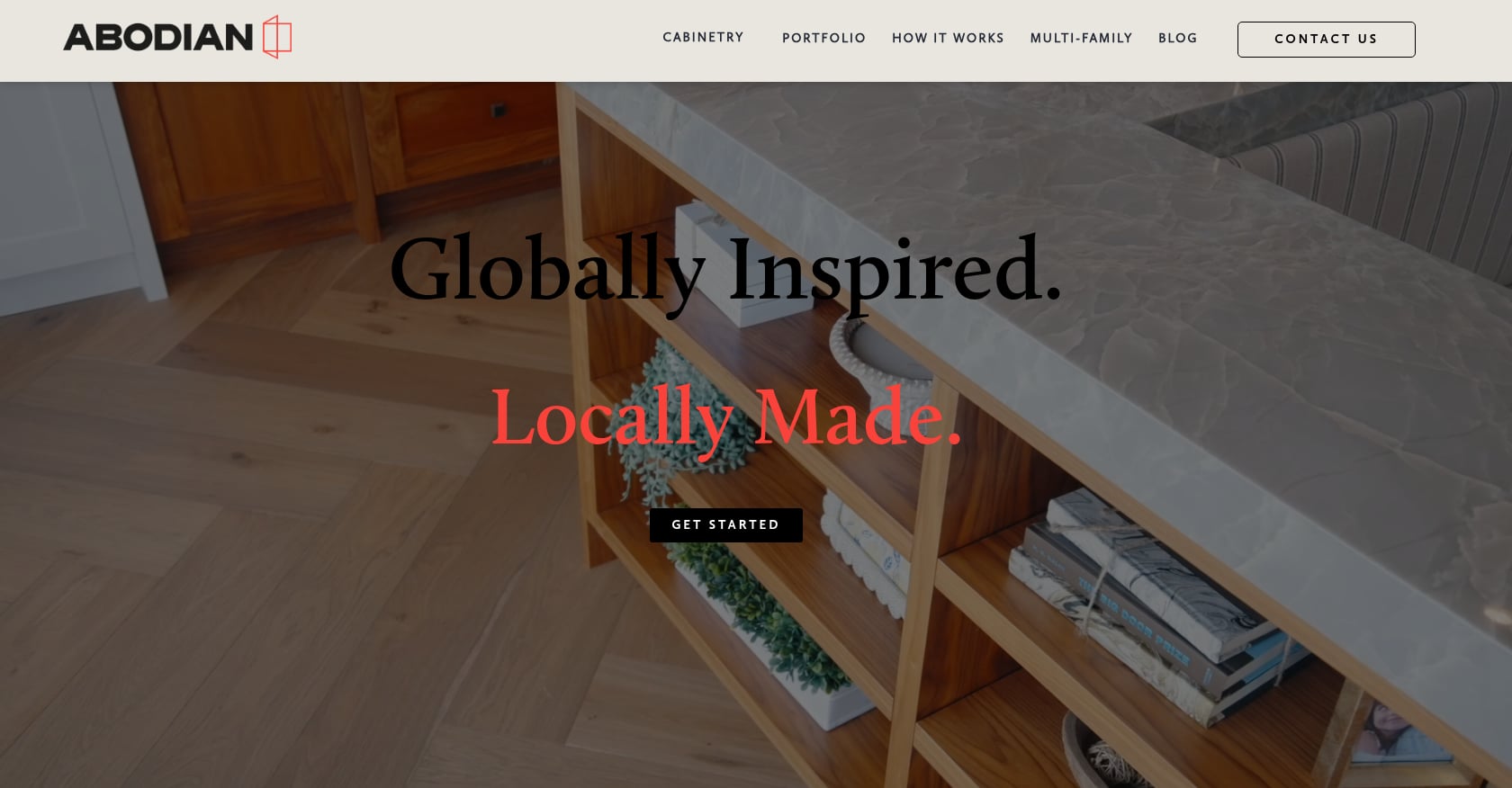
Best for: Designers and builders who need truly custom, made-to-order cabinetry for high-end residential projects.
Abodian manufactures cabinetry for all applications, with an emphasis on environmental stewardship and design flexibility. They hold a 4.3-star rating with 47 reviews across platforms.
Key strengths:
- Full custom manufacturing capability for unique dimensions and specifications
- Design-forward approach with extensive material and finish options
- Positive reviews highlight the design process: “The design process was painless and the design options were limitless. Once all of the decisions were final they turned out the cabinets in record time.”
Tradeoffs:
- Custom means longer lead times, typically 4 to 12+ weeks, and sometimes more
- Polarized quality feedback. One reviewer reported: “Abodian’s mistakes delayed our project by three weeks and incurred extra contractor fees. When the replacement cabinets arrived, they were scratched, damaged, and defective.”
- Another noted the install instructions “lack crucial measurements and proper guidance, requiring everything to be adjusted on site”
- Cabinets only, so you’ll need separate vendors for countertops, flooring, and everything else
For contractors running tight schedules, the custom timeline and inconsistent QC feedback represent real risk. Abodian makes sense for projects where budget and timeline are flexible and the design requires it.
4. ABS Building Supply
Best for: Seattle-area contractors who want straightforward local pickup without a lot of complexity.
ABS Building Supply has operated in the Greater Seattle market since 2012, serving contractors and homeowners with cabinets, vanities, and related building supplies. Their Lynnwood and Battle Ground locations provide local pickup options.
Key strengths:
- Long-running local presence since 2012
- Two convenient pickup locations in the greater Seattle metro
- Established relationships with the local contracting community
Tradeoffs:
- Sells to homeowners as well as trade buyers
- Fewer product categories than multi-category suppliers, so you’ll likely need additional vendors for countertops, flooring, and tile
- No publicly confirmed warranty terms
- Limited online information about specific product lines and construction specs
ABS works well as a supplemental source, but contractors looking to consolidate their vendor list may find the narrower product range limiting.
5. J&K Cabinetry
Best for: High-volume RTA buyers who need consistent all-plywood construction across a national footprint.
J&K has built a strong reputation among contractors for delivering solid value at scale. All collections feature 100% solid wood doors, plywood construction, and soft-close hardware as standard.
Key strengths:
- Plywood box construction and soft-close hardware are standard across all lines
- National distribution network means availability regardless of location
- Strong value positioning for volume buyers
Tradeoffs:
- No Washington State showroom, so you can’t touch product before ordering
- Sells directly to DIY customers and homeowners, creating the margin erosion problem discussed earlier
- Cabinets only, with no countertop or flooring options
- Shipping adds lead time and potential for transit damage
If you’re comparing RTA vs. assembled cabinets across suppliers, J&K is a reasonable national benchmark for RTA quality. Just understand that anyone with an internet connection can buy the same product.
6. Highland Cabinetry
Best for: Contractors with tight timelines who need fast-ship RTA cabinets delivered anywhere in the country.
Highland’s standout feature is speed: 7 to 9 day shipping on RTA orders, which makes them a strong option for projects where timeline trumps everything else.
Key strengths:
- Fast shipping (7-9 days) on RTA orders nationally
- All-wood cabinet construction
- Competitive pricing for the RTA segment
Tradeoffs:
- No local showroom in Washington or anywhere in the Pacific Northwest
- Sells to contractors, suppliers, and homeowners alike
- Cabinets only, no multi-category options
- No local pickup, so you’re dependent on freight carriers
For contractors weighing local showroom options against online RTA suppliers, Highland fits the “need it fast, can’t visit a showroom” scenario. But the lack of local presence means you can’t inspect product quality before committing.
7. Local Custom Shops
Best for: Projects with unique dimensions, unusual materials, or specifications that no stock or semi-custom line can accommodate.
This isn’t a single company but a category worth considering. Practitioners on Reddit consistently surface local custom shops (including Amish builders) as a dark horse option. Multiple users have reported finding fully custom work quoted at or below big-box semi-custom pricing. Fabuwood is the most frequently recommended value brand among trade professionals online, but local custom shops are the recurring surprise.
Key strengths:
- Fully customizable dimensions, materials, and finishes
- Sometimes competitively priced against semi-custom lines from big-box retailers
- Direct relationship with the builder, reducing communication layers
- Often higher build quality than mass-produced alternatives
Tradeoffs:
- Lead times typically run 8 to 14 weeks, with potential delays of 2 to 6 additional weeks
- Inconsistent capacity, because a small shop that’s booked solid may not be able to take your project
- Limited to cabinets, so you’ll need other vendors for everything else
- Quality varies dramatically from shop to shop; there’s no brand-level consistency guarantee
Visit a Seattle-area cabinet showroom to compare products in person before committing.
Why Trade-Only Suppliers Protect Your Business
This topic deserves its own section because it affects every contractor’s bottom line, and almost no one writes about it directly.
Here’s the scenario: you quote a kitchen remodel using a specific cabinet line. The homeowner goes home, Googles the brand, and finds the exact same product available online at the same price you’re paying wholesale. Now they’re questioning your markup. Maybe they ask for a discount. Maybe they lose trust in the project cost entirely.
Practitioners on Reddit have noted this exact dynamic. It’s awkward, it’s common, and it’s entirely avoidable.
A trade-only supplier sells exclusively to authorized retailers and licensed contractors. There’s no consumer-facing website where homeowners can comparison-shop. Your pricing stays protected. Your margin stays intact.
Of the seven options listed above, only Krafter’s Land operates on a fully trade-only model. Every other supplier sells to consumers in some capacity. That’s not necessarily disqualifying, but it’s a tradeoff you should factor into your decision.
For a deeper comparison of dedicated suppliers versus big-box alternatives like Home Depot, the math consistently favors trade-focused partners.
The 2026 Tariff Factor: Why “Local” Matters More Now
The word “local” in local cabinet supplier contractors isn’t just about convenience. In 2026, it’s an economic strategy.
The current 25% Section 232 tariff on imported cabinets and vanities means that for a given cabinet style, the price could be nearly one-third higher in 2026 than it was a year prior if it’s a heavily imported item. Construction input prices increased 0.7% month to month in January 2026 alone, driven partly by tariff-affected materials, according to an Associated Builders and Contractors analysis of BLS Producer Price Index data.
What does this mean practically? Contractors are increasingly looking to domestic cabinet manufacturers and locally warehoused inventory. While prices may still be higher than before the tariff, sourcing locally mitigates the risks associated with international shipping delays and tariff-driven price spikes.
A supplier with 110,000+ square feet of local warehouse space, for instance, has already absorbed the import cost on its current inventory. You’re buying product that’s already here, at a price that’s already set. That’s different from ordering product that’s still on a container ship, subject to whatever tariff rate applies when it clears customs.
The global kitchen cabinet market is projected to grow from $177.68 billion in 2025 to $189.99 billion in 2026 (a 6.9% CAGR), and the U.S. segment alone is expected to reach $43.03 billion by 2032. Semi-custom cabinets currently lead with 46.39% market share, while ready-to-assemble lines are growing fastest. The demand isn’t slowing. The question is who captures it, and at what margin.
How to Evaluate a Supplier Before Your First Order
Knowing the criteria is one thing. Applying them before you commit a purchase order is another. Here’s a concrete checklist.
1. Visit the showroom. Touch the product. Open drawers. Check the box construction. If a supplier doesn’t have a local showroom, that’s a data point, not a dealbreaker, but it means you can’t verify quality before ordering.
2. Ask for actual lead time performance data. Not the marketing number. Ask: “What percentage of orders shipped within the quoted window last quarter?” If they can’t answer, their tracking isn’t good enough.
3. Verify construction specs in writing. Plywood boxes, dovetail drawer joints, soft-close hardware. Get it on the spec sheet, not just in conversation. For a detailed breakdown of what to inspect in box construction, there’s a separate guide worth reviewing.
4. Confirm trade program terms. What’s the contractor discount structure? Is pricing protected from consumer access? Are there volume tiers? Get this in writing before your first order.
5. Check compliance certifications. CARB Phase 2 and EPA TSCA Title VI compliance should be documented and available on request. You may need these for permitting.
6. Test design support responsiveness. Request a quote or 2020 Design file. How fast do they respond? The pre-sale experience usually predicts the post-sale experience.
7. Evaluate multi-category options. Can you source countertops, flooring, or tile from the same supplier? Consolidating vendors reduces coordination overhead.
8. Ask about return and damage policies. What happens if product arrives damaged? What’s the restocking fee? How fast can replacement pieces ship? One forum user’s warning about replacement pieces “taking forever” is worth remembering here.
9. Check independent reviews. Look beyond the supplier’s own website. Google reviews, Houzz profiles, BBB listings, and Reddit threads all provide unfiltered feedback.
10. Order a sample or small batch first. Before committing to a full kitchen, run a test order. Evaluate packaging quality, delivery accuracy, and the product itself.
See how Krafter’s Land compares for contractors evaluating their next supplier.
Frequently Asked Questions
What’s the difference between a cabinet supplier and a cabinet dealer?
A supplier carries inventory (often warehoused locally) and sells to trade buyers, sometimes exclusively. A dealer typically represents one or more manufacturer lines and may or may not stock product locally. The practical difference: suppliers with local warehouse stock offer faster lead times and more predictable availability. Dealers often rely on manufacturer ship schedules.
How long do cabinets take to arrive from a local supplier vs. an online supplier?
RTA cabinets from a local supplier with warehouse stock can be available for next-day pickup. Assembled cabinets from local stock typically take 1 to 4 weeks. Online RTA suppliers generally ship in 7 to 14 days, plus freight transit time. Custom cabinets, whether local or online, run 8 to 14 weeks minimum.
Should contractors buy cabinets from Home Depot or Lowe’s?
For most trade professionals, the answer is no. Big-box pricing is transparent to consumers, which erodes your margin. Lead times on special orders are often longer than dedicated trade suppliers. Selection is broad but shallow, meaning fewer finishes and sizes in stock. And there’s no trade program structure comparable to what dedicated cabinet suppliers offer versus big-box alternatives.
What construction quality markers should I verify before ordering?
The essentials: plywood box construction (not particleboard or MDF), dovetail or doweled drawer joints, soft-close hinges and drawer glides as standard, and solid wood or high-quality thermofoil doors. Also check edge banding quality and the thickness of the plywood (½-inch sides and ¾-inch shelves are the benchmark for quality lines). Understanding plywood vs. particleboard differences helps you ask the right questions.
How does the 2026 cabinet tariff affect contractor pricing?
The 25% Section 232 tariff on imported cabinets increases the landed cost of any product manufactured overseas. This cost gets passed through the supply chain to contractors and ultimately to homeowners. Contractors sourcing from suppliers with domestically warehoused inventory face less exposure because the inventory cost is already locked in. The tariff rate may increase to 50% after January 2027, making this an increasingly important factor in supplier selection.
Are RTA cabinets reliable enough for contractor projects?
Yes, when sourced from a quality supplier. RTA cabinets with plywood construction, soft-close hardware, and proper joinery are structurally identical to factory-assembled versions. The difference is assembly labor, which experienced contractors or their crews can handle efficiently. RTA also offers a significant lead time advantage: next-day pickup from local stock versus weeks for assembled or custom options.
How many cabinet suppliers should a contractor work with?
Most successful contractors maintain one primary supplier for 80% or more of their projects, with one or two backup options for specialty work (high-end custom, unusual finishes, etc.). Spreading orders across too many vendors fragments your purchasing power, complicates logistics, and makes warranty claims harder to manage. Find one reliable partner and build the relationship.