
TL;DR
Choosing the right cabinet supplier in 2026 means weighing tariff exposure, construction quality, trade program discounts, and lead times. This guide profiles 10 top cabinet suppliers, breaks down the 25-46% tariff impact on imported cabinets, and gives trade professionals a concrete evaluation checklist. For Pacific Northwest contractors and retailers, Krafter’s Land Cabinetry stands out as a one-stop domestic supplier with four Washington showrooms, framed and frameless options, and same-day pickup from a 110,000+ sq. ft. warehouse.
Quick Answer: What Is the Best Cabinet Supplier for Trade Professionals?
If you’re a contractor, builder, remodeler, or cabinet retailer, the best cabinet supplier depends on your business model rather than price alone.
– Choose a domestic supplier if you want predictable pricing and less tariff exposure.
– Choose a regional supplier if showroom access and same-day pickup matter.
– Choose a wholesale distributor if you manage multiple projects every month.
– Choose an RTA supplier if speed and lower costs are your priority.
– Choose a semi-custom or custom manufacturer for higher-end remodeling projects.
In 2026, the best cabinet suppliers combine reliable inventory, trade pricing, quality construction, design support, and consistent lead times—not simply the lowest cabinet cost.
Why Your Cabinet Supplier Choice Matters More in 2026
The global cabinet market is projected to hit $148 billion in 2026, and U.S. cabinet and vanity manufacturing alone generates an estimated $22.1 billion in annual revenue. Those numbers sound healthy until you factor in the forces squeezing margins right now.
Section 232 tariffs have pushed the cost of imported cabinets up 25-46%. Labor shortages affect 58% of kitchen and bath firms, up from 41% in 2020. And lead times for custom work still stretch 8-12 weeks. The cabinet supplier you partner with determines whether you absorb those pressures or pass them along profitably to clients.
This guide is built for trade professionals: contractors, builders, remodelers, retailers, and designers who need a supplier they can rely on project after project. Not a generic brand directory, but a decision-making tool with pricing benchmarks, quality markers, and the tariff context that no other ranking article covers.
Browse cabinet and countertop options to see what a full-range supplier catalog looks like.
How We Evaluated These Cabinet Suppliers
Every supplier on this list was measured against criteria that matter to repeat-order professionals, not homeowners doing a one-time remodel.
Construction quality. All-plywood box construction, solid wood dovetail drawer boxes, and soft-close hardware as standard. Particleboard boxes sag. Stapled drawers fail. These aren’t negotiable for trade work.
Certifications. CARB Phase 2 compliance (formaldehyde emissions), FSC certification (sustainable sourcing), and KCMA certification (industry quality standards). If a supplier can’t show these, ask why.
Trade programs. Volume discounts, dedicated account managers, design support, and contractor pricing tiers. The spread between a 12% trade discount and a 45% wholesale discount on a $40,000 kitchen package is $13,200 in recoverable margin.
Lead times. RTA cabinets ship in 3-9 days. Semi-custom runs 4-6 weeks. Full custom takes 8-12 weeks. Your project timeline dictates which suppliers are even viable.
Tariff exposure. Domestic manufacturers carry 0% tariff burden. Import-heavy suppliers may pass through 25-46% cost increases. We flag sourcing origin where known.
Showroom and warehouse access. Practitioners consistently say that seeing product in person closes deals. One contractor on a review forum noted that “plywood boxes and super square factory cuts” were only verifiable after hands-on inspection, not from website photos.
At-a-Glance Comparison Table
Supplier | Best For | Cabinet Types | Trade Program | Showroom Access | Turnaround |
|---|---|---|---|---|---|
Krafter’s Land | PNW retailers, contractors, builders | Framed + frameless, countertops, flooring | Authorized retailers/contractors | 4 WA showrooms (35,000+ sq. ft.) | Same-day pickup available |
Pioneer Cabinetry | Factory-direct RTA at scale | RTA kitchen & bath | Dealer program | Seattle/Kent, WA | Ships nationwide |
Cabinets To Go | Quick-turn in-stock needs | Stock, semi-custom | Purple Hammer PRO (35-45% off) | 100+ nationwide | In-stock: immediate |
Western States | Multi-brand selection | 20+ brands | Contractor-focused | Yes | Varies by brand |
Luxe Cabinet & Stone | Seattle one-stop wholesale | RTA + custom | Dealer program | Seattle | Varies |
Lily Ann Cabinets | Nationwide online RTA | RTA | Wholesale pricing | Online only | Ships nationally |
Canyon Creek | Framed + frameless + value tier | Full range | Dealer network | WA-based | 4-8 weeks |
Highland Cabinetry | Fast-ship all-wood | RTA | Wholesale | Online + WA | 7-9 days |
Spencer LLC | Locally manufactured in WA | Custom/semi-custom | Direct sales | Monroe, WA | Varies |
ABS Cabinets Direct | Factory-direct wholesale | Wholesale lines | Contractor/store pricing | Limited | Varies |
Cabinet Supplier Comparison by Project Type
Project Type | Recommended Cabinet Type | Best Supplier Characteristics |
|---|---|---|
Rental Remodel | RTA | Lowest cost, fast shipping |
Spec Homes | Semi-Custom | Reliable lead times |
Luxury Homes | Full Custom | Premium finishes |
Kitchen Remodel | Semi-Custom | Design support |
Commercial | Wholesale | Volume discounts |
Multi-Family | Stock Cabinets | Large inventory |
How to Choose the Right Cabinet Supplier
Not every supplier serves the same type of customer. Before comparing brands, identify which category best matches your business.
If You Are… | Best Supplier Type |
|---|---|
General contractor | One-stop wholesale supplier |
Kitchen remodeler | Semi-custom cabinet manufacturer |
Home builder | Large-volume wholesale distributor |
Cabinet retailer | Supplier with dealer program |
Interior designer | Supplier with design support |
Property manager | Stock cabinet supplier |
Flipper | Fast-shipping RTA supplier |
Luxury builder | Custom cabinet manufacturer |
The 10 Best Cabinet Suppliers for Trade Professionals
1. Krafter’s Land Cabinetry Inc.
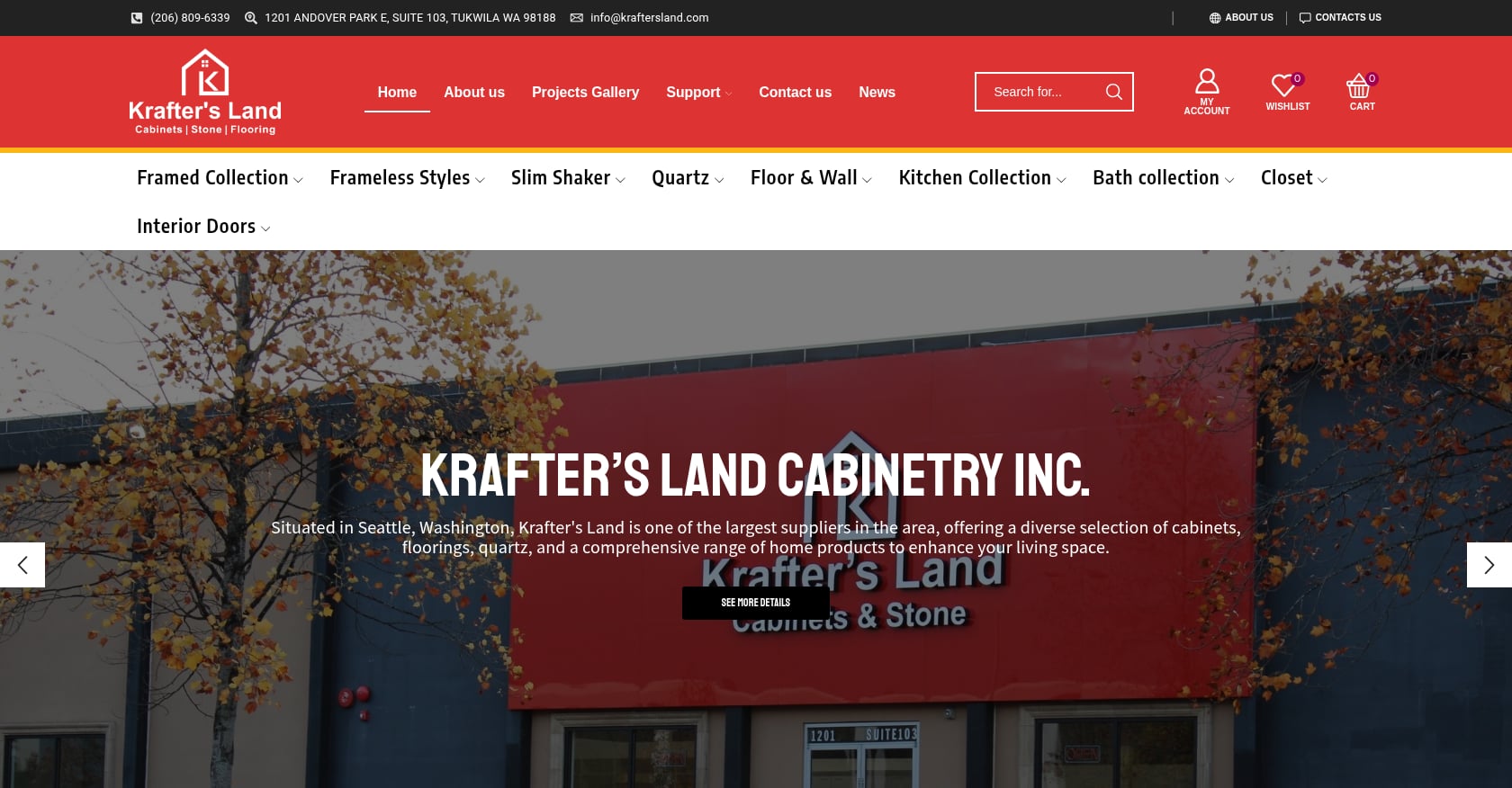
Best for: Retailers, contractors, remodelers, designers, and builders in the Pacific Northwest who want a single supplier for cabinets, countertops, and flooring.
Krafter’s Land operates as a Washington-based cabinet supplier with showrooms in Tukwila, Tacoma, Lynnwood, and Spokane. The company sells through authorized retailers and licensed contractors rather than direct to consumers online. That trade-first model means your projects aren’t competing with homeowner DIY orders for inventory.
Key features:
Framed and frameless cabinets, plus quartz countertops, sinks, faucets, flooring, porcelain tiles, shower doors, closets, and accessories
35,000+ sq. ft. showroom space for bringing clients to see finishes in person
110,000+ sq. ft. warehouse with same-day pickup availability
Free design consultation, 3D renderings, delivery, assembly, and installation services
One-stop model that eliminates multi-vendor coordination on remodeling projects
Why it matters for 2026: As a Washington-based supplier, Krafter’s Land offers tariff-stable sourcing for Pacific Northwest trade professionals. When imported cabinet prices climb 25-46% from tariffs, a domestic supply chain keeps your bids competitive.
Limitations:
Focused on the Pacific Northwest, so out-of-region buyers may have limited access
Not a direct-to-consumer online retailer, which means homeowners need to work through an authorized channel
Trade access: Contractors and retailers can register as authorized vendors to access trade pricing and design support. You can also request a free quote for specific projects.
2. Pioneer Cabinetry
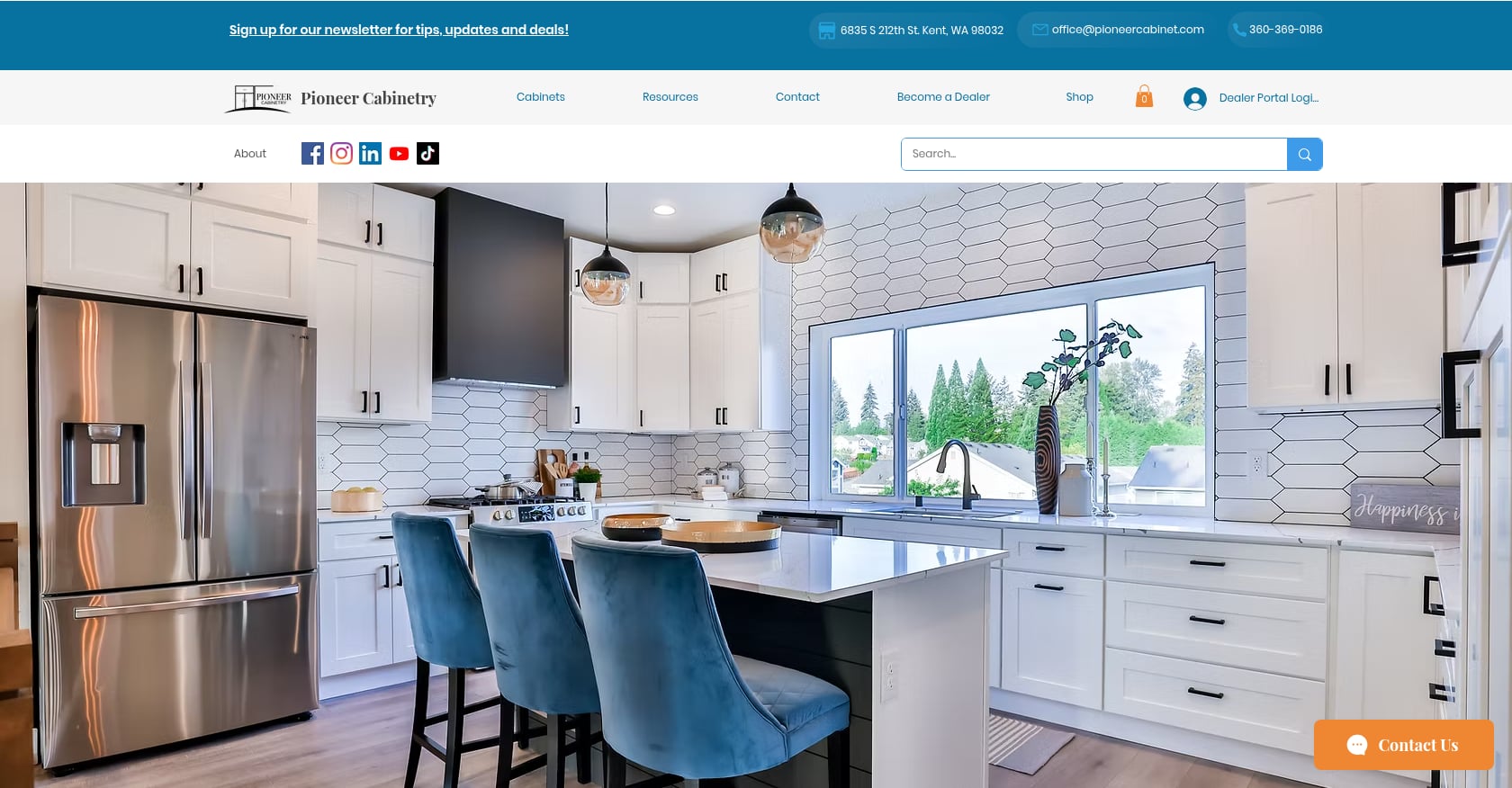
Best for: Trade partners seeking factory-direct RTA cabinets at scale with nationwide shipping.
Pioneer Cabinetry, based in the Seattle/Kent area, targets long-term supply relationships with industry professionals. Their wholesale business is built around stocking retailers, large-scale builders, and professional renovators who place repeat orders.
Key features:
Factory-direct RTA pricing for kitchen and bath cabinets
Dealer program designed for repeat, volume-based purchasing
Nationwide shipping from a Washington base
Focus on consistent, standardized product lines that simplify reordering
Limitations:
Primarily RTA, so contractors needing semi-custom or full custom may look elsewhere
Limited showroom experience compared to larger multi-location suppliers
Product range is narrower than one-stop suppliers offering countertops and flooring
Real-world note: Contractors on review sites praise the predictability of working with a single RTA supplier. As one practitioner put it, the advantage is not only pricing but knowing exactly “what shows up, how it builds, and how it holds up” on every project.
3. Cabinets To Go
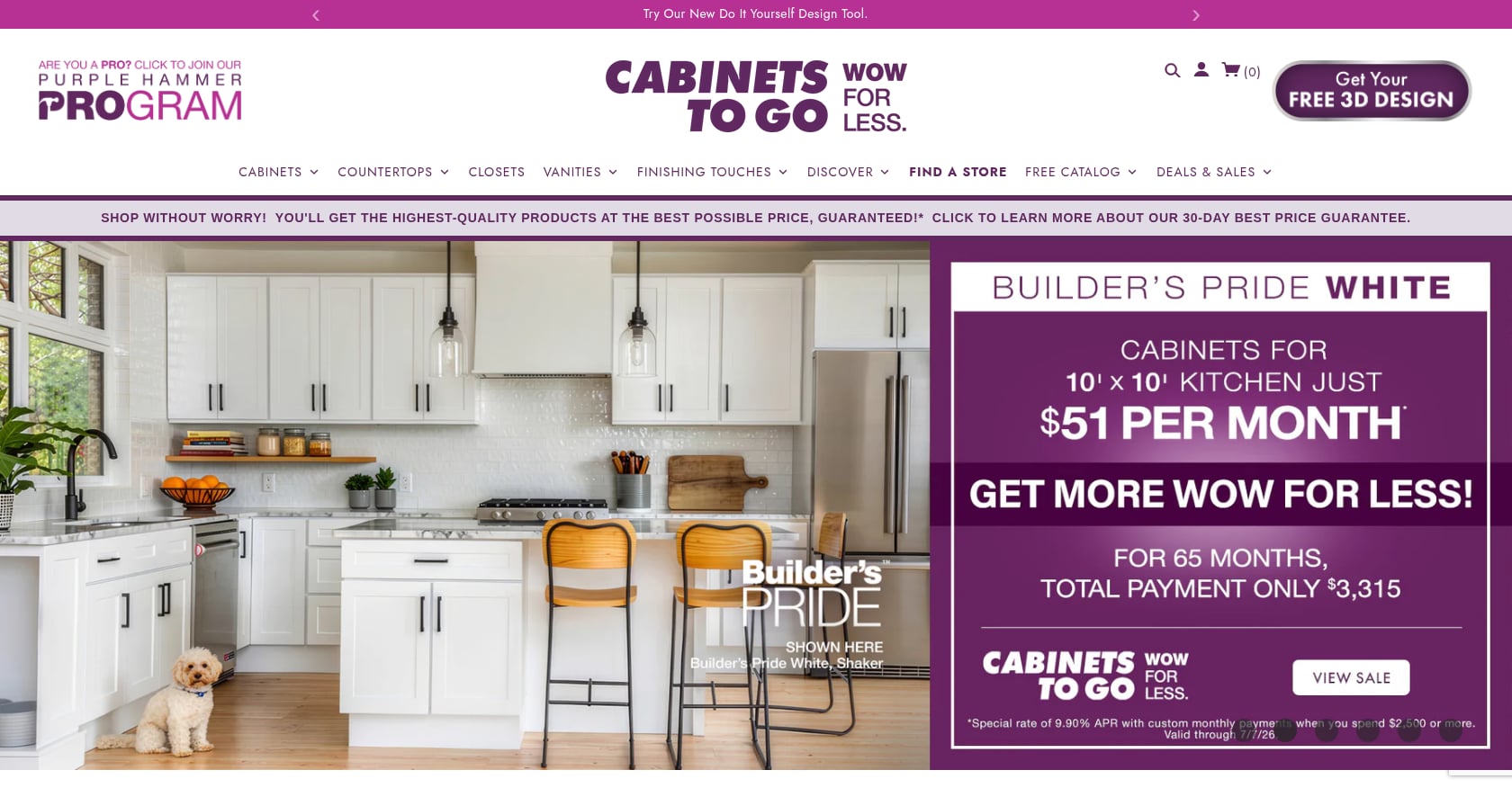
Best for: Professionals needing in-stock inventory with same-day availability across the country.
With over 100 showrooms nationwide, Cabinets To Go is one of the largest consumer-facing cabinet retailers that also serves trade professionals. Their 10’ x 10’ kitchen packages start at $6,328.42 installed, including Painted Shaker cabinetry, countertops, sink, and hardware.
Key features:
Purple Hammer PROgram offering 35-45% discounts for professionals
In-stock inventory means no waiting for common styles and sizes
Physical showrooms in most major metros for client walk-throughs
Kent, WA location serves the Pacific Northwest market
Limitations:
Primarily a consumer-facing brand; the contractor program is an add-on, not the core identity
Product quality varies by line, so inspect stock cabinet construction carefully
Not a wholesale-only supplier, meaning trade professionals share inventory with retail buyers
Pricing benchmark: That $6,328.42 installed price for a 10×10 kitchen gives contractors a useful baseline for budgeting entry-level projects.
4. Western States Cabinet Wholesalers
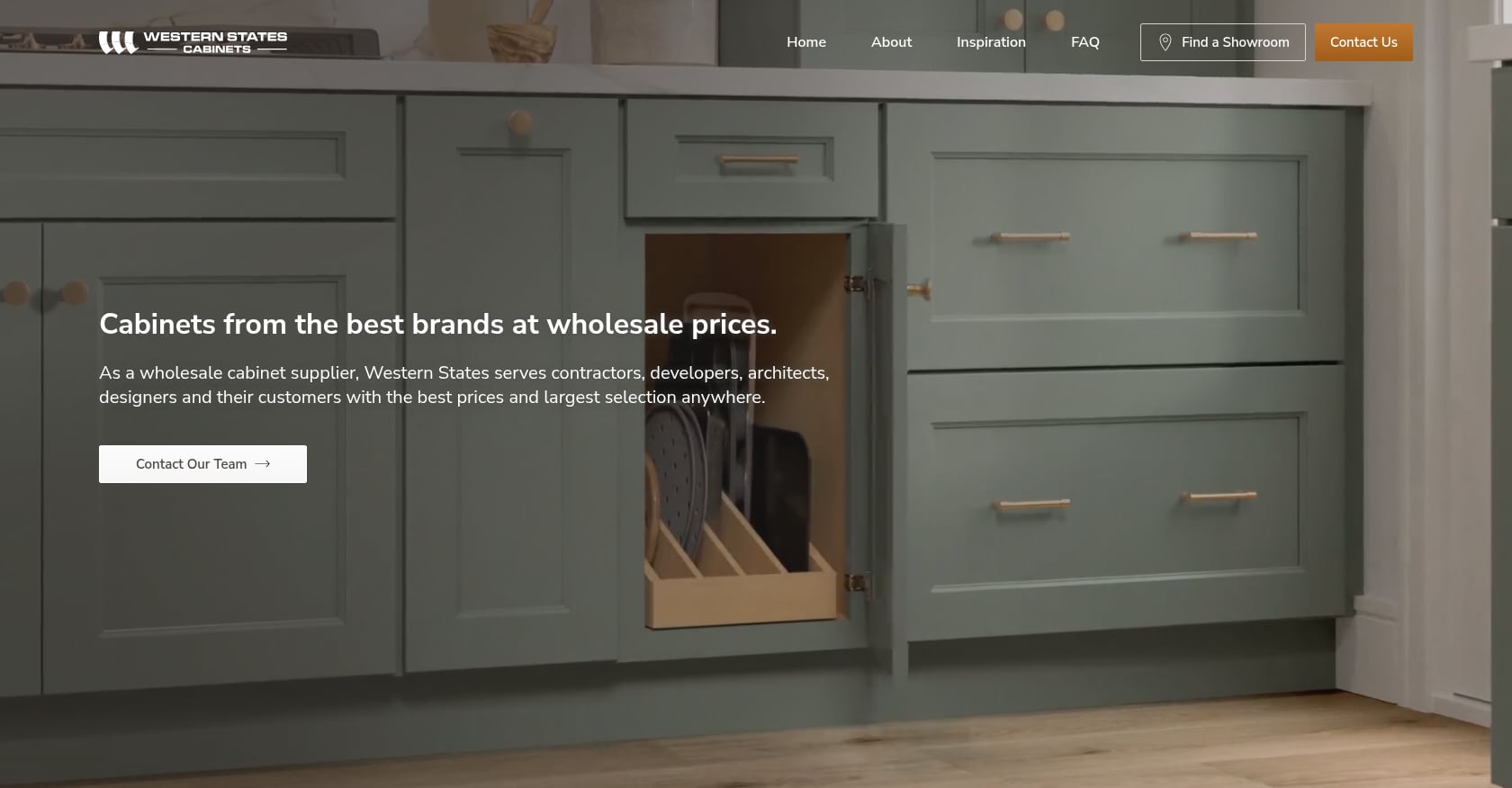
Best for: Professional contractors and builders who want to compare 20+ brands through a single point of contact.
Western States (contractorcabinets.com) is exclusively trade-focused. They don’t serve retail consumers, which means their entire operation is built around contractor needs: volume pricing, multi-brand access, and project-level support.
Key features:
Access to 20+ cabinet brands under one roof
Contractor-only model with no competing retail traffic
Range spans budget RTA through high-end semi-custom
Pacific Northwest presence with showroom access
Limitations:
Lead times vary significantly depending on which brand you select
Multi-brand model means quality consistency depends on the specific line, not the distributor
Doesn’t offer countertops, flooring, or other remodeling products
5. Luxe Cabinet & Stone
Best for: Seattle-area contractors who need cabinets, countertops, and flooring from a single wholesale source.
Luxe Cabinet & Stone has served contractors, builders, developers, and designers in greater Seattle for over a decade. The company is a sister company of Ellie Cabinetry and carries zero negative reviews at the time of writing.
Key features:
One-stop wholesale: RTA cabinets, premium flooring, and countertops
10+ years of experience in the Seattle market
Dealer program for trade professionals
Clean reputation with no recorded complaints
Limitations:
Geographically limited to the greater Seattle area
Smaller operation than national suppliers, which may affect inventory depth
Less useful for contractors working outside the Pacific Northwest
6. Lily Ann Cabinets
Best for: Trade professionals who prefer online ordering with competitive RTA pricing and nationwide delivery.
Lily Ann is one of the nation’s largest online dealers of wholesale cabinets. Their fully digital model works well for contractors who know exactly what they need and don’t require showroom visits.
Key features:
Competitive wholesale pricing on all-wood RTA cabinets
Ships nationwide from their distribution network
Online ordering system with detailed product specs and photos
Free samples available for finish verification
Limitations:
No physical showroom, so you can’t bring clients to touch and see product
Online-only model means returns and damage claims can be slower to resolve
Practitioners on forums note that pre-installation inspection is essential with shipped RTA cabinets to catch any finish inconsistencies or hardware issues before starting work
7. Canyon Creek Cabinet Company
Best for: Buyers who want framed, frameless, and a budget-friendly value line from a Washington manufacturer.
Canyon Creek is a well-known WA-based manufacturer with a dealer network that spans the region. They offer traditional framed construction, contemporary frameless cabinets for modern homes, and a value line for tighter budgets.
Key features:
Full product range spanning three tiers (value, framed, frameless)
Washington-based manufacturing
Established dealer network for trade access
Semi-custom options with size and finish modifications
Limitations:
Lead times of 4-8 weeks put them in the semi-custom wait bracket
Must work through their dealer network, limiting direct access
Doesn’t offer countertops or flooring, so you’ll need additional vendors
8. Highland Cabinetry Inc.
Best for: Contractors who need all-wood cabinets shipped fast, with 7-9 day turnaround.
Highland Cabinetry provides all-wood cabinet solutions to suppliers, contractors, and homeowners. Their standout feature is speed: 7-9 day shipping on RTA orders, which makes them a strong option for projects with tight timelines.
Key features:
7-9 day shipping, one of the fastest turnarounds in the RTA segment
All-wood construction as standard
Serves both wholesale and direct customers
Washington base with online ordering
Limitations:
Smaller brand with less market recognition than national suppliers
Limited showroom experience
Product range is primarily kitchen and bath cabinets without broader remodeling categories
9. Spencer LLC
Best for: Seattle-area homeowners, builders, and designers wanting locally manufactured cabinets from Monroe, WA.
Spencer builds cabinets in Monroe, Washington, and sells directly to homeowners, builders, remodelers, and designers throughout the Seattle area. The local manufacturing angle is appealing in a tariff-heavy market.
Key features:
Cabinets built in Monroe, WA (fully domestic production)
Direct sales model for local buyers
Serves both trade and residential customers
0% tariff exposure on locally manufactured products
Limitations:
Geographic reach is limited to the Seattle area
Smaller operation with less inventory depth than wholesale distributors
Less suitable for contractors who need multi-brand options or large-scale volume
10. ABS Cabinets Direct
Best for: Contractors and retail stores looking for factory-direct wholesale cabinet pricing.
ABS Cabinets Direct operates a wholesale model targeting both contractors and stores. Their factory-direct approach is designed to cut out middlemen and reduce per-unit costs.
Key features:
Factory-direct pricing structure
Serves both contractors and retail stores
Wholesale-focused model
Limitations:
Limited public information about specific product lines and construction details
Showroom access is more limited than competitors with dedicated design centers
Fewer published reviews make it harder to assess reliability before committing
2026 Tariff Reality: Why Your Supplier Choice Matters More Now
This is the section most cabinet supplier guides skip entirely, and it’s the one that will affect your bottom line the most.
On December 31, 2025, President Trump signed a proclamation maintaining 25% tariffs on imported wood products, including cabinets and vanities, through 2026. Vietnam, which had become the single largest source of imported cabinets to the U.S., now faces a combined rate approaching 46%.
The math is straightforward. A UBS analyst estimated that the 25% cabinet tariff alone adds approximately $280 to the average single-family home construction cost for cabinets. For kitchen-specific remodels where cabinets represent 29-35% of the total budget, the impact hits harder. Stock imported cabinets that previously cost $3,000 wholesale may now run $3,750-$4,200 after tariff pass-through.
“The kitchen cabinet industry is highly globalized, and even U.S.-based manufacturers depend on imported materials, hardware, and finishes,” one cabinet maker told PBS News. “These tariffs may sound protective, but in reality, they often raise costs across the entire supply chain.”
Michigan State supply chain professor Jason Miller noted that importers facing these rates are becoming more selective, focusing on bestsellers and high-margin items. That means the variety of imported cabinets available to contractors is shrinking.
What this means for your supplier strategy:
Domestically manufactured cabinets carry a 0% tariff burden. They’re no longer the “premium” option; they’re the stable option.
Ask every cabinet supplier about sourcing origin. Where are the boxes made? Where does the hardware come from? Where are finishes applied?
Build tariff sensitivity into your project bids. If your supplier imports from Vietnam or China, price accordingly.
Consider Washington-based suppliers like Krafter’s Land, Spencer, and Canyon Creek as tariff-insulated alternatives for Pacific Northwest projects.
Domestic vs Imported Cabinet Suppliers
Factor | Domestic Supplier | Imported Supplier |
|---|---|---|
Tariff Risk | Low | High |
Lead Time | Shorter | Often Longer |
Inventory Stability | Higher | Can fluctuate |
Freight Cost | Lower | Higher |
Replacement Parts | Easier | May require overseas ordering |
Price Stability | Better | Can change quickly |
Warranty Support | Usually Faster | Varies |
What to Look for in a Cabinet Supplier: Evaluation Checklist
Whether you’re choosing from this list or evaluating a local cabinet supplier not covered here, run through these seven checkpoints before placing your first order.
1. Construction materials. Open a sample cabinet and look inside. Plywood boxes hold screws better, resist moisture, and last longer than particleboard or MDF. Dovetail drawer joints signal quality that stapled or glued joints simply can’t match. Learn more about what separates good from great in high-quality framed cabinetry.
2. Certifications. CARB Phase 2 compliance is non-negotiable (it governs formaldehyde emissions). FSC certification indicates sustainable wood sourcing. KCMA certification means the cabinets passed durability tests for finish, drawer operation, and structural integrity. Check your supplier’s warranty coverage to understand what’s backed by documentation.
3. Lead times. Match the supplier’s turnaround to your project pipeline. RTA ships in 3-9 days. Semi-custom takes 4-6 weeks. Full custom runs 8-12 weeks. If you run multiple projects simultaneously, you may need different suppliers for different timelines.
4. Trade programs. Contractors typically save 30-50% compared to retail pricing through wholesale cabinet suppliers. Volume discounts can push savings to 45-50% on bulk orders of 100+ cabinets. Ask about dedicated account managers, design support, and sample programs.
5. Showroom and warehouse access. Being able to bring a client to a physical showroom closes more deals than any catalog ever will. And warehouse access with same-day pickup means you’re not waiting on shipping when a project timeline accelerates.
6. Delivery and logistics. Does the supplier offer job-site delivery? LTL and FTL options? Will they stage deliveries to match your installation schedule? These details seem small until a missed delivery pushes your timeline back a week.
7. Damage and claims resolution. One common BBB complaint about wholesale cabinet suppliers describes a pattern: “I received damaged & defective kitchen cabinets from this supplier. I followed their claims process but have yet to have a resolution. They are not responsive and constantly asking for the same information repeatedly.” Before committing, ask how damage claims are handled and what the average resolution time looks like.
RTA vs. Semi-Custom vs. Full Custom: Which Cabinet Type Fits Your Projects?
The cabinet type you specify determines cost, timeline, and labor requirements. Here’s how the three tiers break down.
Ready-to-Assemble (RTA) cabinets arrive flat-packed and require on-site assembly. They sit at the lowest price point, ship fastest (often under a week), and carry the lowest freight costs. The tradeoff is labor: RTA units require knowledgeable assembly, pre-drilling, and jig use to avoid rework. RTA is projected to grow fastest in the market, at a 7.26% CAGR through 2031, reflecting growing contractor comfort with the format.
Semi-custom cabinets offer limited modifications to size, finish, and hardware within a manufacturer’s standard catalog. Lead times run 4-6 weeks, and they currently account for 46.39% of market share, making them the most popular segment. For most kitchen remodels, semi-custom hits the sweet spot between customization and cost control.
Full custom cabinets are built to exact specifications. They handle unusual room dimensions, unique design requirements, and high-end material selections that stock options can’t match. Expect 8-12 week lead times and significantly higher per-unit costs. Custom cabinetry accounts for 40% of all cabinet sales, reflecting the continued demand for bespoke solutions.
For a deeper look at construction differences, compare frameless cabinet designs with traditional framed options to see which style suits your project pipeline.
Choosing the Right Supplier Is a Business Decision, Not Just a Product Decision
A contractor who reviewed Buy Wholesale Cabinets captured it well: “I have assembled and installed cabinets from many different manufacturers. ‘Buy Wholesale Cabinets’ cabinets are top quality. The assembly process is as simple as it gets. Plywood boxes and super square factory cuts make the installation go much better than the lower quality cabinets.”
The point isn’t about one brand. It’s that the right cabinet supplier becomes a partner you reuse, not a low bid on a single order. Reliability and consistency matter more than any single line price, because a missed lead time or inconsistent finish costs you on the job site.
With U.S. demand for kitchen cabinets projected to rise 2.7% annually to $18.4 billion by 2026, the market isn’t slowing down. The contractors who secure stable, quality-verified supply chains now will have a structural advantage over those scrambling to find inventory later.
For trade professionals in the Pacific Northwest, reach out to Krafter’s Land to discuss project-specific needs, pricing, and design support.
Frequently Asked Questions
What is a cabinet supplier vs. a cabinet manufacturer?
A cabinet manufacturer builds cabinets in their own facility. A cabinet supplier may manufacture their own products, source from multiple manufacturers, or do both. Many suppliers act as distributors, giving contractors access to several brands and quality tiers through a single account. Some, like Krafter’s Land, operate as both supplier and showroom with their own warehouse and design services.
How much do wholesale cabinets cost?
Wholesale pricing varies widely by construction type and quality tier. Contractors typically save 30-50% compared to retail pricing. For reference, Cabinets To Go offers a 10’ x 10’ kitchen starting at $6,328.42 installed. RTA cabinets cost the least per unit, while semi-custom and full custom lines scale up from there. Volume orders of 100+ cabinets often qualify for 45-50% discounts.
How do 2026 tariffs affect cabinet pricing?
Section 232 tariffs impose 25% duties on imported cabinets, with Vietnam-sourced products facing combined rates near 46%. This adds roughly $280 per single-family home in cabinet costs. Domestically manufactured cabinets carry no tariff burden, making U.S.-based suppliers increasingly cost-competitive compared to import-dependent alternatives.
What’s the difference between framed and frameless cabinets?
Framed cabinets have a face frame (typically 1.5″ wide) attached to the front of the cabinet box, providing structural support and a traditional look. Frameless cabinets (also called European-style or full-access) have no face frame, offering wider drawer and door openings and a more contemporary appearance. Both can be high quality depending on construction. See guides on framed cabinets for a closer look.
Do cabinet suppliers offer design services?
Many trade-focused suppliers offer design support ranging from basic layout assistance to full 3D renderings. Krafter’s Land, for example, provides free design consultations and 3D renderings as part of their service to authorized retailers and licensed contractors. This kind of support helps contractors present professional proposals to clients without hiring a separate designer.
How do I become a dealer or authorized retailer for a cabinet supplier?
Most suppliers have a dealer application or vendor registration process. Requirements typically include a business license, proof of trade credentials, and sometimes a minimum order commitment. Vendor registration at Krafter’s Land is available for retailers, distributors, and e-commerce resellers looking to carry their product lines.
What should I inspect before accepting a cabinet delivery?
Pre-installation inspection is critical, especially with shipped or RTA cabinets. Verify box squareness with a framing square, check finish consistency across all units, confirm hardware completeness, and inspect for shipping damage before signing off. Documenting issues with photos before signing the delivery receipt gives you much stronger standing in any claims process.