
TL;DR
Next day RTA cabinet pickup lets contractors collect flat packed cabinets from a local warehouse within one business day of order confirmation, cutting 5 to 10 days of freight wait from a project timeline. The process requires a trade account, verified in stock availability, a finalized cabinet schedule, and a thorough inspection at the loading dock. This guide walks through every term and step in sequence, from account setup to post pickup verification, including where to assemble cabinets and how to store them properly once they reach the jobsite.
Most RTA cabinet suppliers quote lead times of two to six weeks. For a contractor juggling countertop templating, tile work, and client expectations, those weeks can cascade into costly delays. Next day RTA cabinet pickup exists to eliminate that gap. When a supplier holds inventory locally and a contractor has a trade account ready, RTA cabinets can move from warehouse shelf to jobsite in 24 hours.
This guide covers every term you will encounter while arranging next day RTA cabinet pickup for contractors, organized in the order you will actually use them. Bookmark it, share it with your project managers, and reference it before every pickup.
How Do Contractors Arrange Next Day RTA Cabinet Pickup?
Contractors can arrange next day RTA cabinet pickup by opening a trade account, finalizing their cabinet schedule, confirming that every required SKU is physically in stock, and placing their order before the supplier’s daily cutoff time. Once the warehouse confirms the order and pickup appointment, contractors can collect the flat packed cabinets the following business day. Before leaving, they should compare the packing list with the order, inspect cartons for visible damage, and document any shortages or damage with the warehouse.
If you’re evaluating suppliers for upcoming projects, start with contractor cabinet pricing to compare your options.
Next Day RTA Cabinet Pickup: Quick Contractor Checklist
| Step | What to Do | What to Confirm |
|---|---|---|
| 1. Account setup | Register for a contractor or trade account | Business details, EIN, resale certificate, and account approval |
| 2. Order preparation | Finalize the cabinet layout and schedule | Cabinet sizes, SKUs, finishes, fillers, panels, and accessories |
| 3. Inventory check | Contact the supplier or warehouse | Physical availability of every required cabinet |
| 4. Order placement | Submit the finalized purchase order | Order confirmation, payment, cutoff time, and pickup date |
| 5. Pickup scheduling | Arrange a warehouse collection appointment | Pickup window, warehouse address, vehicle requirements, and loading arrangements |
| 6. Warehouse inspection | Check the staged order before departure | Carton count, packing list, visible damage, and shortages |
| 7. Post pickup inspection | Open and inspect the cartons | Hardware, cabinet panels, concealed damage, and replacement requirements |
Contractor tip: Do not treat an online inventory indicator as a confirmed pickup reservation. Ask the supplier to verify the physical stock, release the order to the warehouse, and confirm the collection appointment in writing.
How Far in Advance Should Contractors Schedule RTA Cabinet Pickup?
Contractors should contact their cabinet supplier at least one to two business days before their planned pickup whenever possible. Although some warehouses offer next day collection, availability depends on order processing time, inventory verification, payment clearance, warehouse staffing, and daily order cutoff times.
A next day pickup is not automatically guaranteed simply because a cabinet appears in stock online.
Typical RTA Cabinet Pickup Timeline
| Stage | Recommended Timing | Contractor Action |
|---|---|---|
| Trade account approval | 1 to 3 business days before ordering | Submit business and tax documentation |
| Cabinet schedule preparation | Before ordering | Finalize measurements, SKUs, finishes, and accessories |
| Stock verification | 1 to 2 business days before pickup | Request confirmation of physical inventory |
| Order submission | Before the warehouse cutoff | Submit the finalized purchase order and payment |
| Warehouse processing | Supplier dependent | Confirm that the order has been pulled and staged |
| Cabinet collection | Following business day, if confirmed | Arrive during the assigned pickup window |
| Post pickup inspection | Within 24 to 48 hours | Check cartons, components, and hardware |
These are recommended planning intervals, not guaranteed supplier service levels. Actual processing times and pickup availability vary by warehouse.
What Is a Warehouse Order Cutoff Time?
A warehouse order cutoff time is the latest time a supplier accepts and processes an order for a particular pickup schedule.
For example, a supplier might require orders to be submitted before 12:00 p.m. for next business day collection. An order placed after the cutoff may not be ready until the following business day.
Before submitting an order, ask:
- What is the daily order cutoff time?
- Does next day pickup include Saturdays?
- Does payment need to clear before the warehouse pulls the order?
- How long does warehouse staging take?
- Will I receive confirmation when the order is ready?
- Do I need an appointment to collect the cabinets?
Important: Always obtain written confirmation of the pickup date and time. A stock confirmation is not necessarily the same as a confirmed warehouse pickup appointment.
Account and Eligibility Terms
Before you can arrange a next day pickup, you need access to trade pricing and wholesale inventory. That starts with your account.
Documents Contractors May Need for a Wholesale Cabinet Account
Before requesting contractor pricing or next day warehouse pickup, prepare the business documentation required by the supplier.
| Document | Purpose | Always Required? |
|---|---|---|
| Business registration | Verifies the contracting or remodeling business | Supplier dependent |
| Federal EIN | Identifies the business for tax purposes | Supplier dependent |
| Contractor license | Demonstrates professional trade eligibility | Supplier and jurisdiction dependent |
| Resale certificate | Establishes eligibility for applicable resale tax treatment | Depends on business and transaction |
| Sales tax exemption documentation | Supports an applicable exemption claim | Depends on jurisdiction and transaction |
| Business contact information | Establishes account ownership and communication details | Commonly required |
| Trade references | Helps assess business history and purchasing reliability | Supplier dependent |
Requirements vary by supplier and state. A contractor should ask for the supplier’s exact account application requirements before submitting documents.
Contractor tip: Complete account verification before a project reaches the cabinet installation stage. Waiting until the order is ready can turn a one day pickup opportunity into several additional business days.
Trade Account
A trade account is a verified business relationship between a contractor and a wholesale cabinet supplier. It unlocks trade pricing, dedicated account management, and access to in stock programs. Most wholesale suppliers require proof of trade, a state resale or sales tax exemption certificate, and a federal EIN. Some ask for references or projected order volumes.
Why it matters for pickup: Without an active trade account, you cannot place an order, which means you cannot schedule a next day pickup. Account setup typically takes one to three business days, so get this done well before your first project needs cabinets. For a detailed breakdown of how trade accounts and pricing tiers work, see dealer pricing policies explained.
Trade Only / Dealer Only Pricing
This means the supplier sells exclusively through authorized retailers and licensed contractors, not directly to homeowners online. The pricing is restricted to verified trade buyers.
Why it matters for pickup: Practitioners on Reddit have noted that when a homeowner Googles their contractor’s cabinet brand and finds the same product at the same price online, it creates uncomfortable conversations about markups. Trade only pricing protects your margins. When you pick up cabinets from a dealer only supplier, you are working with a pricing structure your clients cannot undercut with a quick search. For more on protecting your pricing, read about dealer pricing for cabinets.
Login Gated Pricing
Wholesale pricing that is only visible after logging into a trade portal. Casual shoppers and homeowners see no prices on the public site.
Why it matters for pickup: This is the mechanism that enforces trade only pricing. It also means you need your login credentials ready before you can check stock or place an order for a next day pickup.
Pre Order Planning Terms
The order itself is where most pickup delays originate. Not from the supplier, but from incomplete information on the contractor’s side.
2020 Design Files
Industry standard cabinet design files created in 2020 Design software. These files generate cabinet layouts, cut lists, 3D renderings, and order forms. Many suppliers provide free 2020 Design packages as part of their trade support.
Why it matters for pickup: A 2020 file is the shared language between your design team and the supplier’s warehouse. When your order references specific 2020 SKUs, stock verification and pull lists become straightforward. Errors drop significantly.
Cabinet Layout / Cabinet Schedule
The document that lists every cabinet unit, filler, panel, and accessory for a project, with dimensions, finishes, and placement. Think of it as the BOM (bill of materials) for the kitchen.
Why it matters for pickup: Your cabinet schedule is what you hand to the supplier to generate the order. If it is incomplete, your pickup will be incomplete. Finalize your exact ceiling height, specific refrigerator model number, filler pieces, and trim selections before submitting. Skipping any one of these details is the most common reason contractors end up placing a second order and losing weeks. For measurement guidance, see how to measure a kitchen.
Order Release Gate
A short checklist that must be completed before the cabinet order moves forward. This typically includes verifying every exposed side, wall irregularity, island back, and finish transition.
Why it matters for pickup: The order release gate is your last chance to catch errors before money changes hands. Once the order is released and stock is pulled, changes mean restocking fees and delays. Treat it as a sign off meeting between your field team and your purchasing coordinator.
Backward Planning Method
Working backward from your install date to find your order deadline. Start with the install date, subtract assembly time, transit or pickup time, and processing time.
Why it matters for pickup: If install is Monday, you need cabinets assembled by Friday, which means pickup by Wednesday or Thursday (assuming a day for assembly per batch). For a next day pickup, your order must be confirmed by Tuesday. A broader kitchen remodel checklist can help map this against all your other trades.
Filler, Panel, Toe Kick
Accessory components that complete a cabinet run. Fillers close gaps between cabinets and walls. Panels cover exposed cabinet sides. Toe kicks cover the recessed base.
Why it matters for pickup: These are the items most often forgotten on first time wholesale orders. They are small, inexpensive, and absolutely essential. Missing a single filler strip can delay an install by days if it is not in stock for a follow up pickup.
Inventory and Lead Time Terms
Understanding how to arrange next day RTA cabinet pickup for contractors means understanding what makes it possible: local inventory.
In Stock Program
Inventory held in a supplier’s local warehouse, ready for immediate pull and pickup. This is the opposite of a special order or built to order program, where cabinets are manufactured after you place the order.
Why it matters for pickup: Next day pickup only works with in stock programs. If even one cabinet in your order is out of stock, you face a choice: pick up the partial order now and wait for the rest, or hold the entire order until everything is available. Read more about handling cabinet backorders to plan for this scenario.
Lead Time
The time from when an order is placed to the time it is available for pickup or ships. Lead times vary dramatically by cabinet type:
- Stock/RTA cabinets from local warehouse: Next day to 7 days
- Standard shipped RTA: 1 to 2 weeks
- Semi custom: 6 to 10 weeks
- Custom: 8 to 16+ weeks
For a deeper comparison, see cabinet lead times by type.
Why it matters for pickup: A supplier with a local warehouse offering next day pickup removes 5 to 10 days of freight waiting, which directly affects when countertop templating can start, when tile work can proceed, and when the project reaches completion.
Next Day Pickup
The specific availability of in stock RTA units for contractor collection at a supplier’s warehouse within one business day of order confirmation. This is distinct from same day pickup (available hours after the order, rare for full kitchen orders) and standard shipping (1 to 2 weeks minimum).
Why it matters for pickup: This is the core term. Not every SKU qualifies. Typically, the supplier’s primary RTA line (often frameless/European style) is the one eligible for next day pickup because it has the deepest local inventory.
Stock Verification
The process of confirming that every SKU on your order is physically present in the warehouse before scheduling pickup. This means requesting a real time inventory check, not relying on a website’s “in stock” badge that might reflect a different warehouse location.
Why it matters for pickup: This is the critical bottleneck. If you confirm your pickup without stock verification and show up to find three cabinets missing, your crew is standing around and your project schedule just took a hit. Always request the percentage of SKUs currently in the warehouse versus on order.
Comparing local pickup against shipped alternatives? See local vs. online RTA cabinets for a full breakdown.
How to Verify Cabinet Stock Before Scheduling Pickup
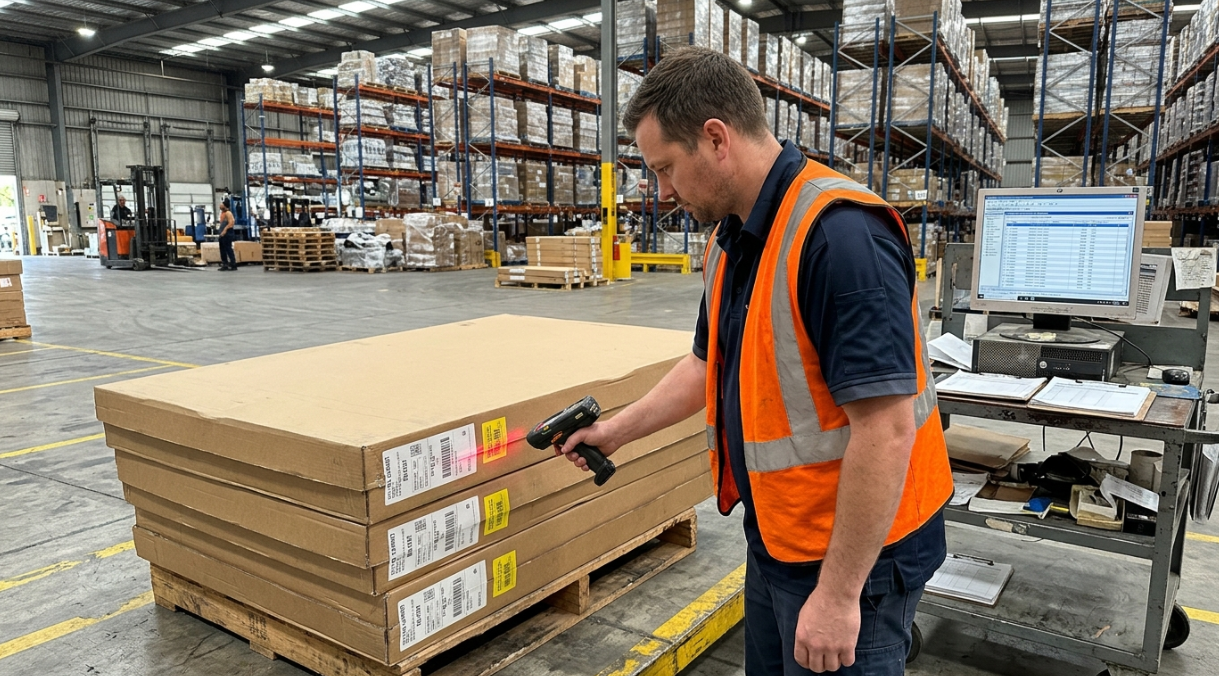
Before confirming a next day RTA cabinet pickup, contractors should verify that every cabinet and accessory on the purchase order is available at the specific warehouse handling the order.
A general website inventory indicator may not reflect current warehouse quantities, reserved stock, or inventory at another location.
Use this checklist when contacting the supplier:
- Confirm each cabinet SKU: Check the exact model number, width, height, depth, and finish.
- Verify physical warehouse quantities: Ask whether the cabinets are physically available rather than on an incoming shipment.
- Check reserved inventory: Confirm that the stock has not already been allocated to another customer.
- Verify accessory availability: Check fillers, toe kicks, finished panels, crown molding, and hardware separately.
- Ask about discontinued products: Confirm that the cabinet line and finish are still available.
- Request written confirmation: Obtain a stock confirmation and expected pickup date.
Cabinet Inventory Verification Example
| Item | Required Quantity | Warehouse Quantity | Status |
|---|---|---|---|
| 30 inch base cabinet | 4 | 4 | Confirmed |
| 36 inch wall cabinet | 3 | 3 | Confirmed |
| 24 inch base cabinet | 2 | 1 | Shortage |
| Finished end panel | 2 | 2 | Confirmed |
| Toe kick | 4 | 4 | Confirmed |
| Filler strip | 3 | 3 | Confirmed |
In this example, the order is not fully available because one 24 inch base cabinet is missing.
The contractor should ask whether the missing unit can be sourced from another warehouse, substituted with an approved alternative, or collected separately when replenished.
Best practice: Do not promise a client a next day installation schedule until the supplier has confirmed the availability of every critical cabinet and accessory.
RTA Product Terms
When you are arranging next day RTA cabinet pickup, you need to know exactly what you are picking up.
RTA (Ready to Assemble)
Cabinets that arrive flat packed as panels, doors, and hardware in cartons. They require assembly on site or in a shop. RTA cabinets cost 15 to 20% less than their pre assembled equivalents, and RTA saves 50 to 75% compared to custom cabinets. The flat pack format also ships denser and suffers less transit damage than assembled units.
Frameless / European Style
A cabinet constructed without a face frame, giving wider drawer and door openings and a cleaner, modern look. Frameless lines are the ones most commonly stocked for next day pickup because the simplified construction means fewer SKU variations and easier warehousing. For a detailed comparison, see frameless cabinets vs. face frame.
Framed / Shaker
A cabinet with a solid wood face frame attached to the front of the box. Shaker style doors with their recessed center panel are the most popular framed option. These may also be available for pickup, but lead times are supplier dependent.
Soft Close Hardware
Hinges and full extension drawer slides with built in dampers that prevent slamming. On quality RTA lines, soft close is standard, not an upgrade. If a supplier charges extra for soft close, that is a signal about the tier of product you are working with.
CARB Phase 2 / EPA TSCA Title VI Compliance
Emissions standards that limit formaldehyde in composite wood products like particleboard and MDF. CARB Phase 2 is the California Air Resources Board standard; TSCA Title VI is the federal equivalent.
Why it matters for pickup: On any jobsite in the US, your cabinets need to meet these standards for code compliance and indoor air quality. Confirm compliance before you order, not after you have installed 40 boxes. Look for certification on the product spec sheet or warranty documentation.
Cam Lock and Dowel Construction
The two primary methods for assembling RTA cabinet boxes. Cam locks use a rotating disc that pulls a threaded post tight, creating a mechanical joint. Dowel construction uses wooden or composite pins that fit into pre drilled holes, typically with glue.
Why it matters for pickup: Cam lock assembly is faster but can strip if overtightened. Dowel joints are often stronger long term. Know which system your cabinets use so your crew has the right tools and technique before boxes start opening. Practitioners on Reddit consistently emphasize that particleboard boxes sag and stapled drawers fail, so checking construction quality at pickup is worth the few extra minutes.
Pickup and Receiving Terms
This section covers the paperwork and processes that happen at the warehouse dock. Getting these right protects you from eating the cost of damaged or missing product.
Vehicle and Transportation Requirements for RTA Cabinet Pickup
Before scheduling next day RTA cabinet pickup, contractors should confirm that their vehicle can accommodate the complete order. Although ready to assemble cabinets arrive in flat packed cartons, a full kitchen order may require significant cargo space.
The appropriate vehicle depends on the number of cabinets, carton dimensions, total shipment weight, and available loading equipment.
Which Vehicle Should Contractors Use?
| Vehicle Type | Suitable Use | Important Considerations |
|---|---|---|
| Pickup truck | Small cabinet orders and individual replacement units | Protect cartons from rain and secure the load |
| Cargo van | Small to medium cabinet orders | Measure interior length, width, and height |
| Box truck | Larger kitchen orders and multiple cabinet runs | Confirm payload capacity and loading access |
| Enclosed trailer | Larger orders requiring additional cargo space | Check trailer payload, dimensions, and securement |
| Flatbed truck | Specialized commercial transportation | Requires appropriate weather protection and load securement |
How to Prepare Your Vehicle Before Pickup
- Confirm carton dimensions: Request the largest carton measurements from the supplier.
- Calculate available cargo space: Measure the vehicle’s usable interior dimensions.
- Check payload capacity: Make sure the combined weight of the cabinets, passengers, tools, and equipment stays within the vehicle’s rated limits.
- Prepare protective materials: Bring moving blankets, cardboard, straps, and corner protection.
- Plan the loading arrangement: Keep heavy cartons supported and avoid placing excessive weight on fragile cabinet panels.
- Secure the shipment: Use appropriate cargo restraints to prevent cartons from shifting during transportation.
Should Contractors Use an Enclosed Vehicle?
An enclosed cargo van or box truck is generally preferable because it protects cabinet cartons from rain, road debris, and direct exposure during transportation.
If an open truck bed or trailer is necessary, use suitable weatherproof protection and secure the cartons properly.
Contractor tip: Ask the supplier for the total carton count, approximate shipment weight, largest carton dimensions, and whether warehouse staff provide forklift or loading assistance before dispatching a vehicle.
Warehouse Pickup Appointment
A warehouse pickup appointment is a scheduled collection window assigned by the cabinet supplier. It allows warehouse staff to prepare the order, stage the cartons, and coordinate loading.
Some suppliers allow walk in collections, while others require contractors to schedule appointments in advance.
Before arriving, confirm:
- Pickup date and collection time.
- Warehouse address and loading entrance.
- Purchase order or confirmation number.
- Identification or authorization required for collection.
- Whether another employee or driver can collect the order.
- Vehicle size and loading requirements.
- Whether warehouse staff provide loading assistance.
Why it matters for pickup: An order marked as ready does not necessarily mean a truck can arrive at any time. Confirm the collection window to avoid unnecessary waiting or a missed pickup.
Bill of Lading (BOL) / Proof of Delivery (POD)
The BOL is the document signed at pickup that confirms what was received and in what condition. In a warehouse pickup scenario where you are the transport agent, the BOL functions as your proof of delivery.
Why it matters for pickup: If any items are missing or damaged, note this on the BOL before signing it. Include the number of missing items or damaged boxes with specific item numbers. Some carriers and suppliers will not accept a “Subject to Inspection” notation on the POD, meaning vague language will not protect a future claim. Be specific: “Carton 7, crushed corner, tape seal broken.”
Packing List
The itemized list included with or attached to a shipment that details every carton, SKU, and quantity. This is different from your order confirmation, which reflects what you ordered. The packing list reflects what was actually pulled and staged.
Why it matters for pickup: Cross reference the packing list against your order confirmation at the loading dock, not back at the shop. Discrepancies caught at pickup are resolved in minutes. Discrepancies caught three days later become claims.
Carton Count and Loading Verification
Carton count verification is the process of confirming that the number of boxes loaded into the contractor’s vehicle matches the supplier’s packing list.
Before leaving the warehouse:
- Count every carton as it is loaded.
- Compare the physical count against the packing list.
- Check that cabinet labels and SKU numbers match the order.
- Photograph damaged cartons before loading.
- Confirm that all accessories and hardware packages are included.
- Keep the signed paperwork and pickup confirmation for your records.
Why it matters for pickup: A signed order receipt should accurately reflect what was collected. Document shortages and visible damage before departure, following the supplier’s claims procedure.
Concealed Damage
Damage found after the pickup is complete and cartons are opened. The carton looked fine externally, but the cabinet panel inside is cracked, chipped, or warped.
Why it matters for pickup: This is the most expensive type of damage because the liability question is murky. Did it happen in the warehouse? During your transport? Reporting windows vary by supplier. Some require visible damage noted at pickup and give 48 hours for concealed damage inspection. Others allow up to 14 days. Know your supplier’s policy before you pick up. For a complete cabinet delivery checklist covering both delivery and pickup scenarios, review the process before your first order.
Damage Claim Window
The period within which damage or shortage must be reported to the supplier. Ranges from 24 hours to 7 days depending on the supplier’s policy. Some require claims submitted within 7 days of pickup.
Why it matters for pickup: Miss this window and you own the damage. Set a calendar reminder for the day of pickup to inspect all cartons within the claim period.
First Floor / Garage Drop
A delivery or pickup term specifying that product is transported only to ground level. The supplier (or their delivery crew) will not carry boxes upstairs, into specific rooms, or through narrow hallways.
Why it matters for pickup: When you arrange a next day pickup, you are the transport agent. But if you opt for supplier delivery instead, understand that “delivery” typically means garage or first floor drop. Plan crew and equipment accordingly.
Restocking Fee
A percentage charged when returning non defective product. Typically 15% to 25% of the item cost, plus return shipping if applicable.
Why it matters for pickup: Double check your order before pickup. Returning cabinets because of a measurement error or a changed design will cost you the restocking fee and a trip back to the warehouse.
Post Pickup: Shop vs. Jobsite Assembly
Picking up the cabinets is not the end. One of the first decisions after loading the truck is where to assemble them. This choice affects quality, speed, and how much rework you end up doing.
Why Assembly Location Matters
Practitioners on contractor forums and Reddit threads consistently debate this topic, and the consensus leans heavily toward shop assembly when possible. The reasoning is practical: a controlled shop environment means flat, clean work surfaces, better lighting, and no competition with other trades for floor space.
Jobsite assembly works fine too, but it introduces variables. Dust from drywall work, painters bumping into staged cabinets, and uneven subfloors all create problems that do not exist in a shop. One contractor shared in a YouTube walkthrough that assembling cabinets on site added roughly 30% more time per unit because of constant interruptions and having to move materials around other trades.
Comparing Shop and Jobsite Assembly
| Factor | Shop Assembly | Jobsite Assembly |
|---|---|---|
| Work surface quality | Flat, stable benches | Depends on subfloor condition |
| Dust and debris exposure | Minimal | High if other trades are active |
| Lighting | Controlled overhead | Variable, often poor |
| Tool access | Full shop setup available | Limited to what fits in the truck |
| Quality control | Easier to inspect before transport | Issues found during install |
| Transport risk | Assembled boxes need careful hauling | No second transport needed |
| Space requirements | Needs dedicated shop area | Uses jobsite floor space |
| Best for | High volume contractors, tight install windows | Single unit replacements, remote jobsites |
Shop assembly drawback: Assembled cabinet boxes are bulkier and more fragile during transport than flat packs. You will need blankets, corner protectors, and a vehicle with enough clearance. A base cabinet that fit neatly as a flat carton now takes up three times the space once assembled.
Jobsite assembly advantage: No second trip. Cabinets go from carton to wall in the same location. For contractors working on remote jobsites or running small orders (a bathroom vanity, a laundry room), assembling on site makes more sense than hauling assembled boxes an hour down the highway.
When to Choose Each Approach
Shop assembly is the better default for full kitchen orders, multi unit projects, or any job where the install window is tight. Assembling 20+ cabinets in a shop over two days and delivering them ready to hang saves significant time on install day.
Jobsite assembly makes sense for small orders, replacement units, or projects where the jobsite has a clean, cleared space and no competing trades. If the kitchen has been gutted and the drywall crew is finished, assembling there is perfectly reasonable.
For detailed assembly instructions regardless of location, see how to assemble RTA cabinets.
Jobsite Assembly Area Preparation
If jobsite assembly is the plan, the assembly area needs to be set up before cabinets arrive. Skipping this step is how doors get scratched, hardware gets lost, and panels end up warped before they ever reach the wall.
Setting Up a Jobsite Assembly Station
A proper assembly area does not require much, but it does require intention. Here is what contractors should prepare:
- Clear a minimum 8 by 10 foot section of floor space, ideally in the room where cabinets will be installed or an adjacent room with good access.
- Lay down protective floor covering. Ram board, heavy cardboard, or moving blankets protect both the subfloor and the cabinet components from scratches and moisture.
- Set up a flat work surface. Two sawhorses with a sheet of 3/4 inch plywood work well. Assembling on the bare floor forces awkward body positions and leads to alignment errors.
- Stage tools in advance. Depending on the construction method (cam lock or dowel), you will need a rubber mallet, a Phillips or square drive screwdriver, a drill/driver with adjustable torque, a tape measure, and a level.
- Designate a hardware sorting area. One practitioner on a contractor forum described losing an hour searching for cam bolts that fell into drywall dust. Keep hardware bags organized on a folding table or in labeled containers.
- Control dust. If drywall sanding, tile cutting, or other dust generating work is happening in the same space, assembly should wait. Fine dust settles into drawer slides and soft close mechanisms, causing premature wear.
- Manage temperature and humidity. Wood and MDF components can warp in extreme conditions. The National Kitchen & Bath Association recommends acclimating materials to the jobsite environment. Avoid assembling in unconditioned spaces during extreme heat or cold.
Common Jobsite Assembly Mistakes
- Assembling on an uneven floor without checking level, which leads to twisted cabinet boxes
- Letting multiple trades work in the assembly zone simultaneously
- Stacking assembled cabinets without padding between them
- Leaving assembled cabinets in direct sunlight near windows, which can discolor finishes unevenly
- Forgetting to verify door alignment and soft close function before moving to installation
Contractor tip: If the jobsite is not ready for assembly, it is not ready for cabinets. Coordinate delivery or pickup timing with your project schedule so cabinets arrive after demolition, rough in, and drywall are complete. For more on sequencing trades around cabinet work, see preparing the jobsite for delivery.
Cabinet Storage and Protection
Whether cabinets are assembled or still flat packed, proper storage between pickup and installation is critical. Damage during storage is entirely preventable, yet it accounts for a surprising share of replacement orders.
Storage Guidelines for Flat Packed RTA Cartons
Flat packed cartons are more forgiving to store than assembled units, but they still need basic protection:
- Store cartons flat, not on edge. Storing a tall, narrow carton on its short side creates pressure points that can crack panels or warp MDF components.
- Keep cartons off the ground. Place them on pallets, 2×4 runners, or at minimum a layer of plastic sheeting to prevent moisture wicking from concrete floors. Garage floors and unfinished basements are common culprits for moisture damage.
- Limit stacking height. Most manufacturers recommend stacking no more than 4 to 5 cartons high. Exceeding this crushes the bottom boxes.
- Avoid exterior storage. Cartons left in a driveway, even tarped, absorb moisture overnight. The corrugated cardboard acts like a sponge.
- Label cartons by room or run. Use a marker to note which section of the kitchen each carton belongs to. This saves time during assembly and prevents opening every box to find the one 15 inch base cabinet you need first.
Storage Guidelines for Assembled Cabinets
If cabinets have been assembled in the shop and are waiting for install day:
- Stand base cabinets upright on their bases, the way they will be installed. Do not stack base cabinets on top of each other without structural support between them.
- Protect finished surfaces with moving blankets or foam padding. Practitioners on Reddit report that even a small scuff on a painted door panel is visible after installation and clients will notice.
- Remove doors and drawers if storage will last more than a few days. This prevents hinge stress, accidental door swings, and drawer slide damage. Bundle hardware in labeled bags and tape them inside the corresponding cabinet box.
- Control the environment. The Forest Products Laboratory at the USDA notes that wood products should be stored in conditions between 60°F and 80°F with relative humidity between 30% and 50% to prevent warping, swelling, or finish failure. This matters more for assembled cabinets with exposed joints.
How Long Can Cabinets Sit Before Installation?
There is no hard expiration date, but longer storage increases risk. A few practical guidelines:
- Under 1 week: Standard for most projects. Minimal risk if stored properly indoors.
- 1 to 4 weeks: Acceptable if the environment is climate controlled and cabinets are protected. Check for dust accumulation in drawer slides and soft close mechanisms before installing.
- Over 4 weeks: Start inspecting for warping, finish changes, and hardware corrosion. If the jobsite has been exposed to moisture (a plumbing issue, an open window during rain), inspect every unit before hanging.
Practitioners on contractor forums note that the biggest storage problem is not time but location. Cabinets stored in a garage during a humid Pacific Northwest winter will absorb moisture even if they are still in cartons. A climate controlled shop or sealed interior room is always the better choice.
Storage Area Checklist
| Requirement | Flat Packed Cartons | Assembled Cabinets |
|---|---|---|
| Off the ground | Required | Required |
| Climate controlled | Recommended | Strongly recommended |
| Protected from foot traffic | Required | Required |
| Stacking limit | 4 to 5 cartons max | Do not stack without support |
| Moisture barrier | Plastic sheeting minimum | Not applicable if indoors |
| Door/drawer removal | Not applicable | Recommended for extended storage |
| Labeling | By room or run | By room or run |
Contractor tip: Treat cabinet storage with the same care as countertop slab storage. A $4,000 set of cabinets sitting in a damp garage for two weeks can easily generate $400 to $800 in replacement costs for warped panels and swollen MDF edges.
Post Pickup Assembly Terms
Assembly Time
The time required to assemble each RTA cabinet from flat pack to ready to install. For an experienced installer, this is typically 15 to 30 minutes per base cabinet and 10 to 20 minutes per wall cabinet, depending on the construction method and complexity.
Why it matters for pickup: Factor assembly time into your backward planning. A 25 cabinet kitchen at 20 minutes per cabinet is over 8 hours of assembly, a full day for one person.
Hardware Kit Verification
The process of opening every hardware bag and checking contents against the parts list before starting assembly. This includes hinges, cam locks, dowels, shelf pins, drawer slides, and screws.
Why it matters for pickup: Opening only the first box and assuming everything else is fine is one of the biggest mistakes contractors make. If a part is damaged, missing, or incorrect, you will not discover it until mid installation, delaying the project for days while you wait for replacements. Practitioners on Reddit and contractor forums consistently report that skipping inspection until install day is the number one delivery mistake. Open all boxes and inspect each unit as soon as cabinets reach your shop or jobsite.
Punch List
The post install document listing items that need correction, replacement, or adjustment. In the cabinet context, this includes damaged doors, misaligned hinges, scratched panels, or any unit that did not meet spec.
Why it matters for pickup: Your punch list starts forming the moment you open your first box. Keep a running document from pickup through install so nothing falls through the cracks.
Replacement Part Lead Time
The time it takes a supplier to ship a replacement for a damaged or missing component. A 5% damage rate is considered industry standard for RTA cabinets. The number that actually matters to your schedule is not the damage rate, but how fast replacements ship. Get lead time commitments for replacements in writing, not verbal estimates.
Why it matters for pickup: Ask your supplier before you place your first order: “If a door arrives damaged, what is the replacement timeline?” The answer tells you more about the supplier’s operational quality than any marketing claim.
Step by Step: How to Arrange Next Day RTA Cabinet Pickup
Arranging next day RTA cabinet pickup requires coordination between the contractor, cabinet supplier, and warehouse team. Following a consistent process reduces stock shortages, incomplete orders, loading problems, and installation delays.
Step 1: Open a Contractor Trade Account
Register with the cabinet supplier and submit the required business documentation. Confirm that your account has been approved and that you can access trade pricing, product catalogs, and wholesale inventory.
Step 2: Finalize the Cabinet Design and Order Schedule
Prepare the complete cabinet schedule before requesting a pickup date. Include:
- Cabinet SKUs and dimensions.
- Door styles and finishes.
- Base and wall cabinet quantities.
- Fillers and finished end panels.
- Toe kicks and decorative molding.
- Hardware and accessories.
- Appliance and sink clearances.
Review the layout against the latest jobsite measurements before releasing the order.
Step 3: Verify Physical Warehouse Inventory
Send the complete cabinet schedule to your supplier and request confirmation that every required SKU is physically available.
Check for reserved stock, discontinued items, missing accessories, and inventory held at other warehouse locations.
Step 4: Submit the Order Before the Cutoff Time
Submit your purchase order and complete the required payment or credit authorization.
Ask the supplier to confirm the order number, processing status, warehouse location, and expected pickup date.
Step 5: Schedule the Warehouse Pickup
Arrange a collection appointment with the warehouse team.
Confirm the pickup window, loading requirements, vehicle dimensions, carton count, and whether forklift assistance is available.
Step 6: Prepare the Vehicle and Loading Equipment
Choose a vehicle with sufficient cargo space and payload capacity. Bring suitable straps, moving blankets, and protective materials to secure the cabinet cartons.
Step 7: Inspect the Order Before Leaving
Compare the packing list with the order confirmation and physically count the cartons.
Document missing items and visible damage using photographs and specific carton or SKU references. Record exceptions on the applicable receiving paperwork before signing.
Step 8: Complete Post Pickup Inspection
Transport the cabinets to your workshop or jobsite and inspect the cartons promptly.
Check cabinet panels, doors, hardware kits, drawer slides, hinges, and accessories. Report concealed damage and shortages within the supplier’s stated claim window.
Step 9: Prepare the Assembly and Storage Area
Before opening cartons, set up your assembly station (shop or jobsite) and designate a clean, dry, climate controlled storage area. Confirm that the space is clear of construction debris, protected from foot traffic, and ready to receive assembled or unassembled units.
Final recommendation: Do not schedule cabinet installation solely around an estimated pickup date. Wait for written confirmation that the complete order has been processed, staged, and released for collection.
Next Day RTA Cabinet Pickup vs. Standard Cabinet Delivery
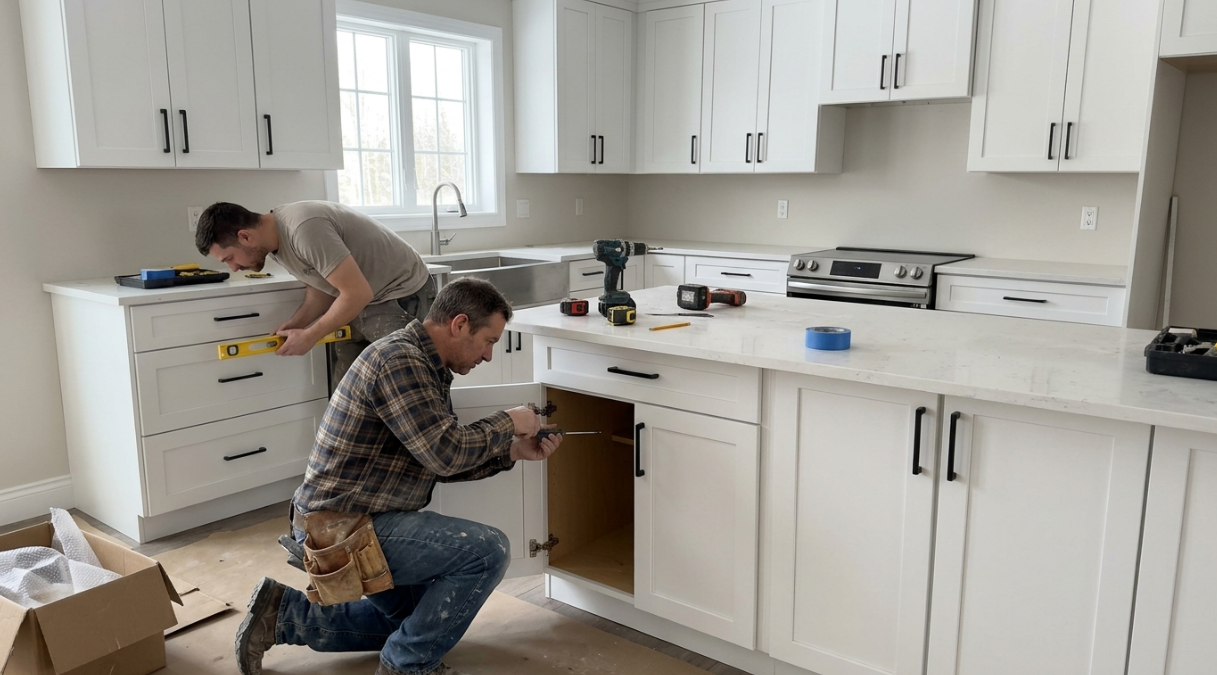
For contractors, the main advantage of next day RTA cabinet pickup is reduced waiting time between ordering and receiving materials.
Traditional cabinet purchasing may involve manufacturing lead times, warehouse transfers, freight scheduling, and final mile delivery. A supplier with local RTA inventory can eliminate some of these steps when the required products are already available.
Comparing Next Day Pickup and Standard Shipping
| Factor | Next Day Local Pickup | Standard Shipped RTA |
|---|---|---|
| Inventory source | Local warehouse | Supplier or distribution warehouse |
| Collection method | Contractor collects the order | Carrier transports the order |
| Availability | Depends on local stock and processing | Depends on inventory and shipping schedule |
| Transportation | Contractor arranges vehicle and labor | Supplier or carrier coordinates freight |
| Inspection | Contractor can inspect cartons before departure | Inspection generally occurs after delivery |
| Freight exposure | Reduced handling through commercial shipping networks | May involve multiple transportation stages |
| Scheduling | Requires warehouse pickup coordination | Requires delivery coordination |
| Best for | Contractors with nearby warehouse access | Contractors without convenient local inventory |
When Does Next Day Pickup Make Financial Sense?
Next day pickup can be especially valuable when:
- A project is waiting for cabinet materials.
- The contractor already has an available crew.
- The supplier has all required SKUs in local inventory.
- Freight charges make standard delivery less attractive.
- The contractor can transport and unload the order efficiently.
However, local pickup is not automatically cheaper. Contractors should compare vehicle costs, labor, loading time, fuel, and any warehouse handling fees against the supplier’s delivery charges.
The bottom line: Next day RTA pickup is most valuable when the warehouse has the complete order ready and the contractor can transport it without disrupting other scheduled work.
Looking for the best cabinet supplier in Washington? Compare options before your next project.
Frequently Asked Questions
What does “next day RTA cabinet pickup” actually mean?
It means your in stock RTA cabinet order is pulled from a local warehouse and available for you to collect within one business day of order confirmation. This applies only to items physically in the warehouse, not special order or built to order products.
What documents do I need to set up a trade account?
Most suppliers require a federal EIN, a state contractor license, and a resale or sales tax exemption certificate. Some also ask for business references or projected annual order volume. Setup typically takes 1 to 3 business days.
Can I pick up assembled cabinets next day, or only RTA?
Next day pickup typically applies to unassembled (flat packed) RTA cabinets only. Assembled cabinets add roughly 7 business days to the lead time because they need to be built before they can be picked up.
Should I assemble cabinets in my shop or at the jobsite?
Shop assembly is better for full kitchen orders because the controlled environment reduces errors and damage. Jobsite assembly works for small orders or when a second transport trip is impractical. Either way, set up a proper work surface, organize hardware, and control dust before starting.
How should I store cabinets if the jobsite is not ready?
Store flat packed cartons off the ground, in a climate controlled space, and limit stacking to 4 or 5 cartons. For assembled cabinets, stand them upright, protect finished surfaces with blankets, and remove doors and drawers if storage will exceed a few days. Avoid garages and basements prone to humidity.
What should I check at the warehouse during pickup?
Cross reference the packing list against your order confirmation. Inspect every carton for external damage (crushed corners, broken tape seals, water stains). Note any problems on the BOL with specific carton numbers and descriptions before you sign anything.
How long do I have to report concealed damage?
It depends on the supplier. Some allow 48 hours from pickup, others up to 7 or 14 days. Ask for the damage claim policy in writing before your first order, and set a reminder to inspect every carton within that window.
How do I prevent the most common pickup mistakes?
Three things: verify stock before confirming your pickup date, finalize every detail on your cabinet schedule before placing the order (including fillers and panels), and open every box within 48 hours of pickup. Skipping any of these is what creates emergency reorders.
Is local next day pickup worth switching from an online RTA supplier?
If you are running projects in a region with a local warehouse supplier, the math strongly favors it. You eliminate 5 to 10 days of shipping, you can inspect product before it leaves the dock, and you avoid freight damage claims entirely because you control transport. The trade off is that your product selection is limited to what is in the local warehouse.
What happens if a cabinet is damaged and I need a replacement?
A 5% damage rate is considered industry standard. What matters is the supplier’s replacement timeline. Some ship replacement parts within days, others take weeks. Get this commitment in writing before you place your first order. It is one of the most telling indicators of a supplier’s operational reliability.
Can humidity or temperature damage cabinets during storage?
Yes. MDF and composite wood components are especially sensitive to moisture. The USDA Forest Products Laboratory recommends storing wood products between 60°F and 80°F with 30% to 50% relative humidity. Cabinets stored in an unconditioned garage during a damp Pacific Northwest winter can warp, swell at edges, or develop finish defects within weeks.