
TLDR
RTA cabinets are ready-to-assemble cabinets shipped in flat-packed boxes and put together before installation. They typically cost 15% to 20% less than pre-assembled cabinets because you’re saving on shipping bulk and factory assembly labor. But here’s the thing most people get wrong: RTA is a shipping method, not a quality grade. Cheap RTA cabinets exist, and so do excellent ones. What actually determines quality is the materials, hardware, finish, and construction inside the box. This guide breaks down everything you need to know before buying.
Quick Answer
RTA (Ready-to-Assemble) cabinets are flat-packed cabinets that homeowners or contractors assemble before installation. They usually cost 15–20% less than pre-assembled cabinets because shipping and factory labor costs are lower. RTA cabinets are not lower quality by definition. Their durability depends on cabinet construction, materials, hardware, finish quality, and proper assembly rather than how they are shipped.
RTA Cabinets at a Glance
Factor | RTA Cabinets | Pre-Assembled Cabinets |
|---|---|---|
Average Cost | Lower | Higher |
Shipping Cost | Lower | Higher |
Assembly Required | Yes | No |
Installation Time | Longer | Faster |
DIY Friendly | Yes | Yes |
Best For | Budget remodels, DIY | Faster renovations |
Quality | Depends on materials | Depends on materials |
What Does RTA Stand For?
RTA stands for ready to assemble. These cabinets arrive at your door in compact, flat-packed cartons containing separate parts (panels, doors, drawer pieces, shelves, hardware, and fasteners) that get assembled before installation. Lowe’s describes RTA cabinets as shipped in flat boxes with individual parts packed together for assembly using basic tools.
The name trips people up. “Ready to assemble” sounds like it means “cheap” or “flimsy,” similar to how people sometimes think of flat-pack furniture. That’s not accurate. RTA just describes how the cabinet gets to you. It says nothing about what’s inside the box. You can find RTA cabinets made with plywood boxes, solid wood frames, dovetail drawer joints, and soft-close hardware, the same materials and construction you’d find in high-end pre-assembled cabinets.
If you’re planning a kitchen or bathroom remodel in Washington, Krafter’s Land offers free design consultations, 3D renderings, and quotes through their showrooms in Tukwila, Tacoma, Lynnwood, and Spokane. They work with authorized retailers and licensed contractors to help homeowners find the right cabinet solution.
What Comes in an RTA Cabinet Box?
Contents vary by brand, but a typical RTA cabinet box includes:
Side, top, and bottom panels
Back panel
Shelves
Door or drawer fronts
Drawer box parts
Face frame (for framed cabinets)
Hinges and drawer glides
Screws, cams, clips, dowels, or other fasteners
Assembly instructions
The Spruce notes that RTA cabinets arrive with pieces cut to size, holes pre-drilled, finishes applied, and hardware included. Not every brand packages things the same way, so it’s worth checking exactly what’s in the box before you commit to a purchase.
RTA cabinets come in both framed construction (with a face frame on the front of the box) and frameless styles (where doors attach directly to the cabinet box for a more modern, European look). The construction style and assembly method are two separate choices, so don’t assume that picking RTA locks you into one look.
RTA Cabinets vs. Pre-Assembled Cabinets
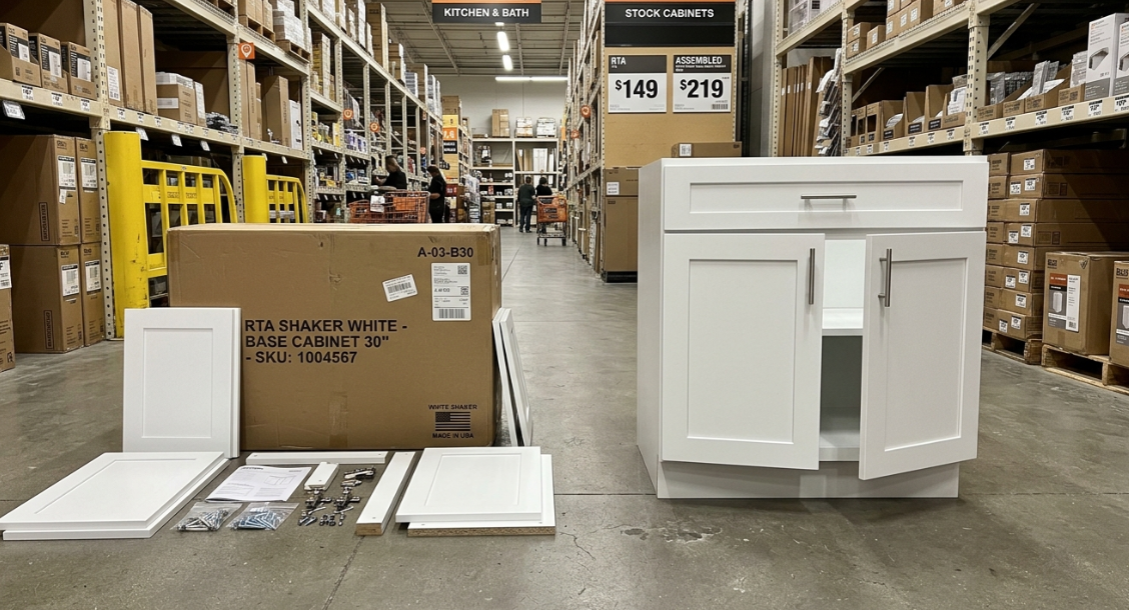
This is the comparison most homeowners are trying to make when they start researching cabinets.
Feature | RTA Cabinets | Pre-Assembled Cabinets |
|---|---|---|
Delivery | Flat-packed parts in compact boxes | Fully built cabinet boxes |
Assembly | You (or your contractor) assemble them | Already done at the factory |
Shipping cost | Lower, because flat boxes take up less truck space | Higher, because bulky cabinets need more space |
Per-unit cost | Typically 15–20% less | Typically higher |
Timeline | Requires assembly time before installation | Ready to install on arrival |
Main risk | Assembly errors, missing parts | Shipping damage to assembled boxes |
DIY friendly | Yes, with patience and basic tools | Yes, no assembly needed |
Both types can use identical materials. A plywood RTA cabinet and a plywood pre-assembled cabinet can be the exact same product, just packaged differently. The assembly format alone doesn’t determine quality.
Why Are RTA Cabinets Less Expensive?
Two things drive most of the price difference. First, flat-packed boxes take up less space on a truck, which lowers shipping costs per unit. Second, the manufacturer doesn’t pay a factory team to assemble each cabinet, because you (or your installer) handle that part.
Kitchen Cabinet Kings estimates per-cabinet savings of roughly 15% to 20% compared to the same cabinet bought pre-assembled. For a standard 10×10 kitchen, they put RTA cabinets at $1,200 to $4,400, with pre-assembled versions costing $300 to $1,000 more for the same layout.
If you’re hiring a contractor to handle assembly and installation, make sure assembly labor is included in the quote. Practitioners on Reddit report that assembly adds real time to a project. One contractor estimated a 20-cabinet kitchen project took closer to 15 labor hours for assembly alone, with qualified installers billing $65 to $85 per hour. That’s a cost worth knowing about upfront so there are no surprises.
For broader context, Angi’s 2026 data puts average full-kitchen cabinet installation at $6,193, ranging from $1,935 to $10,767. RTA cabinets can lower the materials portion of that number, but the total project cost depends on who handles assembly and how complex the layout is.
The real math:
Total cost = cabinet price + shipping + assembly labor (if hiring it out) + installation
If you’re doing the assembly yourself, you save the assembly labor cost but invest your own time. Most handy homeowners find this a reasonable trade-off, especially for smaller projects.
How Much Do RTA Cabinets Cost in 2026?
Many homeowners search for cabinet prices before deciding between RTA and assembled cabinets. While prices vary by manufacturer, materials, and kitchen size, these averages provide a useful starting point.
Kitchen Size | Typical RTA Cabinet Cost |
|---|---|
Small Kitchen | $1,500–$3,000 |
Medium Kitchen | $2,500–$5,000 |
Large Kitchen | $4,000–$8,000+ |
Estimated Total Installed Cost
Project Type | Estimated Cost |
|---|---|
DIY Assembly + Professional Installation | $4,000–$9,000 |
Professional Assembly + Installation | $6,000–$12,000 |
Premium RTA Cabinets | $8,000–$15,000 |
Actual costs depend on cabinet construction, labor rates, shipping, countertops, and the complexity of the kitchen layout.
Are RTA Cabinets Good Quality?
They can be excellent, and they can be terrible. The same is true of pre-assembled cabinets and even custom cabinets. The label on the box doesn’t tell you much about what’s inside it.
Practitioners on Reddit consistently make this point. In kitchen remodel discussions, users argue that doors, finish quality, drawers, hinges, glides, and build consistency matter more than how the cabinet was shipped. One user who installed RTA cabinets across multiple kitchens described the good ones as having half-inch plywood boxes, solid wood frames, and dovetail drawer joinery, materials and construction you’d find in cabinets costing significantly more.
As one Fine Homebuilding forum discussion put it: compare specifications, not categories. The category isn’t the guarantee. The specification is.
How to Tell if an RTA Cabinet Is Actually Good
Look for KCMA certification. Cabinets certified to ANSI/KCMA A161.1 have passed 14 separate tests, including a 600-pound wall-cabinet load test and 25,000 door and drawer open/close cycles. About 40% to 50% of manufacturers fail their first certification attempt, so this seal actually means something.
If the cabinets use composite wood (plywood, MDF, or particleboard), confirm they meet TSCA Title VI standards for formaldehyde emissions. This EPA regulation applies to composite wood products sold in the United States, and reputable manufacturers will have this documentation available.
What Materials Are RTA Cabinets Made From?
Not all RTA cabinets use the same materials. The cabinet box material has a larger impact on durability than the fact that it arrives flat-packed.
Plywood
strongest option
moisture resistant
holds screws well
recommended for most kitchens
Furniture Board
smooth
affordable
common in mid-range cabinets
performs well when properly manufactured
MDF
Often used for painted doors because it produces an exceptionally smooth finish. Less resistant to water damage than plywood.
Particle Board
Usually found on inexpensive cabinets.
Can perform adequately in dry environments but is generally less durable than plywood.
What to Look for When Shopping for RTA Cabinets
Before spending thousands on cabinets for your kitchen or bath, order samples first. Reddit users in remodeling threads recommend requesting 3 to 4 door samples and a small 15-inch base cabinet before committing to a full order. Assemble the sample yourself, test the hardware, and look at the finish under different lighting.
Here’s what to check:
Box material. Plywood is the gold standard. Quality furniture board is acceptable. Avoid anything marketed with vague “all wood” claims without specifying the actual material.
Drawer construction. Dovetail joints or strong mechanical joinery. Stapled particleboard drawers will fall apart within a few years and are the most common source of regret with cheap cabinets.
Hinges and glides. Full-extension, soft-close hardware makes a noticeable difference in daily use. This is the feature you’ll interact with thousands of times, so don’t settle for basic hardware.
Finish consistency. Look at the paint, stain, or laminate across all samples. Check edges and corners especially. Good manufacturers maintain consistency across production runs; cheap ones don’t.
Pre-drilled holes. They should line up accurately. Parts should be clearly labeled. If the sample cabinet is a puzzle to assemble, the full order will be a nightmare.
Damage and return policy. Understand the seller’s inspection window and replacement process. One Reddit user reported that damage in their order wasn’t noticed until after the seller’s inspection window closed, making resolution much harder. Open boxes right when they arrive and check everything.
Available sizes and accessories. Make sure the line includes fillers, panels, toe kicks, trim pieces, and specialty sizes your layout might need. A limited product line forces awkward workarounds that look cheap in the finished kitchen.
Review cabinet warranty details to understand what’s covered and for how long before making a big purchase.
Explore cabinet categories to compare different styles and configurations for your project.
How Long Do RTA Cabinets Last?
High-quality RTA cabinets can last 20 to 30 years or longer with proper installation and normal household use.
Cabinet lifespan depends on:
cabinet box material
drawer construction
hinge quality
moisture exposure
installation quality
daily use
Premium plywood cabinets with soft-close hardware generally last significantly longer than inexpensive particle board cabinets.
Common Mistakes Homeowners Make with RTA Cabinets
Assuming all RTA cabinets are the same quality. The price range is enormous, from bargain-bin particle board to premium plywood construction. Don’t buy based on the lowest price alone. Compare the actual specs.
Not factoring in assembly time. If you’re doing it yourself, expect your first few cabinets to take 35 to 45 minutes each. You’ll get faster, but a full kitchen can still eat up an entire weekend just for assembly, before installation even starts. If you’re hiring a contractor, make sure their quote includes assembly, not just installation.
Skipping the sample order. Photos and spec sheets can’t tell you how a finish actually looks in your kitchen’s lighting, or how the doors feel when you open and close them. Always get a physical sample.
Not inspecting boxes on delivery day. Open every carton the day it arrives. Count the parts and photograph any damage immediately. Discovering missing pieces or scratched panels after your contractor has started work creates delays and extra costs.
Installing cabinets that aren’t square. Cabinets assembled or installed out of level and square create countertop fitment problems that are expensive to fix, especially with stone countertops that get templated to fit.
When RTA Cabinets Make Sense (and When They Don’t)
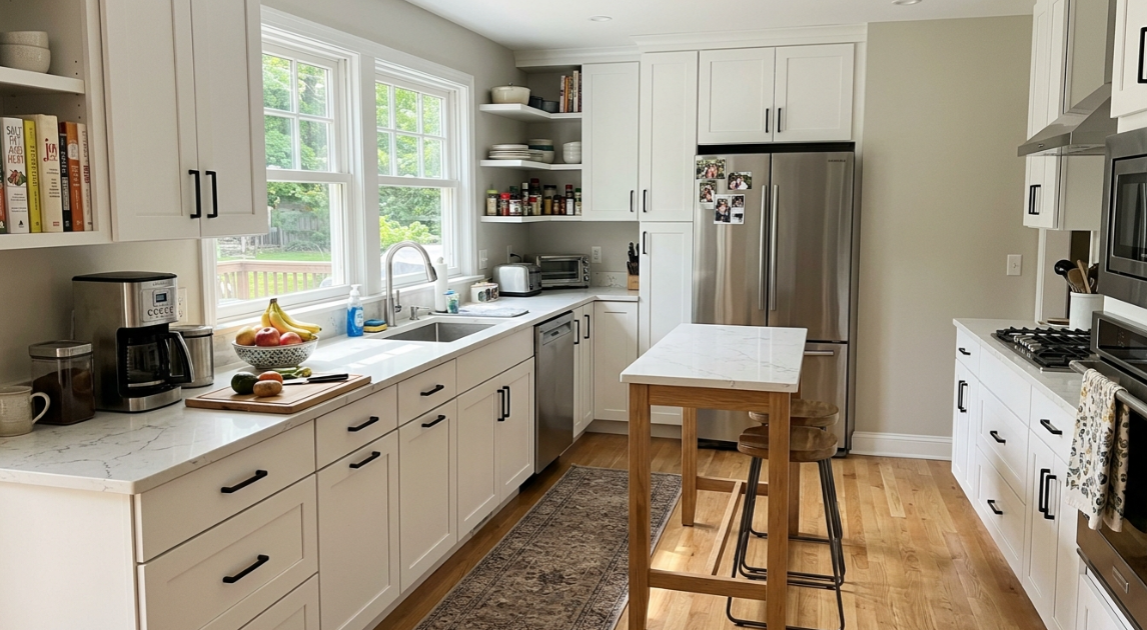
RTA cabinets are a great fit for:
Budget-conscious kitchen remodels where you want solid quality without custom pricing
Rental properties and investment properties
House flips
Secondary kitchens, laundry rooms, mudrooms, and garage storage
Bathroom vanities and utility spaces
Homeowners comfortable with DIY assembly or willing to hire it out
Layouts that work well with standard cabinet sizes
RTA cabinets are less ideal for:
Highly custom layouts with unusual angles, curves, or non-standard dimensions
High-end inset cabinetry with furniture-level detailing
Homeowners who want a completely hands-off experience (though a good contractor can handle everything, including assembly)
Situations where you need cabinets installed immediately with zero assembly time
Browse the projects gallery to see finished kitchen and bath installations and get a sense of what different cabinet styles look like in real homes.
If you’re planning a kitchen or bathroom remodel in Washington, Krafter’s Land has showrooms in Tukwila, Tacoma, Lynnwood, and Spokane where you can see cabinet options in person. They offer free design help, 3D renderings, and work with licensed contractors who can handle everything from cabinet selection through installation. Get in touch for a free consultation.
Are RTA Cabinets Worth It?
For many homeowners, yes.
RTA cabinets offer one of the best values in kitchen remodeling because they reduce shipping and manufacturing costs without automatically sacrificing quality.
They are an excellent choice if:
you’re comfortable assembling cabinets
you have a contractor who installs RTA regularly
your kitchen uses standard cabinet sizes
you want better materials without paying custom cabinet prices
They may not be ideal for highly customized kitchens or homeowners who want a completely hands-off renovation.
Frequently Asked Questions
What does RTA stand for in cabinets?
RTA stands for ready to assemble. The cabinets ship as flat-packed parts and get built on site before installation, either by you or by a contractor.
Are RTA cabinets cheaper than pre-assembled?
Usually, yes. Industry estimates put the savings at 15% to 20% for the same cabinet line. The savings come from lower shipping costs (flat boxes) and no factory assembly labor. Just remember to factor in assembly time if you’re hiring someone to build them.
Are RTA cabinets lower quality?
Not necessarily. The term describes how cabinets are shipped, not how they’re made. Good RTA lines use plywood boxes, dovetail drawers, and soft-close hardware. Cheap ones use thin particle board and flimsy glides. Look at the specifications and order samples before buying.
How long does it take to assemble one RTA cabinet?
If you’ve done it before, expect 10 to 20 minutes per cabinet. First-timers should plan for 35 to 45 minutes per cabinet and expect the pace to pick up after the first few. A full kitchen’s worth of cabinets (15 to 20 units) can take a full day of assembly work.
Do RTA cabinets come with hardware?
Most include all the hardware needed for assembly, along with pre-drilled holes and instructions. Contents vary by brand, so confirm that hinges, drawer glides, fasteners, and assembly hardware are included before placing a large order.
Can I install RTA cabinets myself?
Assembly is manageable for most handy homeowners with basic tools (drill, level, clamps, screwdriver). Installation, which means securing the cabinets to walls, leveling them, and making sure everything is plumb, is more demanding. Many homeowners handle assembly themselves and hire a professional for installation, which gives you the cost savings of RTA without the risk of a crooked kitchen.